

This is taken from a post on my blog. Read and enjoy.
I have a lot of music on my computer. A lot of music. Currently, iTunes says that I have enough music to play for 8.9 days straight. Consequently, I like games that let me bring my music into the games in means that matter, by procedurally generating content based on my music, and I’ve purchased a lot of games that let me do this. I’m going to call these “Custom Music Games”, because “Music-Based Procedurally Generated Games” is clunky as well.
However, such games don’t lend themselves well to full reviews, because the game experience itself varies based on the music you’re playing on it. With that in mind, I’m going to present this roundup of Procedurally Generated Music Games. I’ll be discussing the good, the bad, and some songs that I think that work well with them.
Audiosurf
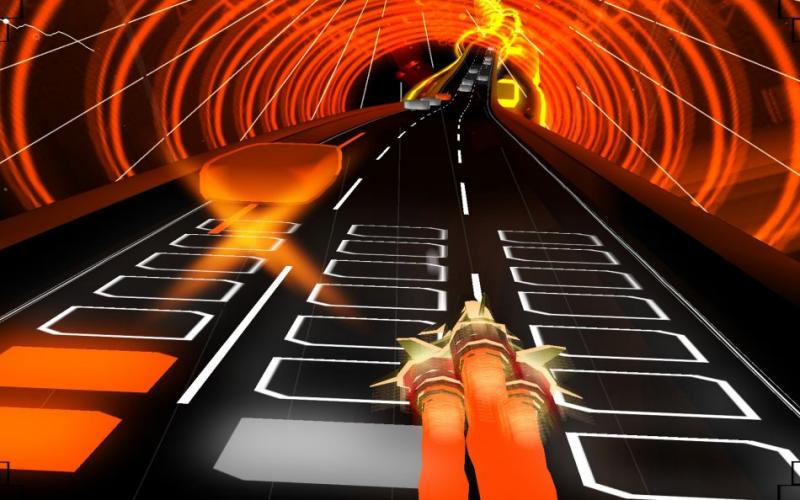
The Concept: This game can legitimately be considered the father of the modern generation of Custom Music Games. Distributed through Steam, the game uses your music to generate a “road” with various colored blocks on it, with the color based on how intense the music is the music and different colored blocks having different point values. You need to fill up a “meter” by hitting colored blocks and getting them to match in the main gameplay modes (with different “characters” having different special abilities that help make things easier). There’s also Mono Mode, where you just have gray blocks and colored blocks, and you have to hit only the colored blocks, with the blocks increasing in value as you hit more.
The Good: The game supports basically every music format that you probably have in your library, as well as music CDs. The only formats I haven’t tried on it are .ogg and .flac, but everything else has worked just fine. Controller support also works really well. Graphically, it scales well enough that it run smoothly on laptops as well as on higher end gaming systems. In addition, because of the game’s popularity, leader-boards in the game are well populated. Additionally, the game is extremely affordable through Steam and ships with the complete soundtrack for The Orange Box.
The Bad: The backgrounds are fairly monotonous. While it took, frankly, a year or two to get there, the essentially the same background essentially bored me, and started to make the game kind of dull. Also, not all the characters are equal in terms of gameplay – in particular, I’ve noticed Mono characters are at a consistent point disadvantage to the other character types, and attempts by the game developers to fix this have failed.
In addition, while the game supports scrobbling to your Last.fm, it doesn’t use Last.fm to authenticate tracks to prevent cheating – so someone could change the name of their mp3 of “Enter Sandman” to “Muskrat Love”, and use that to get a score on that song that no-one could beat. Titles for tracks from CDs are named from CD text instead of CDDB lookup, which means that some CDs just don’t work well with this game (particularly classical music).
Verdict: Definitely worth a buy. Again, the game gets a lot of gameplay for its value.
Recommended Music: “Comfortably Numb” by Pink Floyd, from P*U*L*S*E. In particular, the game’s extended guitar solo makes for a fantastic ride.
Beat Hazard
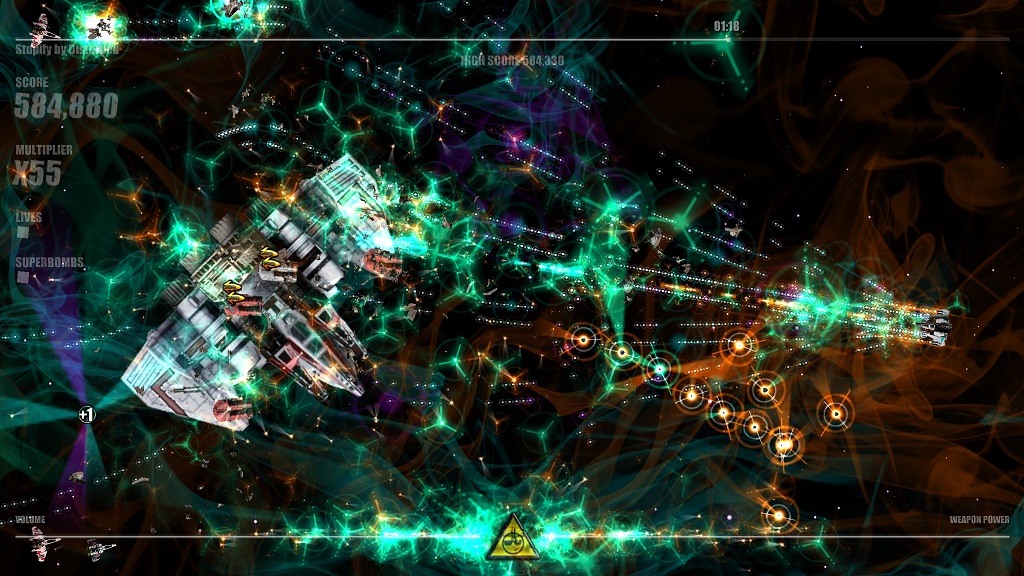
The Concept: Beat Hazard takes a different take on this genre by going combining the Custom Music Game with the revived Twin Stick Shooter genre.
The Good: The game has a level up mechanic that works very well in my opinion. No matter how badly you think you’re doing on a particular level, you’re always progressing and powering yourself up, which helps encourage continued play.
The Bad: The power of your weapons is not only connected to power-ups you collect in the generated levels, but the track you’re listening to. Consequently, softer music tracks, such as “Lights” or “Open Arms” by Journey will be much more difficult than “Seperate Ways (Worlds Apart)” and “Don’t Stop Believin’”. Also, while the game supports .mp3 and .wav out of the box, you have to get, essentially, pay DLC to add support of some iTunes-specific formats – .m4a and .aac.
Enemy types in the game can get fairly monotonous, as there are essentially only 5 types of enemies – three generic types and two boss-types, with four types of attacks. There are also environmental obstacles, like asteroids, but the enemies get old quickly. Also, as you can tell from the screen shot, lens flare can cause the screen to become unnecessarily cluttered, making it hard to pick out projectiles. While you can turn the lens flare off, it drops your score multiplier.
There are also no separate leader-boards by song – only song length. Additionally, while the game supports mouse and keyboard control, it just doesn’t work well outside of a dual-analog stick controller. I understand why they included that functionality – but this is probably a situation where it would have been best to say that in the game.
Verdict: Basically, this is a game for people who own controllers which can connect to their computer by USB, like dual-stick shooters, and have a bunch of metal and techno in their music library. Now, that’s not a small demographic, and it’s certainly enough to support an indy game, but if you favor softer music, are sick of dual-stick shooters, or can’t hook your controller up to your PC, then you won’t have as much fun with this game.
Recommended Music: Because of how the tempo and volume of the music effects weapon power, this game is best for metal and techno.