Home
Home

Matt brings up some interesting questions about writing reviews. Do you agree with his conclusions?
What constitutes a good review: a piece that describes feelings or one that simply critiques quality? Should a writer evaluate a work on its own terms or strictly by the conventions of the genre?
As I went about writing my initial impressions of Game Freak and Nintendo’s newest collection of battle-crazed creatures, I realized something: Pokémon had, in fact, entirely transcended its genre. Another, less exciting epiphany followed this one: This declassification of media happens all of the time. When a series becomes truly popular and expansive enough, traditional methods of evaluation are seemingly rendered useless -- or at least less viable.
Example: Whenever a new Star Wars prequel movie came out, it wasn’t evaluated based on how good of a film it was, but rather how good of a Star Wars film it was. Is this is a good thing or a bad thing? After all, what insight would we really gain from critiquing the dialogue of a George Lucas space epic? Nobody expects it to be anything less than cringingly wooden. Most moviegoers simply want to know how well it fits in with the rest of the series.
The positive side to this phenomenon is that readers of reviews will more than likely find out what they want to know, sans extraneous information. The downside is that we stop holding works of entertainment accountable for how good they actually are.

What franchise genre-fication can lead to.
The same thing happens across other media, especially video games. As I explained briefly in my initial Pokémon Black and White review, critically evaluating Pokémon games has become quite a complicated task. It's difficult for reviewers to decide which aspects they’ll focus on in order to write an adequate review. After all, the story in a Pokémon has never changed beyond the point of recognition – it’s basically a monomyth within the context of its own fiction. Though Black and White have made subtle changes, it doesn’t look like the archetypal Pokémon journey is going to be shaken up any time soon.
Yet the series is still successful in many people’s eyes. Negative comments deriding this lack of narrative innovation are rendered moot.
What’s a review to focus on, then? Mechanics and new features either change minimally or are ignored completely (Pokéthlons? Beauty pageants?), and we can all agree that this is not why we’re still playing. Ostensibly, a good Pokémon review can boil down to a shallow critique of the new roster of creatures -- something that doesn’t exactly bode well for a potential reviewer, especially one trying to refine their process.
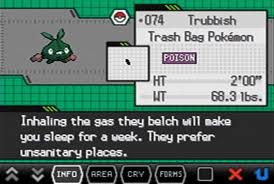
Trubbish, the trash bag Pokémon.
Discussion threads on the IGN Second Opinion article for the games seemed to pick up on this, albeit in the crass, argumentative form that everyone expects a typical Internet discussion to take. Users derided the lack of quests in the Pokémon series, observing and ridiculing the fact that the only way of increasing a Pokémon’s XP is through monotonous grinding. Personally, I’m an expert grinder and relish the mental image of thousands of bruised, unconscious Pokémon piled haphazardly in the tall grass after one of my harsh training sessions. Yet even I’ll admit that to a casual gamer this might be a game-breaking turn off.
Where’s the line that determines if we stop evaluating an entry in a popular franchise based on how faithfully it upholds its own conventions and start holding it accountable for not touching on the base conventions of its genre? How long should quality suffer before creators must be taken to task?
If we again look at Star Wars as an example, the answer to that question would be quite a long time indeed. Personally, I’m okay with the lack of quests in the Pokémon series. Rather than fetching alchemical ingredients, I’m content simply to grind away in the fields. On the other hand, try to picture Mass Effect 2 with a grinding component. Wouldn’t it be nice not to have to do an entire quest simply to get more XP? What if you could just tear apart a random pirate base, as you sometimes could in the series’ first entry?
Matters only become more complicated when review scores are introduced to the equation. When I read a film review, I usually go to the Onion’s AV Club. Their unofficial policy toward their letter grade system is that the better a film is at accomplishing its own objectives, the higher a grade it will receive.
Most commenters, however, tend not to pick up on this. That’s why whenever any film is graded at a B level or lower, the fact is usually angrily brought up that Crank: High Voltage received an A-. The reviewer is not saying that High Voltage is the greatest film of all time; he's simply saying that it was better at accomplishing its objectives than most films. When your only objective is to provide ceaseless, adrenaline-fueled action, this becomes easier. It seems that in some cases, it’s easier to evaluate a work on its own terms rather than the terms of the medium at large.

Well-executed, harmless fun or the new Citizen Kane?
To complicate issues on an even higher level, there are genre hybrids to consider. What would be the proper way to evaluate a new entry to the Fallout series? A reviewer has many aspects to contend with: the conventions of the series itself, as well as the title’s qualities as both a shooter and an RPG (a Western RPG, at that).
We saw this problem recently with Fallout: New Vegas, a game that's not even technically a sequel. Is New Vegas a better shooter than Fallout 3 because it added iron sights? A better RPG because there’s crafting and a “hardcore” mode with sleep, hunger, and radiation meters? Perhaps it’s a better Fallout game because it’s set in a location more traditional for the series. However, it doesn't use a new game engine and the development was outsourced to Obsidian.
Is your head spinning yet, aspiring reviewer?
Just try to review me. I dare you!
The solution to this conundrum, thankfully, is already in place. You’re already a part of it, even if you don’t realize it. The answer is this: Everyone has their own review style. Not every game review is going to focus on the exact same aspects. Which means that if you’re a gamer that relies heavily on reviews and scores to determine whether or not to spend your money, you should be reading multiple reviews.
Some reviews will touch heavily on story, some on multiplayer. Some will delve into technical aspects, while others might just simply describe how awesome the game is.
Maybe there’s a writer out there masterful enough to juggle all these concepts in a single review with impossible balance. Even then, there’s one problem left to tackle: It’s just a review. You’re the only one who can make up your mind.