Home
Home
Paul's in-depth look at the burgeoning trend of game cloning -- and the relationship between Radical Fishing and Ninja Fishing in particular -- is a fascinating read.
Radical Fishing isn’t much to look at. Even its creators, Jan Willem Nijman and Rami Ismail, admit that their development focus was primarily on mechanics. "Sure, we want them to look nice and all that, but our core thing is we want games to be games," Ismail told me via email. This philosophy seems like a byproduct of their hometown -- Utrecht is the birthplace of De Stijl, a minimalist art movement that emphasized reducing form to its essentials. "We work from the idea that nothing in a game's design should be superfluous. Each rule should have the maximum amount of responsibility it can have."
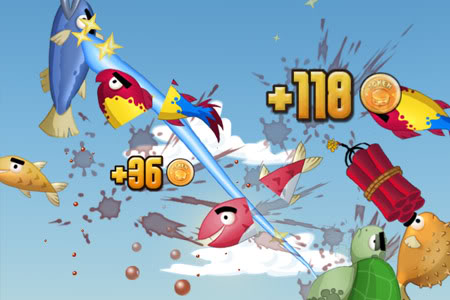
A free Flash title that served as the duo's debut, Radical Fishing exemplifies this approach. Move past the crude graphics (which look like something an eight-year-old drew with a freeware version of KidPix) and you’ll probably get sucked in by the feedback loop they've perfected. Drop your fishing line, avoiding aquatic life until you run out of slack. Then yank it up, grabbing as many fish as you can along the way.
Once they reach the surface, toss 'em in the air and blow them to bits with an array of cartoony firearms. Honestly, it looks too amateurish to be a polished game. But after a play session or two, Radical Fishing will most likely succeed at making you its bitch.

Vlambeer, the two-man studio that Nijman and Ismail started after they both ditched game design school, was also responsible for IGF-award-winner Super Crate Box, and mega-bizarre Adult Swim Games title Dinosaur Zookeeper. After gaining some notoriety, they decided to revisit their first project together. They recruited fellow IGF nominee Zach Gage (Unify, Bit Pilot) and artist/designer Greg Wohlwend (Solipskier) to create a beefed-up reboot named Ridiculous Fishing for iOS -- their first mobile title. New locations, new weapons, fish with hats -- this was to be the definitive mobile fish-desecration experience.
Although they were also busy working on an indie spinoff of the Serious Sam franchise (a turn-based RPG called The Random Encounter,) the developers were confident in their progress. They decided to announce the game in September and release it a month later.
But before they got a chance to tell their fans about what they’d been working on for nearly a year, San Francisco-based developer Gamenauts announced a game called Ninja Fishing for iOS.
Ninja Fishing is a colorful iPhone game with a chubby, masked ninja protagonist. At first glance, the resemblance to Radical Fishing looks coincidental. Spend a few minutes with it, though, and it won’t take long before you’re wondering if the developers sat at their desks with Radical Fishing open in a browser window during the development process.
MTV’s Multiplayer blog explains:
"The core concept of Radical Fishing: You are a fisherman. You must guide your hook as deep as you can without hitting a fish. Once you reach a certain depth, you can sink the hook into a fish and the line will reel up. As the line is reeling, you can pick up more fish along the way, until you're literally reeling in 20 or 30 at a time, including eels, seahorses and turtles. Once the fish are dragged back to your boat they are ceremoniously hurled into the air, where you must blast them with guns. Every fish you blast nets you money which can be spent on upgrading your gear, thus letting you go deeper to catch more valuable fish."
Contrast that with Multiplayer's explanation of Ninja Fishing:
"The core concept of Ninja Fishing: You are a ninja fisherman. You must guide your hook as deep as you can without hitting a fish. Once you reach a certain depth, you can sink the hook into a fish and the line will reel up. As the line is reeling, you can pick up more fish along the way, until you're literally reeling in 20 or 30 at a time, including eels, seahorses and turtles. Once the fish are dragged back to your boat they are ceremoniously hurled into the air, where you must slash them with a sword. Every fish you slash nets you money which can be spent on upgrading your gear, thus letting you go deeper to catch more valuable fish."
"Our first reaction was, 'You’ve got to be kidding,'" Ismail recalled. But they weren’t even the first to know. It wasn’t until a firestorm erupted on Twitter and in the blogosphere -- including responses of unbridled outrage among some industry vets -- that Ninja Fishing’s existence was revealed to the team.
Despite being shocked at the game’s resemblance to their own, Ismail and Nijman weren’t sure what to make of it just yet. They decided to contact Gamenauts and see if they could work something out.
Did they even realize what they had done? I asked Ismail if they tried to play dumb, or deny its resemblance outright. "They admitted they had been inspired by Radical Fishing," he replied. "They felt that [their game] differentiated from ours adequately, but they understood the general consensus was otherwise. Clearly, they felt bad about it."
 Good faith negotiations between the two parties began. First, Gamenauts offered to credit the team in the first Ninja Fishing update, which Vlambeer declined. Incredibly, their next move was more generous: They offered Vlambeer a revenue sharing agreement. "It was a gesture that we honestly appreciated," Ismail admitted. Vlambeer had an opportunity to join Gamenauts in raking in a big chunk of change to fund future endeavors.
But again, Vlambeer declined Gamenauts' offer. "It would have made us some money, but it wouldn't have solved the issue," said Ismail. "What we really wanted was for both games to have an equal chance in the App Store."
Vlambeer proposed a third option: delay the release of Ninja Fishing until Ridiculous Fishing was finished, then release them simultaneously. Not only would that solution allow for both games to be evaluated properly, but it would solve what Ismail called "the massive public backlash Gamenauts had been suffering from." In addition, "It would’ve been an interesting case study of how issues like these can potentially be resolved peacefully." Most importantly, it would show that Gamenauts had faith in the relative originality of their title.
For whatever reason, Gamenauts couldn't -- or wouldn't -- agree to those terms. Negotiations ceased, Ninja Fishing was released on schedule, and the Ridiculous Fishing team was left scrambling to get the game ready for an earlier-than-planned release.