Separator

It's my life: A nihilist reading of Saints Row: The Third

Trit_warhol
Friday, January 06, 2012

 Note: This post is a response to the Bitmob Writing Challenge - January 2012. This post also contains spoilers for Saints Row: The Third.

That is the most extreme form of nihilism: nothingness (the "meaningless") eternally!

Friedrich Nietzsche

Don't let the wealth of colour, vulgarity and fun fool you: Saints Row: The Third is a playground for nihilists. Each gang, law enforcement agency, politician, and paramilitary organisation eventually comes to disregard the laws and institutions of the city of Steelport. The individual player even comes to reject established standards of previous open world action games given enough time with the game itself, and its elaborate arsenal of vehicles, weapons and abilities.

While the killing of civilians in Steelport is technically illegal (read: will illicit a response from police in close proximity), through activities like Mayhem, Tank Mayhem and Trailblazing, violence against public and private property, the police and the city's inhabitants is incentivized. It can be argued that there is a greater reward for shooting inanimate objects instead of people, however, killing civilians is not effectively penalized. I was able to reach target amounts in all but one of these instances by attacking innocent people, gang members and the law; it wasn't until the last instance of Mayhem that I found that destroying fences and barriers was the most effective way of completing that particular activity. Saints Row: The Third's missions are designed in a way that allows players to disregard human life.  
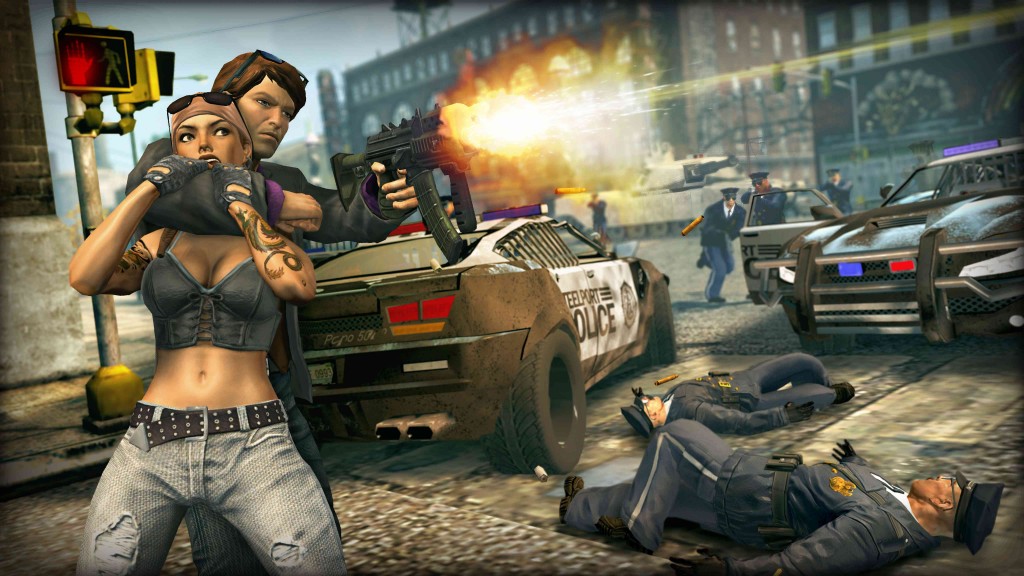
I'd say "I'm sorry", but it wouldn't mean shit

The Wavves - "Idiot" from the WDDT CPDG Adult Swim radio station

Where most other games are designed to punish players who harm civilians or friendlies - through either mission failure, or the use of increasingly-belligerent police as per the Grand Theft Auto series - Saints Row: The Third either completely ignores the player's transgression, or offers them ways to cancel the interest of gangs and/or the police that require little effort. Firstly, players can evade all pursuers by entering any stores that they own. Considering how little this valuable real estate costs, and how densely-populated Steelport is by these retail spaces, shaking your would-be captors and assassins is so easy as to defy the consequence of any misdeeds entirely. You can also call "homies" - that the player acquires throughout the adventure - that can either revoke your "wanted" status or allow for law enforcement personnel to intervene in most conflicts on your behalf. Players can also purchase the ability to wipe notoriety with any of the game's three gangs. All misdemeanours performed by the player can be rendered meaningless with a minimum of fuss.

Nihilism has no substance. There is no such thing as nothingness, and zero does not exist. Everything is something. Nothing is nothing. Man lives more by affirmation than by bread.

Victor Hugo

At the close of the campaign - at least with the choices that I had made - the Saints became immortalized in film, and had been deemed heroes for defusing an explosive situation. Everything that my created avatar had done was for money, fame and power. Not for the greater good of Steelport, not to achieve any form of vigilante justice, just for me (and perhaps Burt Reynolds). I brought death and destruction to Steelport so that it may be covered in my gang's trademark violet hue. Every mission, side mission, collectable, customized vehicle, and weapon was attained so that the Third Street Saints could impose themselves upon another city; to affirm ourselves so that we could have domain over something and everything (well not quite, I'm at 91% completion).  
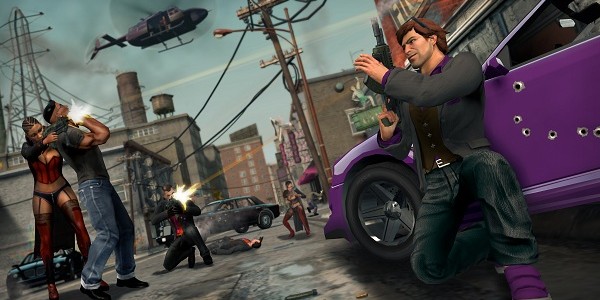
It's my life, don't you forget. It's my life, it never ends.

Talk Talk - "It's My Life" from the 107.77 The Mix radio station

Despite a conclusion that somewhat redeems the player-created lead and the Saints, life after the main saga is meaningless. You could complete the leftover side missions and find those last collectables, but after that, all there is to do is kill. Kill so that you can impose yourself on the people of Steelport once again. To be chased, to evade or to die... and rise again. The various upgrades players can buy only serve to make the final hours all the more pointless: with upgrades to your damage resistance, you can make a close range rocket as painless as a short fall. Saints Row: The Third allows you to do everything and achieve nothing at the same time. It is a nihilistic sandbox in which you must assert yourself, as nothing else matters.

 
Problem? Report this post
TRISTAN DAMEN'S SPONSOR
Comments (4)
Default_picture
January 06, 2012

Terrific article, Tristan! This sort of sharp analysis is what games journalism needs more of!

Trit_warhol
January 06, 2012

Thanks for affirming my writing, Jason :)

Default_picture
January 07, 2012

I have to admit, I had to look up the meaning of nihlist after reading this article along with some of the work by Nietzsche.  I think you may lose some of your readers by basing your article on a word that isn't used in common english. 

That said, nihilist as a term has multiple meanings. I'm not sure you completely flushed out exactly which interpretation you mean by it.  Do you mean the game has no meaning after it is essentially over? (which can probably be claimed by 98% of the games out there) Do you mean that there are no values during the game?

True open world games will only put the values in that of the player, not force a morality on the player.  The sandbox genre like that of GTA and Saints Row have been aiming to reach that marker for some time, or in some perspectives, you can say that is the case in all games.  In a way, the game only becomes nihilistic if the player themselves is nihilistic. 

Now, if you deem to say that it forces you to be nihilistic as in "not having any meaning", you contradict yourself at the end that says that your only meaning is to "Kill so that you can impose yourself on the people of Steelport".  That in itself has meaning.  Simply because it does not follow the current moral standards does not make it nihilistic.  On the contrary, Nietzsche would probably discribe it as post-nihilistic because it establishes a new moral standard or understanding.

Trit_warhol
January 07, 2012

Brian, thanks for the extensive response. The purpose of the January Bitmob Writing Challenge is to evaluate a game from an unconventional perspective. There were several approaches suggested, however I chose to look at the game as a nihilist text. If that means I lose a few readers, then that is an end result of the challenge itself. I accept it, wholeheartedly!

Correct, nihilism does have multiple meanings, and that's something that I tried to illustrate with the quotations I used from Nietzsche and Hugo. The choice of quotations from songs from the in-game radio stations are also strategic, as each can be seen to subscribe to one/both of the interpretations of nihilism presented in my article. You'll also notice that Nietzsche and Hugo's definitions of nihilism conflict to a certain extent.

With the Nietzsche and Wavves quotations, I intended to explore the traditional meaning of nihilism: total rejection of established laws and institutions. Through the use of purchased properties and abilities, the player can cancel the attention of the law/gangs attained through various transgressions (read: killing civilians and gang members). This allows for players to operate in direct conflict with the established law. It also renders these activities essentially meaningless, as players are able to absolve themselves of the consequences of any wrong-doings with the touch of a button. 

BEGIN SPOILER In one version of the final mission, the paramilitary organisation called in to quell gang violence even violates the social and moral order by attempting to destroy a city landmark in a bid to frame the very force that they're trying to destroy (read: the player-created character and the Saints). END SPOILER. This is yet another example of how all groups come to reject the established laws and institutions of Steelport.

With regards to the end game, there is no aberration to the laws and rules at play in Grand Theft Auto IV. While there may not be a whole lot to do, the experience you have traversing Liberty City will be no more-or-less different to that when you first started (read: if you kill, you’re chased and have to work to lose notoriety or you’re killed). In Saints Row: The Third, you can even purchase the ability to be immune to bullet, explosive, fire, fall and vehicle impact damage. Meaningless to the extreme!

So that's the Nietzche/traditional version of nihilism.

The Hugo quote illustrates nihilism as self-aggrandising behaviour or living "by affirmation than by bread". Every mission, side mission and collectable is completed/attained with the objective of affirming the player and the Saints at large. For this reason, I disagree with your assertion that the game only becomes nihilistic if the players themselves are nihilistic. With GTA IV for example, the story deals with Niko trying to establish a normal life within the laws of Liberty City but instead being dragged into the game world's seedy underbelly. Niko's objective is to establish a life with Kate, or to attain the life with Roman that he was initially promised. He isn't trying to create his own law or set of rules as the Saints do with Steelport.

As for your final point, this is where the Hugo and Nietzsche definitions overlap. If the player engages in meaningless activity ad nauseum, they are not creating a new form of meaning; they are instead living Nietzsche's form of extreme nihilism: “‘the meaningless’ eternally!” 

You must log in to post a comment. Please register if you do not have an account yet.