


Games reviews, eh? Not worth the bandwidth they're, um, printed on. Or something. The last month has been a particularly good time for fanboys to froth at the mouth at games reviewers. There was God of War 3 'only' getting nines out of ten, people being derided for criticising Heavy Rain on the grounds of it not being all that great all the time in terms of actual game mechanics, and most hilariously, Edge's 5 out of ten score on Final Fantasy 13 being down to a xenophobic conspiracy.

For the most part, those responsible for the reviews did as they are wont to do- laugh it all off and ignore the deranged rantings. That people get so wound up over reviews however, speaks to some problems gaming media has in presenting itself. Here are a few:
Reviews are subjective- now go and buy this 9.75 rated game.
'A review is just an opinion', whines the game journo at people unhappy with his criticism. Well, that's as maybe, but a review score isn't. It seems that websites try and outdo each other by having ever more scientifically finely calibrated scoring systems. Marks out of ten for graphics sound and the ever unexplainable 'gameplay' combine to give a number that those who know better is plucked finely from the reviewer's rear but is presented in such a way as to say 'yes, we have inputted all these elements into our review algorithmic-o-tron and have come up with this definitive empirical number.'
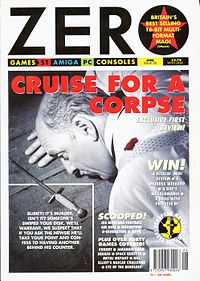
It seems as if in recent years the percentage score has fallen by the wayside in favour of an out of ten system, which seems fine (lower resolution of scores should lead to less nitpicking in theory- more room for argument that the review's subjective) until decimal points just have to be added, meaning you're still looking at percentiles by another name. Even sites that rank out of five can't resist giving games half and quarter stars For crying out loud people, if we have to have scores, either give us a straight out of five star rating like a movie review, or acknowledge how ridiculous the entire concept is and review games out of a thousand a la old 80's UK magazine Zero (laughable projected lasted interest graph optional).
Five out of ten is average
No, it bloody isn't. It should be, but its not. For as long as people have complained about review scores, magazines and websites have adopted the handy dandy legend to explain what each rating means from excellent through average down to poor. This, you see, helps you understand that review scores are scientifically considered and accurate. Despite their being opinion. Ow, my brain. Thing is, by the definition of average quality, an outlet's review scores should center about a mean of five, while in reality most means are closer to seven. Hooray, everyone's a winner! Look how many well above average games we have! Five out of ten is not an 'average' score because no-one uses the full range. How many 9.5 rated games have you read reviews for as opposed to 0.5 rated ones?
We play every game through until its conclusion
Ah, now to get to the meat of things. The games press is full of lazy, inefficient good for nothings. Why, just think about how much you contribute to the igns of this world by looking at some annoying flash advert before being taken to their site. How do they spend this revenue? By playing games for hours on end instead of writing about them! Forty hours of gameplay go into a review that takes all of a few minutes to write, praising an epic RPG for its last ten hours (since it's the last thing the writer remembers). A ten hours, you Mr. Average Consumer, will never reach because you will have barely got through a ball achingly dull opening before taking the game back to the shop in exchange for Let's Dance.
Just think what would happen if Activision head Bobby Kotick were in charge of all gaming media. It'd be a well oiled machine! Reviewers would be whipped day in and day out to produce critiques as fast as possible to the slavering masses. Forget playing a game through until the end- reviewers would base a games score purely off an Amazon consumer review, the box art and the first video that came up when searching for the title on youtube. Hey, that sounds like an idea..
Resonance of Fate/ End of Eternity (ps3)
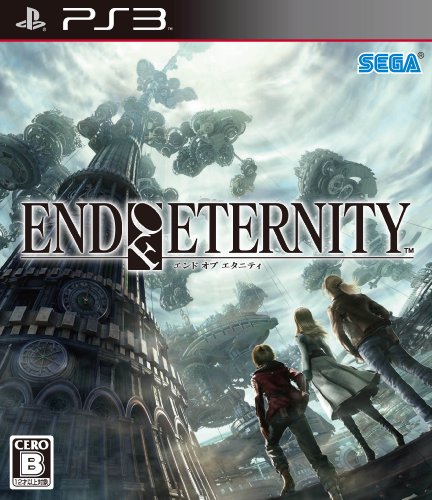
The Japanese box art shows our heroes gazing up in wonder at spectacular structures floating in the sky. It is unclear at this juncture whether these structures are what lies in wait at the end of an eternity. The name suggests a good long play through, so let's add, oh, 65 points for longevity. Onto the US box art:
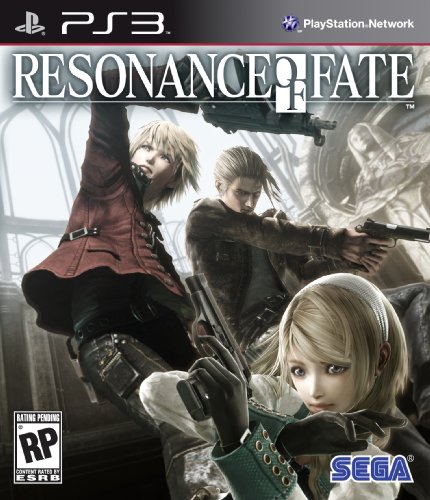
One hero has a moody expression on his face as he shoots something off to our right. His friend in the red jacket appears to be cheering him on, though with a slightly dour expression on his face and spiky hair on his head. Guns and haircuts? This is a Japanese 'stylish action' game then. Good-o. Plus forty two points. A female character lingers at the bottom of the box, appearing to wipe a strand of drool of her chin. Plus an additional two points for giving the opportunity to write a 'Resonance of Fate? Resonance of heroin chic more like' strapline.
Onto Amazon reviews. That's where the real criticism lies. Dark Dreams has played six hours of the US version. He gives it five stars, which is an automatic addition of fifty points to the review score, but goes on to explain it's not a 'stylish action' game at all, but a JRPG. Aww, crap. Minus a whole bunch of points for the genre, and a few more for lying to me with the box art. Worse yet, one reviewer of the Japanese version on Amazon gives it two stars, not being a fan of the combat. If Japanese consumers don't like a JRPG, what does that say? Minus an arbitrary load of points.
Some guy on youtube, meanwhile hasn't played the game but reckons the gameplay will make up for its crummy story and shitty graphics explained away by there being clouds of toxic gas in the environment. You know, so the draw distance can be shorter. Plus a few points, and a comment about 'if you like this sort of thing then this is the sort of thing you'll like'
Quick search for a video of the Japanese version of the game, and we get a protagonist dancing at the prospect of looking at a female character's jiggly breasts while drinking wine. His emo T-shirt clad friends stare on. Plus a few points with a 'those kooky Japanese!' comment or minus a bunch deriding the cliched characters and Benny Hillish-ness of the whole affair depending on how right on and forward thinking we are this week.
Overall- dull looking game that teases tits and guns and gives another humdrum rpg. Plus a few points for the breast physics (while gently chiding in the review text) minus a whole bunch for the fact I hate JRPGs, and plus a load to keep the role playing otaku happy. Let's see... 7.3? Yeah that'll do.
And a quick glance on metacritic reveals a 77 score as of March 20. Wow, I'm pretty good at this. More soon, or probably not.


Thought provoking stuff. I personally agree with you that reviews in general are a tricky sort of damned if you do damned if you don't proposition these days. It's kind of hard to claim that a review should only be treated as a subjective opinion when your purpose for writing the review is to tell people if they should buy the game or not. You are, in effect, deciding the fate of the game for people who consider you a credible source. This makes it much harder to just brush off what you say for people who want to see the game succeed.
Are all reviews advice for purchases, though? I think there are two camps out there. I am sure there are still people who look at reviews before making their purchasing decisions, but I know that I tend to look at them after I have bought and played the game. I do the same thing with movies, and it's to get another perspective on the material.
@luke I know their are two camps to that sort of thing. I was basically saying that if they wanted their reviews to be seen more as a subjective opinion then don't write them to decide the fate of a game as much as examine the game after the fact.
I personally write reviews in a very spoiler laiden rant style where I just take games that I think are too well liked to task for what I percieve as glaring faults. Can't get much more subjective then that. I even would say that I don't want anyone who hasn't played the game to read most of my reviews. I wouldn't want to scare them away from making a more informed decision based off of their own personal intrests.
I still think it is important to write what I feel about a game though, since often times in gushing about how great a game they liked is, reviewers can forget that a game's good points aren't universal truths that everyone will like, as gamers are too diverse to all be pleased by the same things.
If reviews aren't to be seen as buyers guides then scores are entirely irrelevant, surely?
This is why i hate number scores. Play magazine seemed to get it right by doing away with any sort of points system. I think reviews these days are too generalized, instead of "If you like JRPGs, you'll love Resonance of Fate," or "if you're a fan of third person action games like God of War, Dante's Inferno is your game!"
And too often people stack games side by side: for example God of War vs. Dante's Inferno. God of War = perfect example of a third person action brawler with massive amounts of enemies, blood, gore, and cringe-worthy moments. Dante's Inferno = not God of War, so 7.5. Final Fantasy XIII, three out of four stars because it's not the Final Fantasy I WANT.
People read game reviews to see if it's worth checking out for themselves, not just because they're curious on what your opinion is. Yes that matters because an opinion counts, but mostly they're thinking "Is this game for me?" If not, it shouldn't deserve a 6 out of 10 because it "lacks what I want in the game."
I enjoyed the shit out of this piece.
"ball achingly"
While I would have preferred you not to reduce my article to the matter of Final Fantasy, since that's just the tip of the iceberg of a quite sad trend that goes much beyond S-E's latest success, I do agree with quite a few of your points.
Game reviews are often extremely biased opinion pieces. Should they be? No. I don't think so. Game reviews should be a balanced mix between opinions and fact. A journalist can like a game or not, it can appeal to his tastes and expectations or not, he can even like the genre or not, but a professional should be able to use factual quality as a base and foundation of his reviews. While there are many parts of a game whose likeability goes down to opinion, there are many technical areas that don't. That's the reason why scores of 5 (or even 4, like the usual hater on destructoid spouted) simply don't fly for objectively polished games like Final Fantasy XIII, that should be given an higher score by default simply due to objective quality.
That's, or should be, the difference between a professional journalist and a random guy with a blog.
And mind you, thank you for packing me with the fanboys. A lil crack in your theory would be that personally I despised some Final Fantasy games like IX and XII (of course I wouldn't give them a 4 or a 5, because they're still high-quality games, objectively, I didn't enjoy them almost at all, for various reasons, but I wouldn't allow my personal tastes and expectation get over my head THAT much).
Unfortunately we all know what's the real reason behind those scores. Most of the times, besides the bias of which i talk in my article, it's simply a cheap trick to gather attention and stand out between the 1000s of reviews that come out of a popular title.
Who, between the gamers that already read 20 reviews of Final Fantasy XIII, would have cared crap about reading the late-coming trainwreck passed as a review on destructoid if it wasn't a 4?
The fact that I think Japanese games are too often reviewed with a disparity of treatment compared to western games (and for many reasons, not only cultural pride, between which the fact that most japanese companies spend less in marketing on western magazines and websites, and as such contribute to the salary or revievers in a lesser fashion than western publishers), doesn't mean I enjoy or even appreciate them all. Not even all Final Fantasy titles.
In any case, thank you for the free hits on my blog man, much appreciated :D
I don't think "objective" is a word that has any business in the realm of proper critique. If you're writing a buyer's guide, then fine, give a game you don't like a "high" score to be "objective" based on its production values. But a formal product analysis and a review are not the same thing.
A review can -- and I feel, should -- be completely subjective and still serve as a guide by which a consumer can make a purchase decision. The difference between "opinion"/"rant" and a subjective critique comes down to the quality of of the writing.
What does the game make you feel? That's it -- is it more than the sum of its parts? How do its mechanics engage you? Does it do nothing to engage you? If you can communicate those points effectively, your reader will know whether or not its game they will like because either they'll connect with what you're saying or they won't. After playing a game, describe what happened to you and how it made you feel. Do not focus on the game itself -- that's what the back of the box is for.
The worst that a game can do is make you feel nothing or like it wasted your time. In that case, if you're going to give a game a score, then it should be given a low one, regardless of the quality of its production values (and vice-versa).
Saying that someone should check out a movie for its awesome CGI is fine, but any decent film critic would never claim that awesome CGI makes it a good movie. They'd write a review, give it a low score (were one required) and add a line or two mentioning that it might be worth seeing for the effects. I don't think a game review should be different. Does FF13 bore you? Do you feel that neither its narrative nor formal qualities are worth experiencing? Fine, then it deserves your low score*. You also think its looks amazing? Hey, that's what rentals are for.
I think one big problem is that reviewers are treated as sort-of "objective" (really dangerous word, that) advertisers. From a certain perspective, a high score translates to them trying to sell you something and a low score translates to them trying to sell you something else. I think that's a huge problem in this industry.
This, anyway, is the approach that I take when reviewing games.
*For the record, I am love, love, loving FF13.
P.S. Loved the article! All of this was in reply to the discussion happening above me. The article, of course, goes into a lot of good detail about many of the problems with regard to game reviews. I think the public are as much a part of the problem as the tropes of the industry itself. We acknowledge that these pseudo-scientific score breakdowns are bullshit, while at the same time we cry out for more "objectivity." We throw around meaningless terms like "fun factor" while also throwing out loaded ones like "pretentious" without even understanding their meaning or relevance. Uhhh... This is getting way too ranty. I'm done.
:)
@Christian: the problem with a completely subjective review based only on the reviewer personal tastes and expectations is that such a review is useless for the majority of the readers, or better, it's useful only for those readers that share pretty much exactly the writer's tastes and expectations.
That makes the window of usefulness of such a review a tad too small for confort, don't you think? :D
I by no mean think that a review should be completely objective, simply because that's impossible. Though I think that facts (and there's a lot of facts to talk about in a game) should work as a solid foundation for any review, allowing the reader to relate to it even if his tastes don't completely match those of the writer. Then, over those facts, the reviewer should of course be free to add his own opinion.
But if those facts aren't there, and don't reflect on the score, then the review is no more than a personal rant, like the thousands you can find on any average or below average random blog on the internet.
@Giuseppe: That's not what I'm saying. That's true if the review boils down to, "I like this" or, "I don't like that." I agree; that's a bad review, plain and simple. When I say a subjective review, I'm not talking about personal opinion or taste. I'm talking about describing your subjective experience of playing the game; how it made you feel, not what parts you did or did not personally enjoy. If that's done successfully, opinion is irrelevant; either the reader will relate to that personal experience or they won't, and that will inform their decision in regard to the value proposed by the material.
EDIT: I'm not saying facts are irrelevant for informing the reader. Obviously, and ignorant reader won't know what you're talking about if those facts aren't incorporated. However, I do not feel they should inform any "final verdict" unless they significantly contribute to your subjective experience of playing the game. If you didn't enjoy FF13, the fact of its high production values doesn't factor into that, and shouldn't artificially boost your score.
Of course, if we throw out scores, all of this becomes so much easier. You can do both and not have to worry about the "final verdict." Your piece as a whole does the talking and the reader actually has to make up their own mind.
Guiseppe,
No problem, man, any emotional damage you may have received from a slight group lumping should be directed toward the 'satire' tag at the top of this piece. I think I went into a bit more detail on the gaijingamers thread, but hey, like you said, free hits. By the way, are you saying FF13 shouldn't score less than, say, a seven just because it looks nice?
Stojan- I see where you're coming from but the line 'if you like this sort of thing then this is the sort of thing you'll like' has been the bane of games journalism for at least twenty years.