Home
Home

In this inspired vision of the future, Alex changes a lot of names to protect the guilty. As he correctly pointed out, I've been using similar technology for years in the IT field to help people whose computer skills are lacking. I personally think this is a great idea.
You have received a message from Becky:
Hey! I'm at the second boss now. Want to watch?
You see on her profile that she's playing Facade 5e. When you played the unenhanced (that's presumably what the "e" stands for) version towards the end of the PlayStatus 3's life, you were surprised by the final form this boss took. You also found a particular attack that made the fight much easier, so you might as well watch her reaction and be available for tactical support.
This generation, console manufacturer Sonny leapfrogged rival Microx in terms of online functionality for single-player games. Microx unified friends lists across games, allowed friends to chat while playing different games, and created leaderboards of friends' scores. Third-party developers, such as Bazar and Criteria, foregrounded these leaderboards to make single player as competitive as multiplayer. Sonny, though, built on Microx's cross-game chat and appropriated a tool IT-support professionals had been using for years: remote assistance.
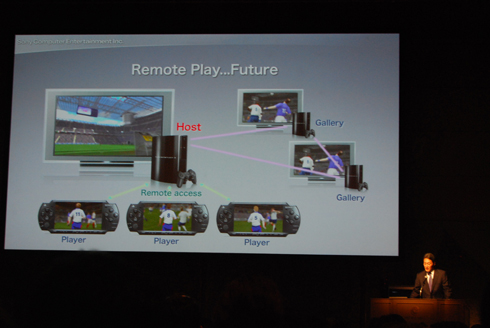
By adding to the “Remote Play” function of the PlayStatus 3, which offered limited compatibility between the home console and the Mini Status portable console, Sonny introduced a new feature into their console’s operating system:
-
One friend plays a game and streams video and audio to a remote server.
-
The server then streams this data to a maximum of 3 others (which later increased with broadband speeds), who may or may not own the game.
-
If the developer so chooses, spectators can play the game for a limited time by offering help with a tricky boss or enjoying it as a demo.
Initially, developers were trepidatious about this new development. But that final bullet point empowered them to prevent the newest version of floppy copying. Quickly, they embraced Remote Play as a vital marketing tool -- it wasn't a substitute for borrowing a game, it was more social than a traditional demo, and it could spur new purchases when a “Buy this game?” pop-up greeted the spectator at the end of a Remote Play session.
Later, after the next-gen Status’ sales explosion -- a perfect storm preceded by a drop in price and the smash-hit Irked Avialae 2 -- and the mass-market success of Googolplex’s Cyborg phones, Sonny had access to a vast mob of casual gamers. Those who had only dabbled with unintimidating handheld games had picked up the NGS for Miffed Avialae 2 and the myriad other cellphone games that had been ported to the NGS due to its similar input systems, then enhanced due to its more-muscular internal hardware. Those who were previously uninterested by home consoles now had a smartphone with the PlayStatus Suite app.
Even as Sonny businesspeople were picking out new ivory back-scratchers thanks to Irked Avialae 2’s sales, old fans were creating a new wave of hardcore gamers. Most of Sonny’s new customers had no time for 80-hour Japanese role-playing games or complex fighting games. A few, pushed by Remote Play invitations from friends, did.
When they connected their PlayStatus devices to Face-o-Fax, millions of people found friends they hadn’t realized were gamers. Irked Avialae fans saw their friends playing JRPGs, first-person shooters, various types of strategy -- all sorts of intimidating, complicated, and huge-looking games. Most of those old gamers scoffed at the new generation, sneered at their babyish bird-flinging toys, and ignored their invitations to multiplayer games they saw as beneath them. But the remaining reasonable, mature, and friendly gamers saw this as an opportunity to share the hobby they had loved since their first Intendro Entertainment System or Game Kid.
Suddenly and unexpectedly, nerds were using Remote Play to share Facade 5 and J-Gang 6 with inexperienced gamers. Nerds showed them the funny, tender, unobnoxious stories they didn’t know existed in the same world as Call of War: Something Military, Twin-Exhaust 6, or Soccer 2015: Latest Roster.
At first, the twin-stick controls and assumed knowledge of game tropes were tricky to grasp. So, like people who are tech unsavvy with PCs, the new crowd needed a helping hand at first. Remote Play became remote assistance again. Slowly, though, they got the hang of it while developers saw the increased need to streamline their games.
Thanks to two factors -- the diversity of people now buying games, and that these people dramatically increased the number of potential customers -- publishers are at last receptive to games they previously thought too risky. Niches are now populous enough to merit big-budget games from major publishers. Writers are challenging and respecting their audiences as they have always wanted to, and new genres are flourishing. A creative renaissance has come about because of one new feature in a game console’s OS.
You accept Becky’s invitation, glad that you’ve found someone to share this game with. She intuitively finds the solution to this boss fight, as if that was in ever doubt, and you both distort your microphones in hysterics as the boss reveals his true form.