


I originally started this blog series on 1UP.com, and the first four entries have already been up on my 1UP page since April. RPGs have been my favorite genre of video/computer games for most of my 25+ years as a video gamer, but I've never really explored why this is so.
What inspired me to do this series? My favorite game store of late has been not Gamestop, not Best Buy, but Vintage Stock - a regional chain of stores with numerous locations across Oklahoma, where I live, as well as Missouri, Kansas, and Dallas-Ft. Worth, which sells old toys, comics, records, videos, sports cards, and video games. Because they pay a pretty decent price for these items, better than Gamestop, for instance, does, they have a pretty extensive selection of rare collectibles that rivals most of the best eBay merchants, with the added bonus that you can see the merchandise before you buy and don't have to pay S&H. One day, to my great pleasure, the glass case at the Norman, Oklahoma VS contained both Lunar: Silver Star Story Complete and Eternal Blue Complete, albeit minus the boxes, hardbound manuals, and feelies. I had previously owned both of these games, but in my younger and dumber years, loaned them to a girlfriend with whom I lost contact with shortly thereafter (I still have some stuff she loaned me as well.)
Overjoyed, I purchased both titles. The fact that they contained only the game discs and "making of" discs with each title didn't bother me; my former girlfriend had only the game discs. I still have the manuals, maps, and assorted goodies that originally came with both games, so this was another successful rebuilding of my game collection, which has had some unfortunate brushes with thieves in the past couple of years. My game collection almost feels whole once more.
This drooling fanboy reaction I had made me really think about why it is I love RPGs. So I started this series to explore my own personal experiences with this complex, controversial genre. My first entry, presented here, was over the game which, while not the first-ever computer RPG, was the game that really popularized the genre - directly in Japan, which fell in love with RPGs, and indirectly in the US, where its influence would be felt more through more popular competitors. That game is none other than Dragon Quest.
Originally published on 1UP 4-13-2009.
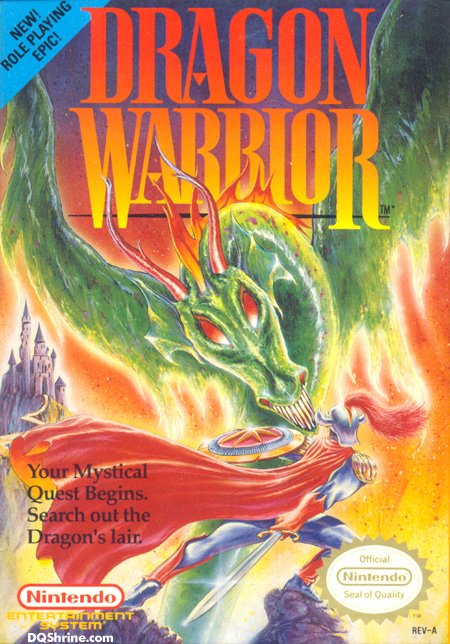
U.S. Box Art
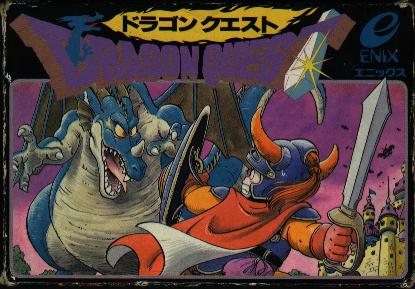 J
J
Japanese box art
Dragon Quest (Dragon Warrior in USA)
Publisher: Enix (Japan), Nintendo (USA)
Release: Japan, 1986; USA, 1989.
...So where better to begin a series on RPGs than with the granddaddy of all console RPGs?
Dragon Quest - known as Dragon Warrior in the US because the Dragon Quest (TM) at the time was held by a company founded by ex-employees of D&D maker TSR - wasn't the first console RPG. But it was the game that launched Japan's huge obsession with RPGs, and indirectly, through its influence on its direct competitor, Final Fantasy, heavily influenced the American RPG scene. Dragon Quest itself was a response to the two seminal American RPG series of its day, Ultima and Wizardry, which were extensively translated and released for the Japanese market. But many younger players found the game mechanics of these RPGs excessively convoluted. Dragon Quest was a concerted attempt to make the RPG genre friendly to the masses of Japan, with a distinctly Japanese face - the manga style of Japan's hugely popular comics and animation industries, and given the pace of the arcades to which Japanese players were accustomed, rather than the PC/Apple II environment on which the American RPG designers cut their teeth.
The game was as basic as could be - your object was basically, to find various artifacts, rescue Princess Lora Anastasia Gwaelin, and defeat the DragonLord. You powered your character up by defeating cartoon monsters in one-to-one turn based combat. That's it. There's no big existential crisis, no evil Empire, no moral decisions (except at the very end). Yet, it was hugely popular in Japan from the very beginning. Dragon Quest games have been the best-selling games of pretty much every Japanese console. It outsells even Final Fantasy by a large margin in Japan. The franchise has transcended video-game popularity - it is an integral part of Japanese popular culture, a part of every Japanese citizen's cultural identity, in much the same way that Mickey Mouse, Bugs Bunny, and Superman are part of the American identity. But why?
Part of it is the artistic talent that created it. While Final Fantasy has been worked on by numerous producers, composers, and art directors over the years, Dragon Quest has always had the same three key people involved, even in spinoffs such as DQ Swords and DQ Monsters: the writer and creator, Yuji Hori, the art designer, Akira Toriyama, and the composer, Koichi Sugiyama.
Even in America, almost every kid is familiar with Akira Toriyama's work even if they don't know his name. Akira Toriyama is the creater of probably the most internationally popular anime/manga series in history, Dragon Ball. Long before American kids began getting up at 6 AM (in my case) to watch Dragon Ball Z, Dragon Ball and Dr. Slump (a lesser-known Toriyama manga) had already been huge phenomena in Japan for over a decade. Toriyama's black-haired Heroes (the main character in Dragon Quest never has a name, this is left up to the player) all bear a certain resemblance to Dragon Ball's protagonist, Son Goku, whether as a child or as an adult. But more than the Goku-like main characters, one enemy character has come to emblemize the series, and its parent company, Enix, in the way that Mario emblemizes Nintendo: the first enemy encountered in every DQ game, the 1-XP, 1 GP, smiling Hershey's Kiss-shaped Slime. It's a far cry from the fearsome beasts American heroes like to do battle with, but I believe the Slime's cute, friendly design was a conscious attempt on the part of Toriyama and Yuji Hori to greet the gamer, "Welcome to our world! Stay awhile and have some fun!"

Yuji Horii, who is considered the "father" of Dragon Quest, had already won some renown as a writer of dramas for television. He was a winner of the "design-a-game" contests Enix used to have back in the day. Though he sticks firmly with the fairy-tale style light fantasy genre, his stories for Dragon Quest are known for being quite movingly written within these bounds. He even pushed the envelope for "naughty" content - in the first town you visit in Dragon Warrior, you have the option spending the night at the inn with an ardent female admirer, and all the Dragon Quest games feature slightly racy, but never vulgar, content. For those who aren't fans of Dragon Quest, Yuji Horii also collaborated with Hironobu Sakaguchi in writing the story for Square's popular mid-90's RPG Chrono Trigger, which will get its turn on this page at some point.
Koichi Sugiyama is a composer as famous in Japan as John Williams is in the United States. At the time he was approached to compose Dragon Quest's soundtrack, he had already had 30 years of experience in television as a director and composer. His soundtracks were known for squeezing grand opera out of the sound chips of home video game systems. Each Dragon Quest soundtrack has its own symphonic suite, performed by a professional orchestra company. Nobuo Uematsu, the composer of the Final Fantasy series, names Mr. Sugiyama as a key inspiration for his own style.
Simplistic as it seems by today's standards (Dragon Warrior had one lone adventurer battling against single monsters, instead of parties), Dragon Warrior was deceptively deep, and its quest was quite panoramic for an RPG of the mid 80's. You had to explore a huge world to find various magical artifacts to complete your quest. At the climactic battle with the DragonLord, you are offered a chance to join the DragonLord and rule the world, which was unusual for the relentlessly heroic adventures of the 80's.
With the instantaneous success of Dragon Quest in Japan, Nintendo picked the game up for distribution in the US, hoping for a similar response, and printed a massive run of cartridges. The game didn't sell anywhere near as well in the US as it did in Japan; Nintendo ended up giving copies of Dragon Warrior away as premiums for subscribing to its magazine, Nintendo Power, which is why, with console RPGs relatively difficult to find even today, you probably won't have any problem finding one or two copies of Dragon Warrior in any mid-sized game shop or pawn shop.
But Enix - and later, Square Enix - have, to their credit, never given up on the series and continued to release it more-or-less faithfully in the US. Even the Super Famicom games, which weren't released due to Enix temporarily closing its US offices, will both be released on the DS.
So that does it for the game that started Japan's love affair with the RPG... next time, I will talk about one of the games that inspired it - made by a "British" student at the University of Texas at Austin.