Home
Home

History repeats itself yet again. Matthew's spotted eight lessons from the comic-book industry that video games have failed to learn from. Do you think developers and publishers will resolve any of these issues?
After reading Chase Koeneke’s What games can learn from comic books, I began to wonder if there were any specific lessons that the medium could learn from the extensive experience of the comic book industry.
Unfortunately, history likes repetition, and games have already made some of the same mistakes that comics did years ago. So let's take a look at some of the lessons games should have learned from comics, but didn't.
1) The Chuck Austen lesson: Vote with your dollars
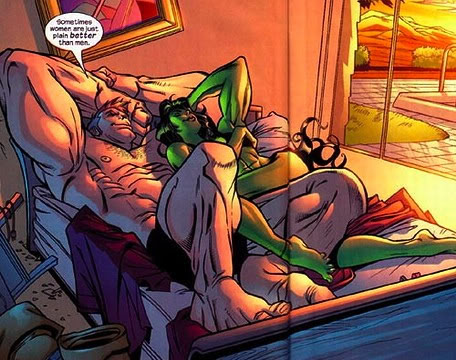 Back in the early to mid 2000s, Chuck Austen was the writer for Uncanny X-Men (#410-442), and fans loathed his entire run. With plots points such as Nightcrawler’s demon daddy, Juggernaut/She-Hulk sexy time, and the Havok/Polaris/school nurse love triangle, fans derided Austen for focusing on the X-Men’s sexual escapades while ignoring the finer points of storytelling, like coherent plots and characterization.
When asked about Austen’s sordid run, then Marvel Editor-in-Chief Joe Quesada said that they had heard the fans’ complaints, but since the sales for the comic were still high, the complaints seemed to be coming from a vocal minority. He then urged fans to vote with their dollars.
They did not, and Uncanny X-Men remained one of Marvel’s top selling comics month after month after month, which is kind of like what we do as gamers.
We praise unfinished games, like Skyrim, and complain about an abundance of sequels, only to make Modern Warfare 3 the best selling entertainment product ever. Until publishers start to notice a difference in their bottom lines, they aren’t going to care what you don’t like because you’re still buying it.
2) The O.M.A.C Project lesson: Required tie-ins
Before Infinite Crisis began, DC Comics launched four mini-series that would serve as lead-ins for the big event, and The O.M.A.C Project proved to be the most precarious of the bunch.
In The O.M.A.C Project, former superhero Maxwell Lord is the primary antagonist. At the end of issue #3, he is alive and evil; however, he’s dead at the start of issue #4, and Wonder Woman killed him.
Between issues #3 and #4, DC ran a four part mini-series called "Sacrifice" that ran in all three of Superman’s comics and concluded in Wonder Woman’s. So, in order to understand Infinite Crisis, readers had to peruse The O.M.A.C Project and the other three lead-in mini-series, as well as the "Sacrifice" mini-series, for a total of 28 comics before the event even started.
While it would be easy enough for games to sidestep this issue, they haven’t. In Kingdom Hearts 2, Organization XIII plays a major part in story, but half of them are dead before the game begins. What happened? See Kingdom Hearts: Chain of Memories.
Mass Effect 3 finds itself in a similar position. At the start of the game, Commander Shepherd is supposed to be on trial. Why? See Mass Effect 2 DLC Arrival.
3) The Tarot lesson
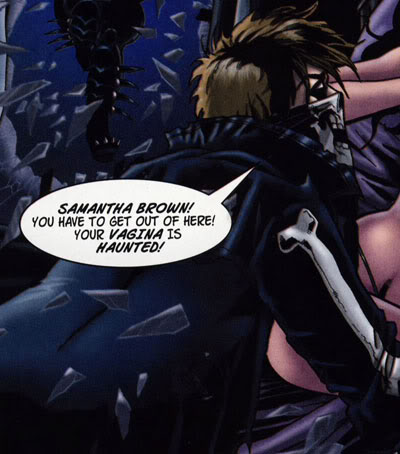
Describing Tarot: Witch of the Black Rose is difficult at best. The comic is about a witch named Tarot with ridiculously huge breasts who runs around fighting bad guys while naked and getting chained up and molested.
She was also bit by an eel. On her ladyparts. And someone’s vagina was haunted.
The only reason I bring this nigh pornographic comic to light is because it is billed as "one of the most female-empowering comics on the stands." But there’s nothing empowering about a woman who can’t keep her clothes on.
Someone should have said this to Bayonetta’s creator Hideki Kamiya.
Bayonetta is a game that insists upon itself -- mostly by insisting the titular character’s sexiness onto me, the player. She has guns as her heels, battles with poledancing moves, and loses her hair for her sadomasochist (S&M) torture attacks (which include sexually assaulting a female monster with a wooden horse), and she wears glasses. The game works really hard to convince me that Bayonetta is sexy.
I don’t find her the least bit sexy.
All I see is an oddly proportioned witch who (like Tarot) can’t seem to keep her clothes on and (like Tarot) finds herself in S&M situations in a story that makes little sense (like Tarot).
It’s not sexy. It’s not empowering. It’s just stupid.
4) The Hal Jordan/Kyle Rayner lesson
Back in the early 90’s, sales of Green Lantern dropped incredibly low. DC decided to have one Green Lantern character, Hal Jordan, turn evil and kill all of the other Green Lanterns so that they could re-launch the comic with new character, Kyle Rayner, as the last Green Lantern.
Fans lost their shit -- going as far as taking out ads in Wizard magazine in protest.

Almost 20 years later, and Capcom decides to abandon Devil May Cry’s Dante in favor of a new emo Dante in DMC: Devil May Cry debacle.
Just like with the Green Lantern shift, the fan backlash was immediate and harsh, with some fans going as far as sending death threats to Ninja Theory over the reboot.