Separator

Between giants and dragons: Politics in Skyrim

Default_picture
Friday, January 13, 2012
EDITOR'S NOTEfrom Sam Barsanti

My Skyrim character, an elf named Harold Bloodshadow, was completely on board with taking down The Empire...until he met the Stormcloaks and realized that they're totally racist...against elves. As far as I'm concerned they can all go to Hell. Thankfully, Steven has put more thought into this dynamic than I have.

Every fiction writer worth their salt will tell you that the best villains always imagine themselves to be the heroes of the story.

Video games create a similar situation. Rarely are we forced to second-guess our actions in Gears of War's battle with the underground-dwelling Locust, and we're never left wondering whether Halo's destruction of the human race is indeed the will of alien gods.

Because the efficient video-game soldier cannot have a crisis of faith on the battlefield, the warrior must see himself not as a murderer but as an instrument of God.
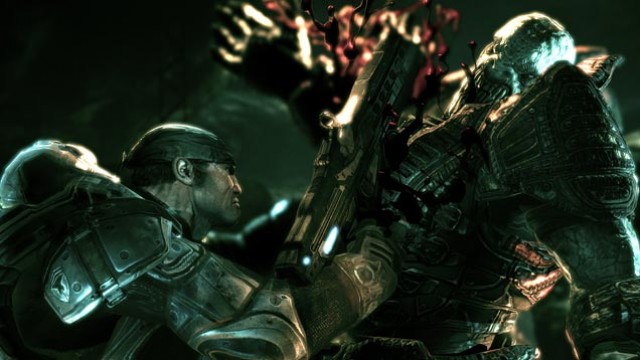
I understand your party's trade policy but if I may interject here...


There's no need to discuss the government's tax policy when aliens declare holy war on humanity, and there's no time to debate political agendas when the world is ending. With this oversimplified moral motivation we willingly give up higher brain function in favor of ignorance and guilt-free violence. We're just here to shoot things.

It's easily the route Skyrim could've taken. I can just see designer Todd Howard laughing gleefully to himself during the opening sequence as the player is led to the executioner's axe on account of a paperwork error. I can't help but sympathize with the rebel faction and despise my imperial captors.

40 to 50 hours of gameplay later I am horrified to learn that these seemingly patriotic Nords I've pledged my allegiance to are nothing but racist louts.

Wait...what happened to taking the fight to the evil empire? Why do we hate elves now?
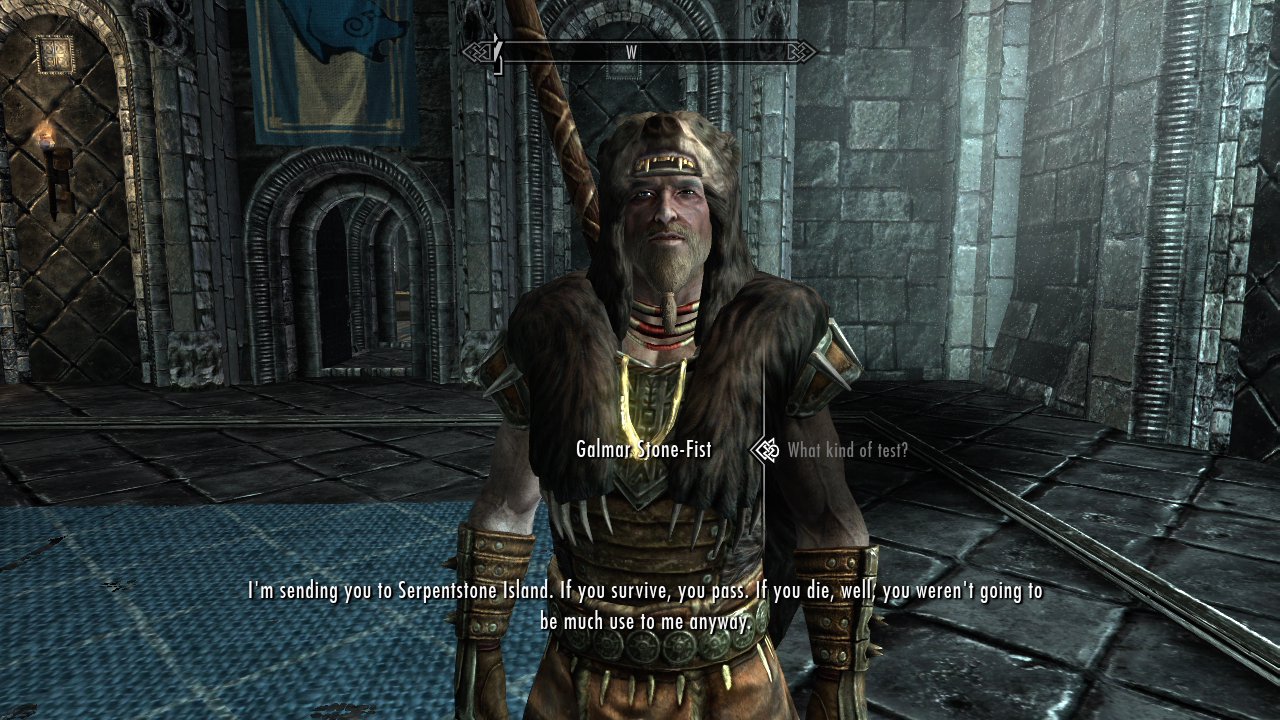
 

Uhh, is that a standard issue uniform? Or do I have to find my own bear skin?


This shouldn't have come as a surprise. The nuance was always there, I just wasn't used to looking for it: a guard sympathetic to my unjust execution, a shopkeeper extolling Skyrim's dependence on the empire, a Stormcloak slur about dark elves. I had been blinded by my own fanaticism.

The Empire’s supporters are not other-worldly invaders, they are my friends and neighbors. At every turn the game plays with my preconceptions and forces me to face issues head on. 

The city of Whiterun is the perfect microcosm of Skyrim's division. Upon arrival, I was immediately set upon by a member of the Battle-born clan, strong supporters of the Imperials, and bluntly questioned as to my intentions and loyalties. 

The man cornered me outside the inn: "So, which political party do you belong to?"

It's a loaded question. My answer would reveal my political leanings in the civil war, my adherence to traditional Nord values, and even my religious beliefs.

 Come on, I haven't even saved yet. 

The brawny blonde offered me a warning: "You better make up your mind soon."

A few more steps and I'm confronted by a preacher ranting about a deity whose worship has been outlawed by the Imperials. "Injustice!" I cry, only to discover the decision was actually a last-ditch effort to create peace between the weakening empire and a supremacist nation of elves. Once again, things weren't as simple as I thought.

Yet, how can I support religious persecution at the hands of an invading force? How can Skyrim be free while foreign armies control our government and trample our traditions, devour our wealth and bleed our sons and daughters in wars far from home?

There is no righteous cause in Skyrim. There is no cut and dry theology or political view here, only hard choices and people struggling to live with the consequences.

It may take some getting used to, but that's the last time I join a rebellion on a whim without hearing all the facts.

 
Problem? Report this post
BITMOB'S SPONSOR
Adsense-placeholder
Comments (11)
Dscn0568_-_copy
January 12, 2012

Skyrim isn't my type of game, but this is the first time I heard of these kinds of themes in the game. It makes me glad to have chose this topic for the Bitmob Writing Challenge.

Default_picture
January 13, 2012

Things are getting intense for this Bitmob Writing Challenge. I need to go read a top ten list to relax.

Default_picture
January 13, 2012

It's definitely a different situation but reading this article reminded me of being ordered around by Atlas in Bioshock just because he says  "Would you kindly?"  You're working for a bad guy when that thought had never even occurred to you.

Default_picture
January 13, 2012

I know! And his scottish voice was so soothing as well, you couldn't help but want to help him.

Lolface
January 13, 2012

It's nice to see an RPG handle a religous conflict without devolving into a "God is evil" argument and forcing the players to fight "God" as the final boss.

Also, the Skyrim civil war is loosely based on the Christianization of Norway. King Olaf I, and later King Olaf II (cannonized as Saint Olaf), forced the people of Norway to convert to Christianity under penalty of death. The worship of Norse gods were outlawed, but Norwegians wore an amulet shaped like Mjolnir (Thor's hammer) in defiance. There were some wars and a brief lapse into paganism after the death of King Olaf I, but eventually Christianity took hold.

Default_picture
January 13, 2012

Hmm, that's interesting Matthew, because the religion of Elder scrolls seems to be universal acknowledgement of all the deities, though some are preferred by other races. So in the case of Talos in Skyrim's civil war, there aren't competing religions trying to beat out each other, but simply one god crossed off the generally accepted list. But in the case of Norway, it's a direct confrontation between christianity and paganism. Makes the talos ban seem strange, it would make sense for the Thalmos to try and replace that with something else.

Sam_photo
January 13, 2012

The way I understood it is that the Thalmor wanted Talos out of The Nine because it would knock the humans down a peg. After all, Talos was a human that became a God, so if Tamriel no longer has this constant reminder of mankind's strength, it'll be easier to wipe them out and put the elves in charge. Ergo, it's not about forcing everyone to worship who they want to worship, it's about making sure that a human isn't the one being worshipped.

This may be the nerdiest thing I have ever written.

Default_picture
January 13, 2012

That's one reason they did it at least. It also seems that they were intentionally trying to create strife in Skyrim through their actions, just as they created strife between the empire and Hammerfall in the very same treaty, and ultimately lead to Hammerfall breaking off the empire. Ulfric was doing what the Thalmor wanted him to do the whole time. 

I agree, this is one of the nerdier things that I've commented on. 

Lolface
January 14, 2012

Okay, I want to stress the "loosely" part of my previous comment. Everything that's been said is true as far as the lore of the game goes, but I was talking about a historical allegory.

Looking at the history of Norway (Skyrim is a loose allegory of Norway), Thor was the most worshiped god in all of Norse paganism (he's also where we get Thursday from). So, when King Olaf I began Norway's forced conversion to Christianity, it was mostly Thor's temples that were destroyed and Thor's followers that were tortured and killed (that doesn't mean that Thor was the only Norse god worshiped in Norway. Freya also had a rather large following). This is very similar to Talos in Skyrim.

Also, looking at the statue of of Talos, he bears a striking resemblence to the popular depiction of Thor (Marvel's "The Mighty Thor"). The chainmail tunic, the winged helm, and cape execute the look. Finally, the statue of Talos has him standing atop a serpent. At Ragnarok, Thor was fated to battle and slay the Midgard Serpent Jörmungandr. Thor would then take nine steps before falling dead from the serpent's poison (nine is an important number in Norse mythology).

So why am I comparing Talos to Thor? Because Talos is Thor. Not in a mythological sense, but in more of a socio-political sense.

When Norse paganism was banned in Norway, it was mostly Thor that was banned. As the most widely worshiped of the Nine in Skyrim, Talos was banned. When Norse paganism was banned, people wore a penant in the shape of Thor's hammer, Mjolnir, in defiance. When the worship of Talos was banned, the Nords wore the Amulet of Talos in defiance.

It's not a 1:1 comparison, but I do think that the Skyrim civil war gets its roots from the Christianization of Norway. Afterall, the game is largely inspired by the people and traditions of Norway.

Default_picture
January 14, 2012

It's funny because the man-becoming-god is sort of a reversal of Christianity's God-becoming-man. So in a way, it seems Talos is a strange mixture of the pagan Thor and the Christian religion.

Lolface
January 14, 2012

Sort of. While Jesus is God becoming a man (though there are theories that argue against this), the man becoming a god motif exists within Norse mythology, though it's actually woman becoming a god.

Valkyries were goddesses of war and death, and thus choosers of the slain. All valkyries originated as human women, who were turned into goddesses (demi-goddesses really) after their death.

You must log in to post a comment. Please register if you do not have an account yet.