Home
Home

Omar's examination of careful use of popular music in games is an interesting one. Check it out.
Regular players of Gears of War 3 will have noticed a peculiar detail about the multiplayer map Gridlock. A layover from the series’ sequel, the map’s open design ensures that the cityscape becomes a killing field as soon as possible. But one small Easter egg turns Gridlock’s typical scenes of bloodlust into tender moments of reflection.
Scattered across the map are ashen silhouettes -- presumably created in the noiseless moment of a nuke’s detonation. If a full round concludes with all of the silhouettes intact, the Easter egg is triggered: “Mad World” begins playing in slow, determined piano chords.
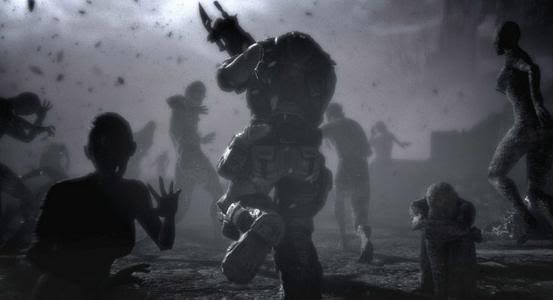
By putting its regular cacophony to rest for a few short minutes, Gears of War 3 forces players to view the environment holistically rather than through tunnel vision. Suddenly, you’re not so fixated on your ammo counter or the minimap. For a few minutes, you take the time to absorb the environment and remind yourself of the science-fiction narrative surrounding your character.
Instead of scanning the same 10 pixels that constitute your reticle for signs of enemy life, your eyes begin to move beyond the crosshairs.
After enough repetition, the human brain can learn to adjust its behavior with relative ease. So after your 5,000th game of Battlefield 3, the synapses between certain brain cells begin to strengthen in response to their frequent use. Your brain will know what parts of the screen deserve your attention and which don't. With most first-person shooters, one's eyes rarely stray far from the centered reticle. But with the correct stimuli, a developer can throw your a wrench into your brain's clockwork...if only for a few moments.
Red Dead Redemption, for instance, succeeds at shifting the player's attention away from immediate threats as they wander into Mexico for the first time. Once you've made your way south, the serenading voice of Jose Gonzalez makes itself heard. This subtle cue forces the brain to widen its field of perception, and the player begins to see the beauty in the landscape rather than its strategic potential.
After putting so much effort into a game, it's no wonder that a developer might force players to appreciate its aesthetic aspects. In the same way a director might stage a shot to divert attention away from the actors and towards the green-screen environment, a game developer might want to call to mind the "bigger picture." Whether that proverbial picture entails the in-game environment, the narrative, or even the purpose of the game, a well-placed audio cue should do the trick.

Developers ought to stay cautious, however, as their mileage may vary with original soundtracks. You see, the brain is exceptionally good at prioritizing stimuli. Should you walk into a horse stable, for instance, your mind will eventually tune out the smell of manure, deeming it irrelevant. Similarly, if you associate original music too much with the game experience, Marty O'Donnell's evocative arrangement won't register as much as you rip through Halo: Reach's campaign.
The solution is twofold. First, developers have to confound the brain by introducing music that feels out of place. This ought to force your hippocampus to momentarily rethink the way it processes information, leaving the cerrebellum to address the anomaly. A song like "Mad World" accomplishes this feat beautifully. The second objective is to assign a new subject of attention. Gears of War 3 directs players to the visual environment by saturating the colors and kicking the bloom of light sources way up.
The ruse is finally complete, and for a moment, players experience something altogether novel. Play team deathmatch on Gridwork enough, however, and the brain will learn Epic's little trick, ignoring the licensed track as though it were manure in a horse stable.