Home
Home
They wrote about games, violence, history, the rights of minors, and the responsibility of adults. They cited history, warned against the future, and both questioned and defended the present. The majority opinion lasted barely 18 pages -- miniscule for a ruling of this magnitude -- while a pair of dissents went up into the mid-50s. But ultimately, in a 7-2 decision, the U.S. Supreme Court upheld a 9th U.S. Circuit Court of Appeals decision to throw out California's ban on the sale or rental of violent video games to minors.
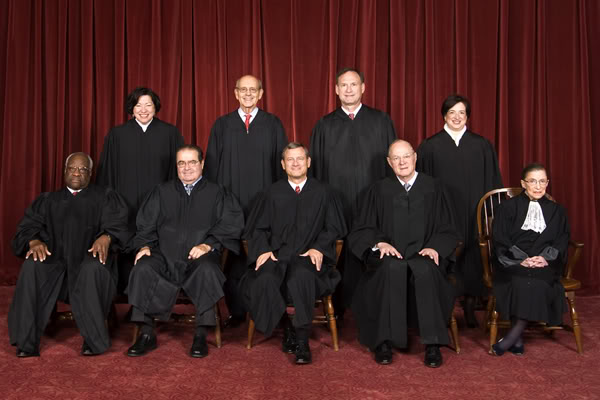
A smiling judge is a hangin' judge.
But why they did and what they wrote (both for and against) went far beyond simple cash transactions. They recognized, inaugurated, and validated a new art form.
Four Justices wrote opinions. Antonin Scalia delivered for the majority (himself, Roberts, Kagan, Ginsburg, Sotomayor, and Kennedy). Samuel Alito sided with them but disagreed on their arguments, submitting his own. Both dissenting Justices, Clarence Thomas and Stephen Breyer, contributed their writs as well.
As is his custom, Scalia's opinion starts bold and stays bold. "Like the protected books, plays, and movies that preceded them, video games communicate ideas -- and even social messages -- through many familiar literary devices (such as characters, dialogue, plot, and music) and through features distinctive to the medium (such as the player’s interaction with the virtual world). That suffices to confer First Amendment protection."
Game proponents argued that one for years. This settles the issue: Video games are protected free speech, period. Scalia even notes books featuring graphic violence like The Odyssey to Lord of the Flies have been on high school reading lists for decades without any legislative attempt to restrict them. I wouldn't argue that the typical Call of Duty plot matches up with those classics, but they do now legally fit into the same category. They tell stories. We can -- and should -- debate the quality of those stories, but this ruling implicitly states that interactive games are valid frameworks for art and substantively no different from film stock, paper, or MP3 formats.
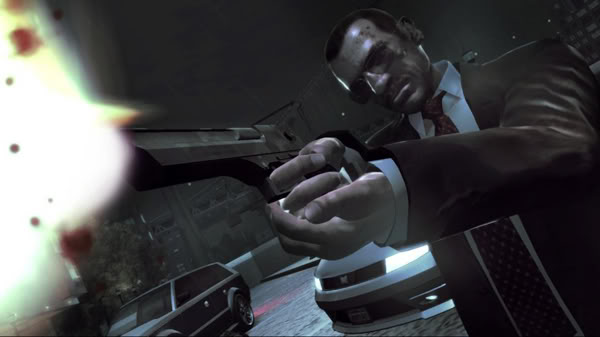 Also protected? The Second Amendment.
Scalia also makes a point of shooting down the very research that prompted State Senator Leland Yee to legislate a ban in the first place. "These studies have been rejected by every court to consider them, and with good reason: They do not prove that violent video games cause minors to act aggressively."
So now games also pass the Elvis test. Back in the '50s, concerned parents swore Elvis would lead children to alcohol, drugs, and pre-marital sex. Now he's on the easy-listening channel while Eminem and Kanye West barely raise an eyebrow anymore.
Not everyone's convinced. Alito's opinion -- which reads like a dissent -- bemoans today's violence and warns how it might become more 1-to-1 with emergent technologies like Kinect. By contrast, Thomas reaches back into antiquity, claiming the Founding Fathers' puritanical intentions with "freedom of speech" didn't include "a right to speak to minors (or a right of minors to access speech) without going through the minors’ parents." He bases his objection on the Founders' "belief" that kids are basically property, ignoring both child labor laws and the realities of the information age.
More thoughtful opposition comes from Breyer, who points out the proposed ban only affected games "that the industry itself tells us it wants to keep out of the hands of those under the age of 17." He also singles out an interesting anomaly. "What sense does it make to forbid selling to a 13-year-old boy a magazine with an image of a nude woman, while protecting a sale to that 13-year-old of an interactive video game in which he actively, but virtually, binds and gags the woman then tortures and kills her? What kind of First Amendment would permit the government to protect children by restricting sales of that extremely violent video game only when the woman -- bound, gagged, tortured, and killed -- is also topless?"
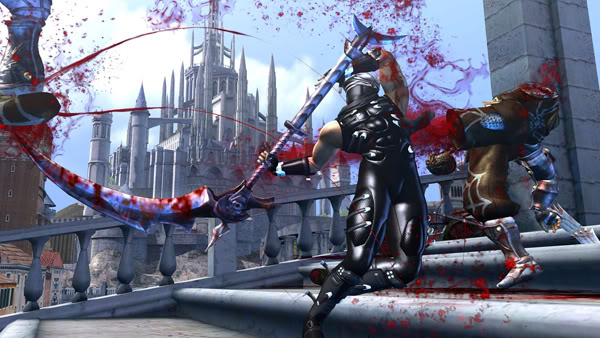 "Owwie!" by Team Ninja. Medium: viscera on pixels.
Scalia answers him: a First Amendment that prioritizes people over state edicts. "While some of the legislation’s effect may indeed be in support of what some parents of the restricted children actually want, its entire effect is only in support of what the State thinks parents ought to want."
"No doubt a State possesses legitimate power to protect children from harm," Scalia writes, "but that does not include a free-floating power to restrict the ideas to which children may be exposed."
So think of this as a rite of passage. Every entertainment medium -- theater, prose, film, television, music, comic books -- experienced a moment where society challenged, then ultimately vetted it. Whether by design or as an incidental choice of language, the Supreme Court just filed video games alongside those other artistic endeavors. Like those other media, governments have no say in defining what's "appropriate." That's a parent's job and nobody else's.
And now games get to do their job. After decades spent in the legal fringes, always waiting for the next Congressional hearing to hit, the highest court in the land declared that video games are real, valid, and protected under the Constitution. It's a new day.