Home
Home

It's been an interesting week for game reviews. I'm not referring to my Rage review - which is pretty great - rather, the shenanigans some game journalists have gotten away with this week. Firstly, there were some perfect review scores for Battlefield 3, an eloquent - though misguided - look at Uncharted 3 that was torn apart by trolls, and IGN once again set the standard for journalistic integrity (or its opposite, as it were).
I'm more concerned with the whole perfect score issue. Not that a game should never attain one: if a game has no discernable flaws at the time of release, and sets new standards in presentation and design, it should get as many points, stars or thumbs-up available. Battlefield 3, however, is not one of those perfect games; the reviewers even say so themselves.
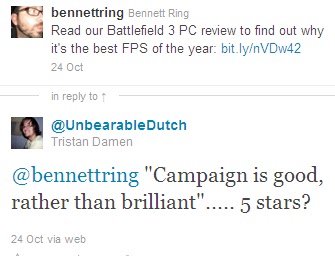 It all started with an innocent tweet from GameSpy editor, Bennett Ring. I read the review as instructed, but had some questions once I'd read it all, and saw those five (out of five) stars. As above, a perfect score when justified is fine, but when I read "campaign is good rather than brilliant," "much of what's new is familiar," "BF3 is a flawed game," I thought that some questions were in order. To his credit, Bennett answered the first one, but understandably - the response was pretty defensive, and didn't really address the issue. That is, the writer's challenging the definition of what perfect is.
Then, peripheral to this, I thought I heard a dissenting voice. That of veteran Australian game journalist, David Wildgoose, proclaiming that he had always expected the following concensus between reviewers: "Great MP, Crap SP." I joined in, questioning how the game could still enjoy perfect scores despite part of the package being flawed. His response floored me: "No drama with the scores. It's a great multiplayer FPS. The campaign shouldn't detract from that."
What the hell? You can include a derivative single player campaign and have it written off as a value-added bonus? It got more interesting.
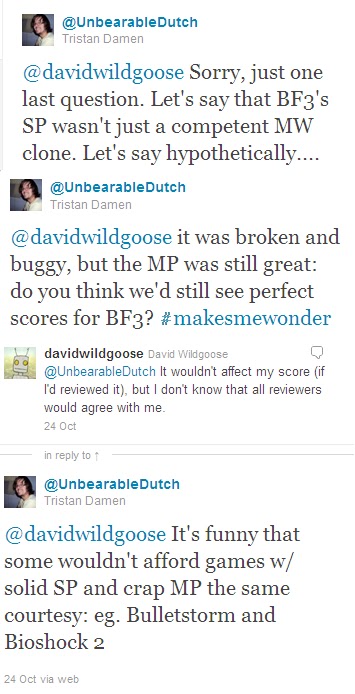 So, as quoted in the picture, Wildgoose went on to say that even if Battlefield 3's campaign was an unplayable mess, he would still be comfortable awarding it a perfect/ near-perfect score. Ars Technica writer, Ben Kuchera mirrored those comments as well, equating his experience to Battlefield 3's multiplayer suite being a great steak, with the campaign compared to a "bad beer."
Let's consider that then: let's compare gaming to a meal. We'll just tweak the analogy so that it suits my thesis. Imagine you order a steak (tofu for you vegetarians out there) with all of your favourite sides: potato bake, fries, gravy, the whole spread. The steak is amazing, cooked just how you like. The fries, however, are cold. The potato isn't cooked properly, and and the gravy is a watery mess. Did you have the perfect meal? No! Did you have a great steak? You bet. How did the meaning of perfect get lost?
Why are we also then, so hard on single player-focused games that either feature no multiplayer component, or one of questionable quality? Why is a stellar single player campaign not exempt in the same way Battlefield 3 and Call of Duty: Modern Warfare 2 are, when they feature a "tacked-on" multiplayer suite?
Bulletstorm isn't the best example, as it has a fairly solid metarating; but it did cop stick for its laggy multiplayer mode. To be fair, plenty still sung its praises, but some did point it out as a "failing." Sure it "shines as a single-player shooter," but obviously not enough to account for the lack of depth in regards to multiplayer.
As for Eurogamer's oft-discussed Uncharted 3 review, it seemed as though Simon Parkin was expecting something other than a heavily-scripted third-person cover shooter / platformer. The whole franchise has been defined by the action movie set pieces and meticulous pacing. I can't think of a single game in the genre that has succeeded when it allowed players to meander around, looking for the next objective. If you subtract the shooting from the equation, the 2008 reimagining of Prince of Persia failed - in my opinion at least - because there was a little bit too much freedom and a lack of direction. It was beautiful, but if I left the game alone for a sustained period, I forgot what I was doing. In the end, I never finished it. I can almost guarantee that the same won't happen with Drake's Deception. I should clarify that I don't believe Uncharted 3 is entitled to a perfect review - nor do I think that I'll give it one - I just think you could maybe pick on the arbitrary nature of the platforming sequences and the ambiguous damage model (going from my experience with its predecessor).
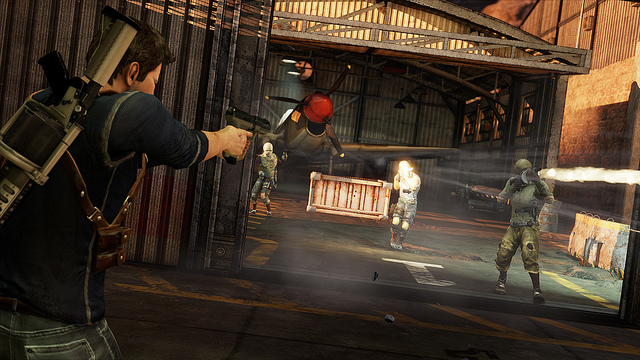
I didn't like it how the bad guys shot at me.
I'll mention Daemon Hatfield's gaffe in passing, because what did you expect? It's IGN! I'm not saying you can't get a feel for a game playing on Easy, but when a substantial portion of content is locked to a higher difficulty - like Jamestown, for example - you may just have to man-up and put it on Normal. Better yet, if the developer calls you on it, don't hack a part out of your review and try to cover it up. Transparency is a bitch sometimes, I know. I should also clarify that I haven't yet played PixelJunk Sidescroller, but the situation doesn't look good for the site or the developer.
We need to change the way we review games. I'm not saying that you need to get rid of scores - it might help - but there are other ways. How about issuing different scores for both the single and mutliplayer components? How about letting your words do the talking?
How do you think game reviews should be handled? Is the status quo acceptable?