Home
Home

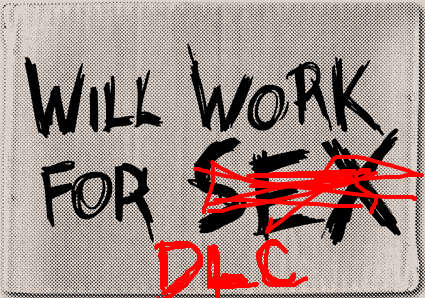
I'll bite – I like DLC. No, not because, as of late, I have to pay more money for a part of a game that should have already been part of the game in the first place. Rather, I like enjoying new content within the same universe, whether it be a new mission or new maps, hell even a new character or game-type thrown into the mix. It's similar to the hype behind sequels – everyone loved the original Combat Evolved, but who didn't want to see where Master Chief would end up next in a sequel?
However, we all know that DLC has gotten a bit too ridiculous as of late. Paying for characters that are already on the disk? 15 dollars for a three-map multiplayer expansion? It's beyond ridiculous, actually, but we have to put up with it because, well, every time these expansions arise, people buy them. They really have no choice – the developer knows somebody will buy, so anyone who tries to boycott will just be left in the dust and either forced to enjoy the game without the extra content (which are now becoming requirements to play some game-types to force players to buy) or cave in and join in on the DLC fun.
This creates a problem for people like myself who don't have the spare cash lying around to throw at the gaping wallets of the industry, unfortunately. If I did, hell yeah I'd buy every expansion pack imaginable. Money would be a non-issue. But it is.
Thinking about this issue. I put myself in a situation – I'm a video game designer with at least a few years of experience. I'm no Cliff Blezinski, and a comparison of myself to Shigeru Miyamoto would make the word “laughable” such an understatement that you could be legally prosecuted for using it in this context. However, in this hypothetical situation, I'm pretty well-off and certainly qualified.
So here it goes: I'm at an interview for We Make Awesome Shooting Games Studios and my potential boss, Mr. Designer, has me in for an interview. Mr. Designer asks me a question: “As a designer, how would you remodel our DLC structure? Walk me through how you'd release a game and its content, and how you'd further handle its DLC expansion.”
Bear with me on this one. Note: I'm walking through this as if I'm behind designing the next Halo game, for example, so keep this in line with precedents set within the shooter genre (Gears, CoD, Halo, Battlefield, etc.). We Make Shooting Games Studios only makes games like Halo, apparently, who'd-a thunk it?
1) The original release includes content that should not need any expansion if a DLC structure was not already planned.
To simplify – the game should be released so that way the full package does not need expanding if the developer does not want to release future DLC. That means a completely finished campaign plus a multiplayer mode that is not hurt by its lack of depth and content.
One of my biggest problems with DLC is that, as of late, games seem to be tailor-made to allow for DLC so that DLC becomes an absolute need rather than option. Take Halo: Reach for example. The game released with a pitiful amount of maps, and I mean pitiful. Too many of them were just made from the game's Forge mode, not original maps (and even some of the original maps aren't even “original”, as some are remakes [IE, the Ivory Tower remake]).
At the helm, I'd go out of my way to make sure the next We Make Awesome Shooting Games Studious release had upwards of over 15-20 maps? Seems like a lot? It is, and that's a good thing.
One of the best things about original maps, and having a lot of them, is that it shows off the scenery and beauty of a game. The more maps you have, the more locales players get to traverse and explore (or blow-up and destroy, whatever floats your boat) during their multiplayer excursions. Likewise, more maps means more variety – no one has to go into a game-type expecting to play the same 2-3 maps over and over because there are over a dozen, maybe even two dozen, potential maps to play on right out of the box.
And that leads to another thing, as well. People who do not have the luxury of playing online do not suffer from a low multiplayer content, either. They won't necessarily have to buy any new DLC because they're more likely to be content with 15-20 maps that are on-disk and ready-to-play right after purchase, rather than a couple.
Of course, the developer may need more resources and man-power to do this, but ultimately it pays off. A developer that puts more content in for the same price is one that is showing a lot more love and care for the game than another. And you'll most likely see more customer loyalty, as well. In other words, you don't need statistics to tell you that an FPS with a 10-12 hour campaign and 16 maps on-disk will satisfy gamers more than an FPS with a 5-6 hour campaign and 8 maps on-disk.
On a side-note, lets consider competitive gaming – for any developer that sees profit in eSports or wants to get more involved would be shooting themselves in the foot by making key gameplay components (like maps) DLC-based. Take Gears 2, for example – the game itself had very few maps on-disk, and even less were used competitively (by the time it was removed from the MLG Pro Circuit in 2009, there were 6 maps being played). There were many more accessible via DLC, but that is simply not acceptable in the competitive realm. Competitive Halo: Reach got away with Forge maps becoming part of the circuit because that's a separate issue entirely.
2) DLC should target everybody.
The world of gaming has a multitude of kinds of gamers – many like to enjoy casual multiplayer matches with friends, others like to play campaigns with friends, some by themselves, others are builders using in-game construction modes, etc. There are just too many different kinds of gamers to count.
However, there's really only one kind of DLC: “here's more content, spend money.” Rarely do we ever see DLC geared towards specific kinds of gamers, and if it is, it's only because of the type of game. For example, the Call of Duty series only sports DLC for one kind of gamer – the multiplayer gamer who plays enough to warrant new maps. That's why you'll never see a single-player campaign expansion for Modern Warfare 3 because the big draw of the series is multiplayer, not single-player.
However, those gamers who enjoy other parts, or all parts, of the game still exist, and it's not necessarily fair to let them collect dust while all attention is paid to the 13 year-olds in booster lobbies (eh, not the best generalization, but you get my point).
This brings me to my next point.
3) DLC should be more flexible.
Let's start giving the masses options, and when I say the masses I mean every single person that has online access and is willing to buy extra content for the game they purchased, or at least has the potential to. Developers need to start considering everybody, not just their main cash-cows, even if they have those.
What can be done to fix this? Offer more variety and do some cool things to pack and unpack DLC to give every gamer possible a new fix when they begin to thirst for new content.
I'll give a hypothetical example, putting myself in charge of the release of 2010's Halo: Reach. I'm the big guy on campus that helped release it, I pretty much designed the game, etc. Hypothetically, of course. Here's how things would have gone down.
The game releases, etc. etc. Three quarters of the way into the game's first year of its lifespan and some gamers are probably looking for more. And we all know that the next Halo is a few years away. What to do?
To consider everybody, why not this? Halo: Reach's first DLC is not one package, but a flexible “mass expansion” in which gamers have many opportunities to expand their original content.
What would be offered here is this: a new 3-4 hour single-player campaign expansion, new maps, and new building options for Forge. That's a lot right? Must cost a lot, right? Depends.
What I would do is offer the DLC is different ways – the cheapest options would be to sell each component for a few dollars by themselves. So maybe I'd price the map pack at X amount of dollars, the campaign expansion at X-2 amount of dollars, the Forge expansion at X-5 dollars. Gamers would then be able to purchase individual expansions for whatever they see fit. The Forge fanatics would only have to pay a couple of dollars for new tools and not have to pay more for components they wouldn't otherwise use. Same goes for the single-player campaign nuts and the multiplayer addicts out there.
“But what if I use more than one of those expanded modes?” Then buy more of the DLC, but at a discounted price. If Gamer A, for example, only wants the single-player and Forge expansions, Gamer A can purchase those two DLC expansions and not purchase the map-pack while getting a slight discount for purchasing more than one DLC pack.
And if you want to spend big and get everything? No problem. The entire DLC pack can still be purchased together in one bundle like any other DLC expansion out there.
With that kind of system, obviously one that is simply theory, everyone can purchase exactly what they want and for a reasonable price without having to indulge into expansions they don't want and without being left in the dust by a developer that just doesn't want to expand all parts of a game.
Of course, this is all hypothetical, but worth the discussion. Ultimately, I think developers could do more to make their fans happy and still make money off of them, since we understand that the industry is a business regardless of how you look at it. I'm just saying that a full Halo: Reach “Mass Expansion Pack” with all of its components available together and separately at different prices reaches more people and will satisfy more gamers than a run-of-the-mill 3 map CoD expansion for 15 dollars.
And, well, what do you think? Do you agree with my system? What would you change, add, or subtract? If you were in charge, what would you do. Ultimately, what the big question here is, how would you handle DLC?