


Reggie's put together a series of retrospectives on computer role-playing games from the eighties and early nineties -- this is the first installment. Check back in a week for the next development studio.
SSI: The Midas Touch
1979 - 2001
The very first impression that I had of Strategic Simulations, Inc. was that they made games for old people. At the time, I had no idea why I should care about the Fulda Gap or superpowers colliding, only that it didn't seem all that exciting. That is until I saw their CRPGs. Those boxes looked a lot more interesting.
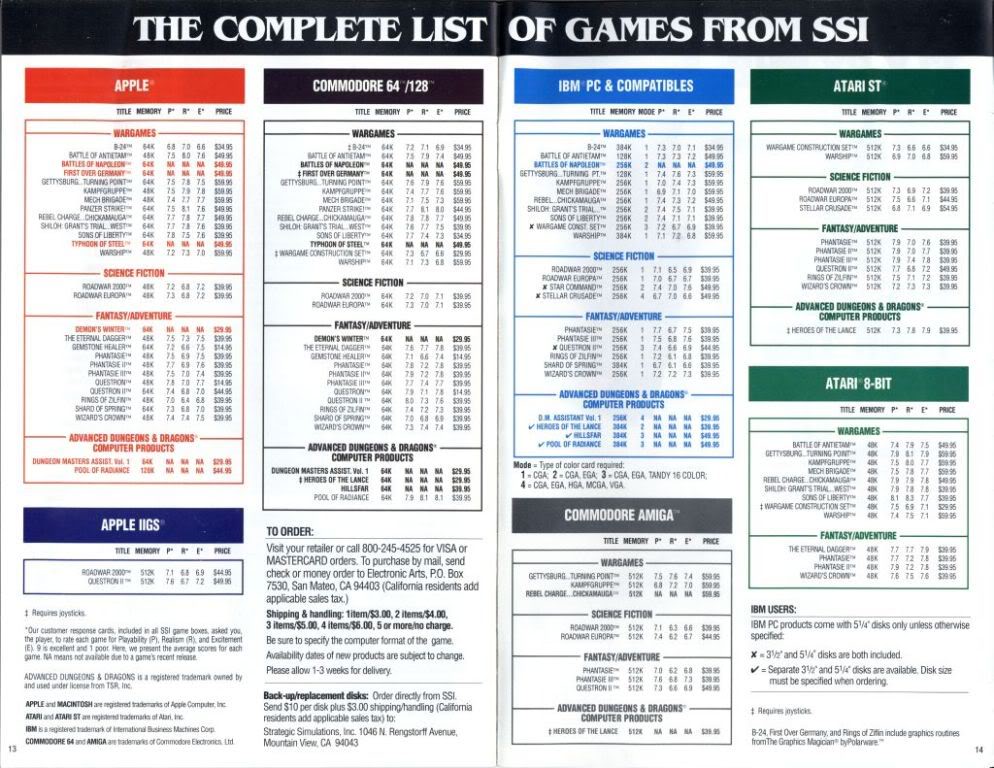
What I didn't know then was that they were one of the de facto masters of tabletop-styled simulations on PCs. Looking at their catalog (and wishing they did more CRPGs), it seemed as if they did everything from the Civil War to the Cold War with some football and baseball thrown in between just for giggles. From fighting along the Eastern Front on the Apple to the beaches of the Commodore 64, they were there.
They were also one of the most prolific developers and publishers in PC gaming history with a catalog of well over a hundred and fifty titles stamped with their logo. If you think the WW2 genre is saturated with shooters, you should have seen their catalog during the eighties when it came to turn-based strategy. Yet no one complained.
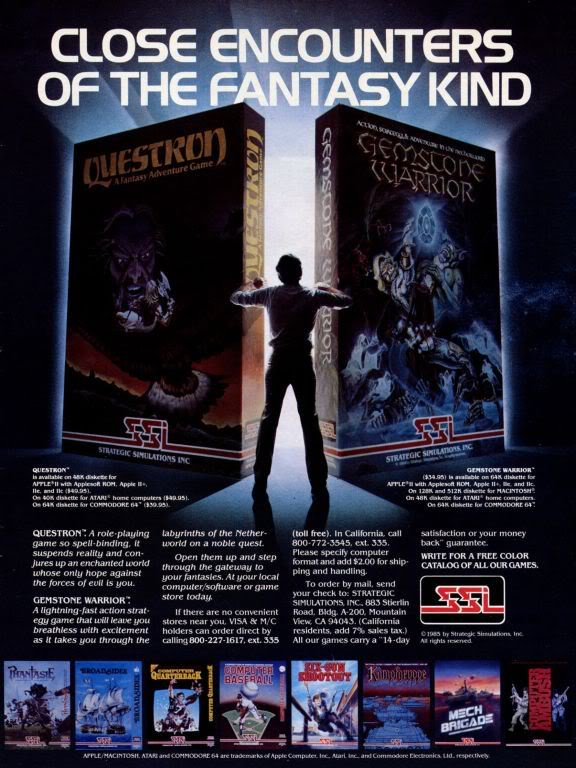
But they also had a turn on the CRPG circuit with the Phantasie and Questron series -- along with many others such as Demon's Winter, the action-adventures Gemstone Warrior and Gemstone Healer, and the post-apocalyptic titles Roadwar 2000 and Roadwar Europa. Stat heavy, tile-based, and packaged with manuals as thick as car instructions, these games immersed the player in each experience with plenty of details to chew over.
While they lacked in looks, that only left our imaginations and what their writers packed into the manuals to fill in the blanks. The one for Gemstone Healer came complete with a diagram done in an arcane style that also doubled as a hint guide for what to do.
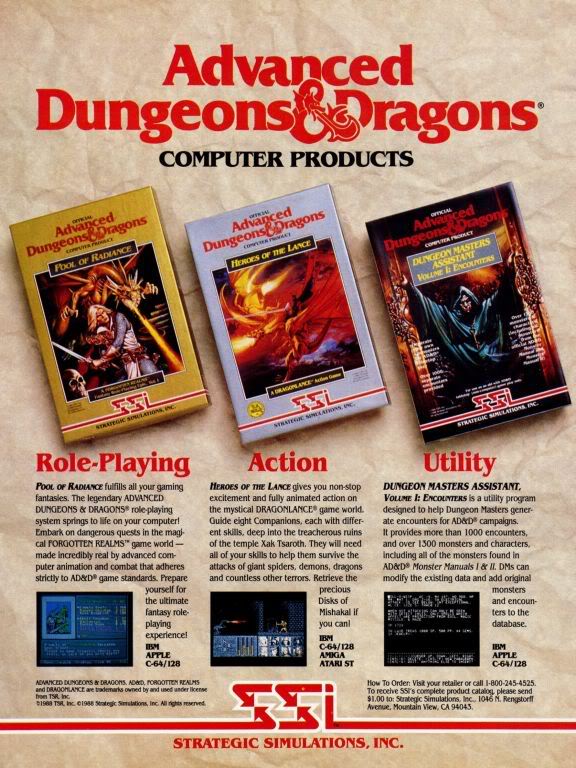
Their biggest coup was in scoring the Advanced Dungeons & Dragons license from pen-and-paper RPG publisher TSR. So named because of the gold-colored paper used to label the boxes, the “Gold Box” series would prove to be one AD&D's biggest splashes on PCs until the arrival of Bioware's Baldur's Gate under the Interplay label almost a decade later.
SSI opened up TSR's worlds to players with fancy graphics, turn-based tactical planning, and all of the nitty gritty details stuffed into every statistic. It would be the biggest impression that AD&D would make on CRPGs in years -- if not for the gameplay, then for the sheer body of work that would follow.
For players that had never touched the tabletop version but had a PC, it was a great way to get a taste of TSR's worlds without having to find a group, deal with temperamental dungeon masters, or buy all of the rulebooks. In my case, it was a little of each. The releases came with a manual that explained how the gameplay systems work and described the mysteries of THAC0 (to hit armor class zero). But they would often include an illustrated “Adventurer's Journal” detailing the monsters, D&D concepts, and the journal entries that would be referenced within the game as a form of copy protection.
The games had also recycled their engines to a degree unheard of today and leveraged storytelling and AD&D mechanics to create memorable scenarios that stood on their own; although, they started to show their age with later installments. Other titles had also debuted without gold boxes, such as the Dark Sun series and SSI's later partnership with Westwood which produced Hillsfar and Eye of the Beholder 1 and 2. The Dark Sun titles in particular demonstrated SSI's streamlining of the gameplay from the Gold Box series of titles, but never capitalized on these changes -- something that Bioware would take advantage of later on with their Infinity Engine.
SSI had even developed its own world with the steampunkish land of Aden introduced through Thunderscape and Entomorph after losing the TSR license in the early nineties; although, they never enjoyed the same level of success even if Entomorph wasn't that bad. As decent as they were, though, they didn't seem to do much to establish SSI's post-TSR identity as a CRPG shop that could survive without them.
So they refocused on their roots as a strategy company developing and publishing deeply detailed wargames such as Steel Panthers, Panzer General, and Silent Hunter. Unfortunately, titles such as Bullfrog's Populous along with Westwood's revolutionary Dune 2 and the Command & Conquer series changed the landscape of tactical gaming despite their critically acclaimed -- yet increasingly niche -- efforts.
The storied developer appeared to die a slow death in the mid to late nineties. Even with conversions of several of its Gold Box titles on the Nintendo Entertainment System early on, SSI was forced to compete against Japanese RPG houses that also flooded this new market with games that proved to be both more accessible and entertaining for a new generation of players.
Later, as hunger for the kind of statistics-heavy wargaming that SSI excelled at producing began giving way to the popularity of the real-time strategy genre, it became more difficult to keep up with its rivals. Although its games would continue to be popular among hardcore tacticians, the level of dominance and the vast number of titles it once produced had steeply eroded.
SSI was eventually bought out by Mindscape in '94 under which it produced several impressive titles such as the sequel to Panzer General. After changing hands several more times, mostly through the acquisition of its parent such as Mindscape, it eventually landed at Ubisoft who only used the SSI name on one or two games before it was finally retired in 2001.
All in all, SSI had a very successful run. Its games may not have been the most popular -- or the easiest to get into as they were often aimed at a more adult crowd -- but the quality of its work speaks for itself with every armchair general and D&D grognard. SSI passed quietly into history on what could arguably be considered a high, though muted, note.
Check back in a week for the next installment: Origin Systems: We Create Worlds. See two more SSI ads on page three.