Half-Life 2's intro: an example of good storytelling techniques in action

Default_picture
Saturday, February 04, 2012

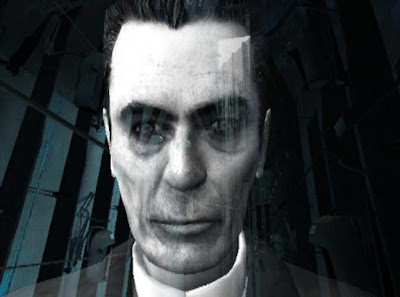
A close-up of the G-man.

In any sort of storytelling medium, one of the most important skills to master is making the opening scenes immediately grab the viewers' attention. In video games, this is especially important, because if the player doesn't feel they're being engaged from the get-go, they're likely to shut the game off and never look back.

Crafting a good opening sequence, however, is hard. If story is to be a primary focus, then clearly you want to make sure the tone is set and groundwork laid quickly. Perhaps, then, use the opening to get all that nasty back-story and set-up out of the way. Of course, that's how we often end up with dull, expository-heavy cinematics.

Valve Software, makers of the Portal and Half-life franchises, and proprietor of the popular digital PC game storefront Steam, have a good understanding of this area. They forgo long explanations and refuse to take control away from the player whenever possible, instead inserting progression unobtrusively and succinctly. Take, for instance, Half-Life 2's intro.

Half-Life 2's introduction is great for many reasons, but two in particular stand out. For one, it puts you in control quickly. Anything that lets you start playing sooner is always welcome. And second, it doesn't outright tell you anything; it shows you.

Walking through the streets of City 17 reveals a lot about the state of the world following the events of the first Half-Life. Human kind is now enslaved by a dictatorial race known as the Combine, who patrol the streets at all times and frequently raid citizens homes. Oppression is clear from the second you walk off the train leading into town. Citizens are forced to wear blue work uniforms and are often unjustly punished by their overseers. Security checkpoints are placed all throughout the station, the watchful eyes of the guards always on you. It's an unsettling atmosphere.

Once outside, the gravity of the situation truly hits home. Barren streets give off a ghost-town feel, security checkpoints and the occasional Combine cruiser being the only regular signs of life outside. The interior of living spaces looks old and decrepit, as though abandoned long ago and only recently taken up. Residents live in fear of their overlords, resigning themselves to merely counting the days until they become the target of the next raid to be taken god knows where.

All the while, large screens play propaganda that attempt to ease the populace. The speaker's calm voice and professional manner clearly an act, his speeches of a better life under Combine rule being an obvious farce merely to guise the rampant corruption throughout the city.
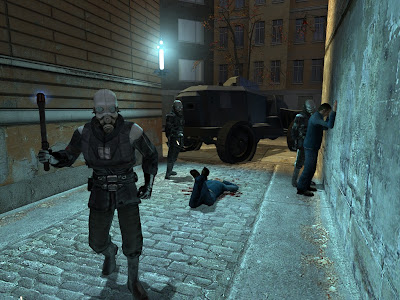
A few Combines admistering "justice" to an unarmed civilian

The place feels like a prison.

All that is conveyed not through words or cutscenes, but through visuals. The brief time spent jogging through the streets of the metropolis is enough to show how bad the state of the world is. The incident at Black Mesa has taken a terrible tole on both human and alien kind. And never once does Valve completely spell out the situation or how it came to be. They trust the player to understand the circumstances, how the last game's events caused this outcome. And even if the player is not familiar with the series' debut, enough subtle hints are placed for the pieces to be aligned. It's rather incredible.

I've already had some experience with Valve's particular talents through the Portal games, but I'm still amazed at how effortlessly they handle story progression. Most developers assign such duties to lengthy, static cutscenes. That Valve's able to avoid that almost entirely is a testament to how seriously they take this matter. If everyone were to adopt their methods of doling out info, I think game stories everywhere would be much better off for it. (Better writing and acting wouldn't hurt either, though.)

 
Problem? Report this post
BITMOB'S SPONSOR
Adsense-placeholder
Comments (5)
Default_picture
February 05, 2012

If there's one thing Valve is best at, it is certainly placing a player in a world with little to no explanation and having them learn about it through experience.  From Half-Life's tram ride and walk through the halls to Left 4 Dead's survivor graffiti, each of their games drops you in and lets you feel out the world.

Default_picture
February 12, 2012

I don't know, Half-Life 2 kind of had the opposite effect on me. If you rely on a tactic like in-game explanation, then your production values better be pretty damn good. I was recently playing skyrim and pre-patch there were a lot of little bugs that threw me out of the experience. Also, the repetitive Nordic voice acting also killed the immersion factor.

Half-Life 2 might have been excellent for it's time, but it jusn't do it for me now.  A better modern example might be Batman: Arkham City, which is the best playable intro I've ever indulged in. That represents a great use of a scale and high production value to really SHOW what a scummy underworld you've entered.

Otherwise I think my favorite games start with cutscenes. I especially love Fallouts 3 and New Vegas. The voice narration by Ron Pearlman sets the tone of the hopeless wasteland your about to enter perfectly. And the cutscenes are quick, gratifying, and provoactive.

I think it's all in presentation too, but even the written word can be presented in an enrapturing manner. Just look at the Star Wars introduction; did you ever think floating words in space could possibly be so cool?

But great article, I am going to go watch a few game intros now :)

Default_picture
February 17, 2012

I haven't played Arkham City (or Arkham Asylum, at that), so I can't comment on that game's intro. But I'll take your word for it.

Cutscenes are good, especially those that are quick. The less time it takes to actually get playing, the better. Problem is that so few games really make a good intro cutscene. Either they just get the set-up out of the way quickly or just don't manage to enrapture you right from the start. That is the purpose of an intro, right? To capture one's attention at the beginning? I can't think of many games I've played in the past year that managed to do that, but then, maybe I'm just playing the wrong games. I don't know.

I just think that, with such a visual oriented medium as video games, developers should be focusing less on passive storytelling and more on active. That doesn't mean every game should take the Valve approach -- Bastion, for instance was able to tell its story entirely through narration so as to never interrupt play -- just that developers should at least try to find more compelling means of conveying a story other than through five-minute or more long cutscenes.

I mean, I like cutscens as much as anyone else, and I think they certainly have their uses (the cutscenes of Uncharted are one of the best parts, for instance). It's just, I'd like to see developers diversify. Try something different every now and then rather than always rely on cutscenes or long streams of text to convey a story.

Default_picture
February 12, 2012

I've been tinkering with an article about game intros, and you took the words right out of my mouth in many ways regarding this game. It works so well to subtly teach the player, yet drives the story home in an equal balance. Valve knows how to craft a great game in general, but their introductions really stick out for sure.

Default_picture
February 13, 2012

Nice article Callum.  I think it was this month's Edge that mentioned that the 'put the can in the bin' moment is a nice way to show that the movement and placement of objects will be important.  It fits in seamlessly to the gameplay and also shows the Combine as less than gentlemen.  I hadn't really considered it that way before.

You must log in to post a comment. Please register if you do not have an account yet.