

You want my opinion?
Don't "introduce" your kids to gaming.
I know that that is the antithesis of what your entire article is about; but I've learned through three kids that you can't turn them onto anything they don't want to, no matter how badly you want them to be like you. My oldest is ten and he's seen a decades worth of amazing games...but he has no interest in any of it.
I know that probably sounds a bit deflating, but there is also the chance that your children will see you playing and take interest. But let them discover it on their own and take their own approach towards it. You can't introduce them to the perfect game -- it doesn't exist.
The best thing you can do is keep your ear on the pulse, listen to things that interest your daughter. I know you want her to grow up admiring the classics, but her first game should be something that will hold her attention. What that means is you don't get to pick the game, it probably more than likely won't be good from a reviewers standpoint -- but if they're having fun, that's all that matters.
But at 2, I think you might be starting a bit too early. I'm sure you've heard the stories of people being gamers since the age of 3 or whatever, I'm here to tell you they're full of shit. Kids that age don't have the fine-motor skills nor the comprehention to grasp the tasks put before them.
Anyways, before this entire counter-point turns into an article all it's own, I'll just leave you with a few recommendations if you're dead set in your ways, and that's pbskids.org, sesamestreet.org and nick.com/games. They're easier games that often only involve pointing and clicking and teach rudimentary lessons; but kids love Dora, Elmo and Curious George. And that's all they really need.
Don't knock educational software that's also sort of gamey. That's where I started at a very young age on the TI-99/4A (spelling and math games), and I eventually moved on to the Zork text adventures and Atari games on my own. I don't think I was two years old, though -- probably more like four or five.
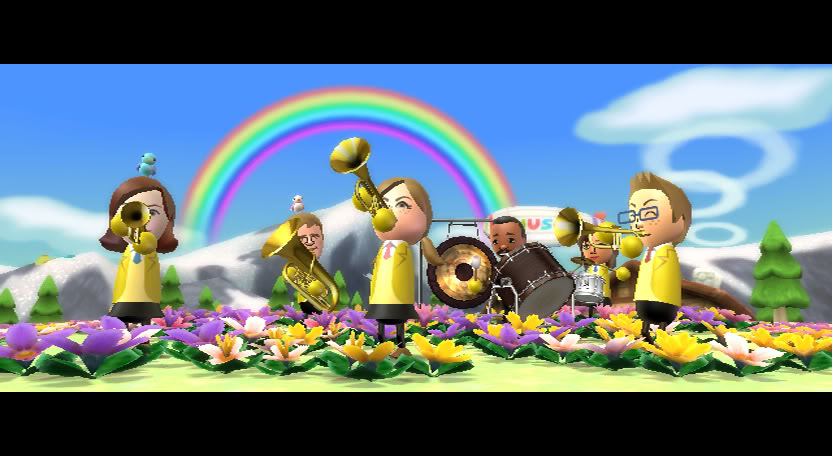
@Matt - I wasn't really that dead set on finding a game she'd love, I was just curious if she could handle the basic controls of Wii Music. She's already shown plenty of interest in video games. She sees me playing Shadow of the Colossus and she climbs up on the bed, lays down on her belly, and watches intently. She takes the DS and PSP out of my hands and fumbles around playing whatever is on there for a really long time until I get worried about her deleting a save or something and take it back and start her a new game.
The premise of the article being about "finding the perfect first game" was more just because every gamer seems to want that. It was really more about me figuring out if she could get into Wii Music much deeper than the other games she's trying to play.
@Harold - I've been meaning to get on the Katamari train forever. Maybe I should pick that up.
@Rob - Very true, but those games weren't designed specifically for little kids, they just had simple enough controls for you because all games did back then. V.Smile Baby is made with kids 1-3 or so in mind, and she still didn't give a crap about it.
I have recently (over the past six months) been getting my five year old daughter involved in gaming. She started out with nickelodeon online games and I have now been getting her into more traditional games. We started out with th co-star mode of Super Mario Galaxy. She absolutely loved this to begin with, but now wants to try it out for herself. Her motor skills are not advanced enough for her to perform well, but she has an absolute blast even in her failure. I now am constantly bombarded with requests to skip nap time to play Super Mario. Just this past weekend we started playing Beautiful Katamari. This is an excellent game for her as it is quirky enough to make her want to keep going even though she doesn't get anywhere near the goal of a level. She will just laugh at all of the crazy stuff she or I pick up while playing. Don't shy away from trying the games on nickjr.com, as the subject matter will more than likely keep kids interested, while developing her motor skills for gaming when she gets older. These games are also nice as they don't give the sense of failure that many traditional games can often lead to.
My youngest showed an interest in games before he could walk. I was "playing" Nintendogs and he kept tapping away with his finger to get the dog to put her paws up on the screen. It took awhile but I finally got him to use the stylus and he was interacting with the virtual dog nicely.
Now he's almost 6 and he really enjoys PBSkids.org and NickJr.com. But byfar the game that gets the most attention is LittleBigPlanet. Him and his older brother can't get enough of that game.
There's nothing I can really think of that's two-year-old centric besides education games, but they got to start somewhere.
I'm assuming that all the dads here already do it, but it needs to be mentioned:
1) Invite them to your excitement and enjoyment by setting an example, enjoying while you play. You may know how weird it is to watch people on TV shows or commercials play games, because they seem *too* exuberant. But why? Maybe it's because of a habit of internally *feeling* excitement without actually letting it all out? It's possible, consider taping yourself while you play your favorite games, even classics from your youth, and see how excited you look.
It's likely that Alex's daughter prefers to watch her dad play because he is encouraged to be so active (with Wii Music), that there's so many invitations to really go over the top to entertain the child. Alex might even get an even better response from really getting into Smooth Moves (which I think of as the Shrek or the better Pixar films of games, something for everyone).
2) Encourage children when they do what you want them to do (whether or not you punish them for the converse is outside the scope of this topic, and I don't want to entertain the notion of parents punishing children for not playing video games (unless maybe as some kind of reverse psychology thing, but still twisted)). It's mean to liken this process to animal training, but humans are animals, so get over it. You might feel dirty if you consider it manipulation, but I get the feeling you'll only want that ability once it's no longer appropriate: when your children get to a rebellious age.
Anyway, don't wait for your child to play a game and try to think and feel through the experience on their own, and you don't have to wait for your child to play a game "right" or earn a score or whatever before you celebrate them. Focus, at least at first, on the simple participation in the activity, having hands on controllers, that sort of thing. You might even try to "patronize" them asking them how they did some thing in a game so they can explain it to you (personally I'd rather be patronized than quizzed), but you might even be fortunate enough to witness your child actually do something you haven't done yourself or known was possible; regardless whenever you get the chance you need to reinforce their interest in the activity by actually expressing interest in your child while they do the activity. Don't worry, you only need to keep it up until you see them taking initiative or palling together with other (hopefully good) kids who are also into video games.
Even if in reality children are too young to appreciate anything about gaming, even with research suggesting that the growth of neural connections is most rapid in those earliest years and probably most conducive to learning, then at least you've practiced what to do when your kid *is* ready, or even better, when your kid *is* ready, even if you don't know it, they'll already be picking up the right cues from you!
(Side note: if you feel your kids are getting frustrated by a game thing, remember that a little goes a long way; nudge them/clue them into one or more solutions and see where they go from there; probably not a very good idea to encourage frustration, unless you know what you're doing regarding the teaching of persistence or something).
3) Finally, as a more advanced process, combine 1 and 2 and focus on "teaching", "mentoring" your child. Possibly the most vital thing to teach when it comes to approaching games is a sense of fantasy, a sense of reality too, and an appreciation for the freedom to experiment in games that is not the case in real life. Even more than accomplishing a goal, it's the sense of curiosity to find out what something does in a game, or anything else for that matter.
In this regard, consider peripheral activities that have some conceptual relation to gaming: navigating kid-friendly websites, Legos/Duplos, arts and crafts, taking things apart and putting them back together (kid-safe materials please). Even reading to your kids (or better, making up stories for your kids, or at least openly exploring other things their favorite characters could be doing), coupled with having them tell you stories, real or fiction doesn't matter, then asking questions to consider the possibilities, these all have familiar aspects to gaming, and gaming also reflects back on them.
Most of all, don't be freaked out if you think of raising your kids like figuring out a video game. Just remember to focus more on the discovery and constantly rethinking strategies and tactics instead of merely the flag at the end of each level, or the points you earn. If you do it right, your kids might end up thinking about you in the same fun but challenging way. Nothing wrong approaching the philosophy of life as a video game, so long as there's a healthy dose of practical reality.