
Manual transmission: Why I still want instruction booklets

230340423
Friday, March 25, 2011

Did you know Bowser, King of the Koopas, is actually an evil sorceror?

It's true. At least, it's true according to the original instruction manual for Super Mario Bros. on the NES.

Earlier this week, EA Sports announced that it would no longer ship paper manuals with its games, furnishing digital copies in-game instead. Reasons for doing so include making packaging more environmentally friendly as well as saving on printing costs.

Those are logical, understandable points. But you know what? I don't give a crap. I want my paper manuals. Because they proved that, even in a bottom-line industry like gaming, publishers cared (at least a little) about showing off the creativity of the people who made the game.

Now? I'm not so sure.


Back in the day, games were so simple that the instruction manual was the only way to get across the story. And did they ever. The aforementioned booklet for Super Mario Bros. informed you that you weren't just crushing bricks and stomping turtles for fun -- those bricks were actually transformed Mushroom Kingdom citizens! So every time Mario punches a block, that's an innocent Toadling he's killing? Reading the manual gave gameplay an entirely different flavor.
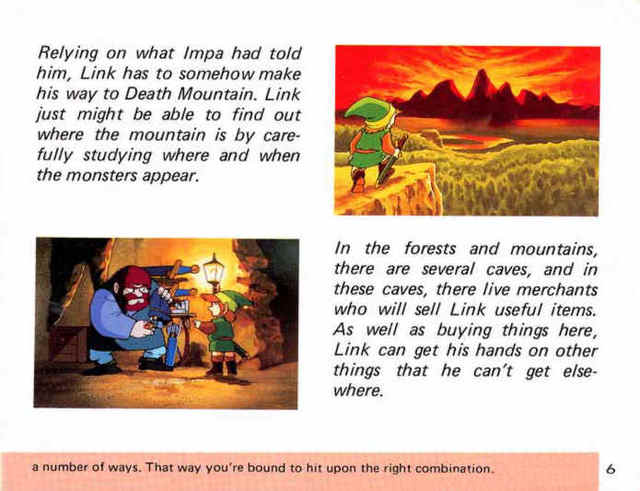
The Legend of Zelda

The Legend of Zelda's manual went even further -- it included cartoon drawings that gave a whole new perspective to the top-down, pixelated action on the screen. Along the way, the booklet gave hints and tips that were a lot more helpful than "It's dangerous to go alone." As I read, I could sense the feelings and artistic motifs the developers were trying to convey. I don't think I'd have gotten that picture so clearly without those few simple pages.

The SNES version of Earthbound didn't just have a manual; it came with an entire strategy guide, chock-full of adorable artwork and background detail. In fact, the book read like a tourist brochure, highlighting all the areas you'd pass through in the game as if you were just seeing the sights. I can't imagine any company providing something so charming these days.

I also remember the booklet for Final Fantasy 6 (then called 3) on SNES, specifically because of its artwork. FF3 used super-deformed sprites for its characters, so you never really got a sense of what they looked like, aside from a small portrait in the menu screen. But the FF6 manual included the full concept drawings for each party member, so you could see how the artists envisioned them before transferring that vision to pixelated form. (This was how I first discovered the work of Japanese artist Yoshitaka Amano, whose manga and anime I came to enjoy later in life.)

These constructions of paper and staples gave depth and color to the games they described. They conveyed creativity in ways the titles themselves could not.

These days, things are different. We have tutorials to teach us how to play. We have vast compendiums of backstory and lore that we can access on the fly (see also: Final Fantasy 13). And games don't have to rely on -- indeed, they shouldn't rely on -- the written word to get the story across. Advanced graphics and gameplay help to do that already.

Plus, you'll find a lot of that concept art and background detail in the strategy guides that companies like Prima and Brady Games pump out. Why bother packing a high-quality item like that Earthbound book in with the game when you can sell it later for 20 bucks?

So I understand why instruction manuals are going extinct. But I never saw them as mere objects that taught me which button to press. I saw them as another part of each game -- another avenue of creative expression for the developers to explore.

And if that avenue closes in the name of saving a few bucks, or even saving the planet, I for one will be disappointed.

 
Problem? Report this post
LAYTON SHUMWAY'S SPONSOR
Comments (13)
Image
March 25, 2011

I actually disagree with you. I think that a game should present itself in such a way that I shouldn't need a manually to figure out how to play or to figure out the story. Both of those things should be wrapped up in the game itself. While they added something to games of 20 years ago, I think they are an obsolete construct that long since should have been done away with.

Default_picture
March 25, 2011

I haven't read a manual in 4 years...and I can't remember the last game that I bought having anything meaningful in the manual anyway, well other than button layouts. Besides, most games have built in tutorials that walk player through the control scheme. Story based additions can be handled like Halo Reach, a seperate book in a upgraded edition. Based on those three things, I say they are not needed. 

Bithead
March 25, 2011

Layton, I'm with you, man.  Oddly enough, a buddy of mine was going through his closet and stumbled upon an old SMB NES instruction manual, the very same one you scanned and quoted from above.  I'd never seen it before.  Reading it was like some window into a crazy alternate dimension where Super Mario Bros was actually this vast, epic experience (not that it isn't....  but the story has always seemed pretty light). 

At the very least, manuals are historical documents.  Even if they don't "help" you all that much, they're a fascinating glimpse of how makers view their games, or how they wish to present them to the players.  The inevitable death of game manuals saddens me.  I loved to read lyrics and look at the photos and art of my favorite bands in the CD liner notes.  Now that many have become digital files?  I can't remember the last time I actually saw what those e-booklets had inside, interactive or otherwise. 

And don't forget StarTropics, perhaps one of the greatest game manual tricks ever...  "Dip it in water?  Say what?"  Can't do that with an in-game tutorial.

Chas_profile
March 25, 2011

Actually, when Nintendo ported StarTropics to Virtual Console, they did just that...and it was totally lame. You watched an animation of dipping the manual in water.

230340423
March 25, 2011

I get Nick's point completely, and these days it's true -- game narratives should stand entirely on their own merits, with no outside explication. That wasn't always possible in 1986, but it's required today. (I said as much in the article.) What I'm talking about is the added value, the extra format to showcase a game's creativity. That used to come standard. Now it requires an upgraded edition, like Joshua mentioned, or an aftermarket strategy guide. 

I know I'm old-school, and I also work for a print publication as a day job, so I have perhaps a biased opinion of physical media. Ah well. :)

New_hair_029
March 25, 2011

I love manuals too. But like you Layton, I'm probably biased- my family business is manufacturing custom looseleaf binders. In fact I rivted a bunch of them today so print can't be completely dead yet :D. 

Default_picture
March 25, 2011

when things get over saturated, they'll be gone.... then when they're gone, they'll come back as hot

Scott_pilgrim_avatar
March 25, 2011

I will also miss the manuals. In fact, I was thinking about writing my own post on their value. I'm currently studying literacy resources and sponsors and, looking back, see video game manuals (particularly the one for the original Legend of Zelda) as very influential resources to my own budding literacy. Wanting to tell stories that were (to my 6-year old mind) as good as Zelda's is the reason English would be my favorite subject in school, why I would read books for fun, study literature in college, and teach college English.

Further, I became a sponsor of my younger brother's literacy when (as a kid who hated to read) I wouldn't let him play one of my games until he'd read the manual and could pass a verbal quiz I would give him.

Layton's right; it's not that good manuals made their games make sense, but they enabled us to enjoy them in different ways--from me studying their storytelling techniques to serving as challenges to my brother's desire to play.

Default_picture
March 26, 2011

I have been wanting to write something about this even before the EA thing. Manuals just aren't what they used to be. At least, most of them aren't. I think this post has me motivated enough to write my piece! Man did I love reading through Zelda manuals!

Sany0276__small_
March 26, 2011

One of the major downsides I see to not only getting rid of manuals but the shoddy quality of them is for myself  perceived value. With the advent of mass market downloads of games, sometimes at a cheaper price than retail boxed copies, what am I paying for in the store? My download can't be scratched, get lost or stolen, or even ate by the dog. My retail copy takes up space and has to be stored when obsolete. The only quality I can find personally in store bought games are the packaging and books, such as most of Working Designs games. Sadly that is a time long past. 

Lolface
March 27, 2011

Ironically, the first time I've had to look at a manual in the past few years was because of an EA game. In Dragon Age II (published by EA), they don't tell you what the dialogue icons mean in game, so I had to read the manual to know that a star icon meant that I got a special option because of a previous conversation, or that a purple diamond meant that I would be charming.

Wile-e-coyote-5000806
March 28, 2011

I think EA's choice makes sense, but I too will miss instruction books.  If for no other reason than I usually read through the instruction book before I get time to play the game, or while it is installing and downloading patches.  Hopefully they will still have the instruction book in a virtual form -- in-game or a .pdf online -- or have more complete information in the menus for reasons like Matthew said.  Sometimes the game itself leaves out infromation.

New_hair_029
March 28, 2011

When I first picked up my copy of Dragon Age 2, my boyfriend and I went to a Chinese Restaurant before heading home to play. While waiting for our food we both sat and read the manual. I have to say that was a damn useful manual and I'll miss moments like that.

You must log in to post a comment. Please register if you do not have an account yet.