
Separator

Musings of a Gamer: Gaming History...Is It Necessary?

100_0005
Saturday, February 06, 2010

Editor's note: Mike poses an interesting question: Do you need to know gaming's past to be a real gamer? My appreciation for the early days of film, past eras of music (I'm listening to Benny Goodman's "Memories of You" as I edit this), and older literature certainly enhances my enjoyment of modern works. Does this apply to gaming as well? -Jason


As a historian, I try to know as much about history as I can. As a gaming fan, I want to try to experience as many "legendary" games as possible.

But to be a gamer, is it necessary to have these experiences?
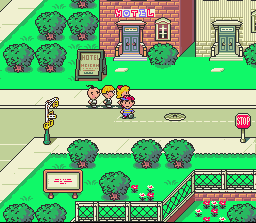
Earthbound

Before you answer, I think it might be safe to assume that the older a person is, the more likely they are to believe that, yes, the golden age of Nintendo is worth visiting. Or the prime of console role-playing games in the late SNES/Early PlayStation days, such as Earthbound, is enough of a reason to look them up.
 

As a 26-year-old, I was around 12 or so when I truly became a hardcore gamer. I think this experience was vital to me continuing to pick up the hobby today. I'm not sure that I could pick up a game today without the prior skill sets I had acquired earlier in life. A kid, however, could probably do so easily. I'm not even sure my actual skill set from the old days transfers over, but I do at least generally know how games work, so that might be a help.

Can you really call yourself a gamer if you've never played Super Mario Bros. 3? How about The Legend of Zelda? I really think that many young gamers today are bored much more easily and are used to an influx of titles coming all the time, so they would not have the patience for a timesink that some of these games create. I love my old games, and I still enjoy them today, but I'm wondering if it's only because I was there at the time.

The lack of effort that has gone into Virtual Console seems to prove this point. Nintendo and company have a huge backlog of excellent titles they could release, but licensing issues and general lack of interest seem to be holding everybody back. I used to look forward to Monday because new Virtual Console games would come out, but it's been awhile since I've seen anything worth spending my money on.

So, people: Do you think that you can call yourself a gamer if you've never indulged in the gaming past? Can you be comfortable with the future if you don't know where you've come from?

 
Problem? Report this post
BITMOB'S SPONSOR
Adsense-placeholder
Comments (40)
Img_20100902_162803
January 29, 2010
I imagine a video game history course will be based between periods and genres, say the stealth games of the Xbox and ps2 era. Play and review.
Lance_darnell
January 29, 2010
I put a lot of thought into this, and from what I gather : If a gamer who is 15 asked me if they should play all the old games, I wouldn't be able to say YES without saying, some of them are not that good. I think the only reason someone should have to go back and play all of those old games is purely for historical reasons. If they have no historical interest it could just be painful.
100_0005
January 30, 2010
@Lance: What about the gems of the old days? There's lots of crappy games out there from the old days, but I wonder if Zelda and Mario still hold up to this young generation
Lance_darnell
January 30, 2010
@Mike - I actually did not mention them for it kills my point! I was just thinking that there are a lot of people who love film, but have never watched anything before the Godfather or Clockwork Orange. In the same vein, there are many gamers who never played anything made before the time they started gaming, but are still really into games. I think in both film and video games only a certain type of "fan" would go the distance to start checking out the history of the media they love. And I think the majority of people on Bitmob are that type. Oh, shit, I think I just reversed my point! Nix everything I have ever wrote!
Jason_wilson
January 31, 2010
It's not necessary to know gaming history in order to get into the hobby -- but I feel it makes it more enjoyable and adds an appreciation for the medium. I know a knowledge of baseball's history makes that sport much more enjoyable.
Default_picture
January 31, 2010
[quote]As a historian, I try to know as much about history as I can. As a gaming fan, I want to try to experience as many "legendary" games as possible.[/quote] I feel the exact same way! (probably because I was a history major). But to answer your question, I agree with Lance's point. I don't think you necessarily have to play titles before your time to be a gamer, but I think it's important for people who cover the industry to know it's history pretty well. I mean, I guess that's not a requirement for everyone, but it's nice to have a few people who can compare a NES or Atari 2600 title to a game of the 64-bit era. Oh, and as for whether or not Mario and Zelda hold up, my lil bro who started gaming during the 32 and 64-bit era loves the original Zelda. He's not as keen on 2D Mario games, but to him, the original Zelda is an excellent game. Nice topic, Mike.
Default_picture
February 05, 2010
I am a bit supporter for knowing the past before you can appreciate the future. There are reasons people are required to watch Orwell and Kubrick films before they are film majors. I get kind of pained when I hear people who consider themselves big gamers saying how they won't buy Sonic's Ultimate Genesis Collection because they can't go back to games of that age. For one thing it makes me feel old, and I am not even near 30. For another, a good game is still a good game despite the limitations of the time. Not only are they damned fun, they are important! Let me ask you this. What if the only Miyamoto developed title you ever played was Nintendogs? Why should you care about Nintendo? (A question that is getting harder and harder to answer, I am afraid)
Christian_profile_pic
February 05, 2010
Necessary to enjoy games? Not at all. Necessary to understand them and truly appreciate them as a medium? Absolutely. In the same way it is with music, film, literature, art, etc.
Default_picture
February 05, 2010
As a gamer? No, of course not. People start playing games, watching movies and TV or following sports with no understanding or knowledge of their histories. Games are no different. But if you want to speak intelligently about them, then some sort of history is important. How far back that history should go is debatable. (A good friend is a huge film nerd - he probably sees three movies a week of all types - but admits that he has a huge gap before 1950.)
Default_picture
February 05, 2010
I think Edge Magazine had it right when they recognized, in E200's Top 200 Games of All Time issue, that very few "retro" games hold up over time (Super Mario Bros. 3 was perhaps their only top game from the pre-16 bit era). Should gaming history be preserved? Absolutely. Are old games worth playing? Not always.
Img_0183
February 05, 2010
We don't [i]need[/i] our past as gamers, anymore than we need to know the [url=http://video.google.com/videoplay?docid=4186437927867084105&ei;=fN9tS5TsJZTErAOCpKm_Bg&q;=Connections+video&hl;=en#]history of scientific development[/url]. That doesn't make the history of video games any less interesting, or less fascinating, by allowing us, as gamers, to see the path that took us from Contra to Gears of War. Further, by knowing how video games got to where they are today, we in turn get to learn something about the games we play, and get a better appreciation of them.
Default_picture
February 05, 2010
I think gaming is at the end of the day an individual experience. Personally, I think knowing gaming history is an option that is out there for gamers who want to do so, but certainly not necessary for an "enhanced appreciation" of gaming today. PS: Pet peeve; game reviews/articles that [i]constantly[/i] namedrop old/obscure games as reference/comparisons. It's like saying, "If you don't know these games, shame on you!"
Default_picture
February 05, 2010
I think anyone who has a genuine interest in a medium, any medium, should take time to learn its past. Perspective is never a bad thing, and I wouldn't consider anyone whose experience extends only a few years to be properly informed on the subject. Not that everyone needs to be 'properly informed'; there's nothing wrong with simply consuming the products of a medium.
Me
February 05, 2010
I think you can be a gamer and not know the history of video games. If a person has fun playing games, then that's all that really matters. But I can't say enough how important it is to know the history of video games, because who you are is the sum total of your history. How far back you take that history - how much of your own identity you claim - is up to you.
Default_picture
February 05, 2010
I have to take another stab at this... I think video game history is essential to heavily appreciate the medium; but it is not necassary to enjoy it, of course. If I were to review a game like Demon's Souls I would name drop King's Field or Wizardry and if my audience has no idea what I am talking about...Well, Wikipedia is thadda' way. On the other hand, I am writing for those who are like minded and of course am not getting paid for my valiant efforts. Our game journalist overseers do not usually have the same luxury, unfortunately. I think a hardcore gamer can enjoy Demon's Souls without ever playing King's Field, but they may not appreciate all the clever changes as much as I would. Same goes for Batman: Arkham Asylum. If you don't know the history of superhero games, or even of Batman games, you might not understand why game reviewers are offering up their first born to the team at Rocksteady. Obviously it is a great game, but seeing where many people got it wrong is a good way to see how these guys got it right. Plus, you can't have taste without knowledge. Everyone wants to have taste, right?
Mikeshadesbitmob0611
February 05, 2010
You can play Peggle, and have no idea that any games existed before that, and be a gamer. You can have an encyclopedic knowledge of the industry, its history and key players, and be a gamer. There are no prerequisites, and you can enjoy what you do regardless of how much time you put into it. I think that the people who suggest that you HAVE to have a knowledge of the history of a medium to truly appreciate it are delving dangerously close to elitism. Sorry if that points to anybody here. There's just a tendency for people who put a lot of time into something to demand some kind of recognition and status for their effort. Usually, that involves taking what they've done and deciding it's a requirement. Play games and enjoy them. Who cares if someone doesn't "understand" as much as you do?
Default_picture
February 06, 2010
@Michael That all depends on what you consider a gamer to be. It is not like there is some definition in the dictionary with my picture next to it (Aw snap!). Let me put it this way...You own five DVD's, your favorite film of all time is Avatar. Are you a film buff? I mean, a gamer tends to mean a person who generally plays videogames in their downtime. Someone like me and most of the uders of this site would probably be described as "hardcore" gamers. As much as I hate the term, it probably works best. Can you be a "hardcore" gamer if you just play Peggle? Answer is probably no. Are you a "hardcore" gamer if you play six hours a day, but the only game you play is Madden? Most would agree you are not. There are clearly different levels of what a gamer is. If someone claims they are a hardcore gamer because they smell terribly and have only played World of Warcraft I would beg to differ. Socking poop does not a hardcore gamer make. I don't think you HAVE to have knowledge of videogame history in order to enjoy or appreciate the medium, but to TRULY appreciate it...That is a different matter. There are different levels of appreciation -- ANYBODY can pick up New Super Mario Bros and play it, enjoying it and having fun. Games are fun, after all. If you want to appreciate a game on a deeper more "literary" level, you need to go home and bone up on Pitfall for the 2600, fool. You may think I am an elitist, and I probably AM an elitist, but understanding the past to appreciate and comprehend the present is the norm for lots of genres; books, film, music, whatever you like. I don't believe games are any different.
Pshades-s
February 06, 2010
The "classic movie" analogy doesn't work in this case because video games are harder to revist than films. Anyone with a Netflix account can easily queue up a bunch of respected films and burn through them in a weekend. Just getting your hands on any ONE of the NES classics is a bit of a hassle, to say nothing of the time required to actually play the damn game. This is a problem I've encountered lately as there are an increasing number of influential/revered games that [url=http://bitmob.com/index.php/mobfeed/never-been-played.html]I never played[/url]. While some of these are much easier to find and play than an old 8-bit game, the matter of finding time to play them is still a dealbreaker. So there cannot be any prerequisite video games like there are films, but those with the means and the interest should be encouraged to look back and learn what once was. And the flip side of that means more games from the past need to be made accessible.
Mikeshadesbitmob0611
February 06, 2010
@Alex, you just contradicted yourself. You say there's no definition of what a gamer really is... then you talk about "what being a gamer tends to mean"? You can't have it both ways. And no, there aren't levels. Those are just monikers people make up to better categorize themselves, usually based on a subconscious need to elevate themselves above other people who do what they do. I play games. I'm a gamer. I'm not "more" of a gamer than anybody else, and any adjective you put in front of "gamer" isn't going to change the fact that I love games. You have to have knowledge to truly appreciate it? Really? So the kid with terminal cancer who gets a DS and plays his first game as a reprieve from the pain truly doesn't appreciate it as much as you, just because he doesn't have the "literary" knowledge you do? Your move.
Default_picture
February 06, 2010
You're not a true gamer if you haven't played Combat in the Atari and Sea Battle in Intellivision.
Franksmall
February 06, 2010
I just wish more gamers would be inviting to anyone who wanted to game for fun. All of these people who want to act elitest seem to want to scare off more casual gamers by treating them like they are nit *real* gamers. I find it kind of pathetic actually. I prefer my gaming inclusive. Sure, it may help to understand gamings past, but it is not at all a requirement. I think all you need to do to be a gamer is *gasp* play games.
Mikeshadesbitmob0611
February 06, 2010
@Frank, that's exactly what I'm trying to say. Thanks.
Default_picture
February 06, 2010
I agree that you don't have to know the history of games to be a gamer, but I also agree that you will get more enjoyment out of the medium by knowing the history. From what I've heard about Bayonetta, there are a lot of allusions to other, older games in that game. Being able to compare games lets you appreciate them more. I really enjoyed Darksiders because it was not only reminiscent of The Legend of Zelda, but the Soul Reaver series as well. I was able to appreciate the design elements that improved on both of those series. The skills do transfer from one console generation to the next. I can sit down with a game and recognize the tropes and cliches involved, and my wife will watch and be like, "How did you know to do that?" I respond by saying that it's because I'm gaming literate.
Default_picture
February 06, 2010
@Michael Wow. This isn't a war of attrition. Calm down. Let me explain something to you. When I say there is not a dictionary definition of gamer, there is not. Obviously. What do you want me to say? Some people play games, others actively read about them in their off time and research them and play them and love the medium enough to waste hours talking and writing about them without getting paid. People tend to give themselves monikers, and I dislike doing so but I am not going to make them go away by ignoring that they exist. Millions of people play video games, not all of them have an active book collection which detail the history of them. Unless you are what many call a "hardcore gamer", you are not going to 'get' Retro Game Challenge for the DS. Most people must not be hardcore gamers, because that game sold like shit (but then again piracy is fucking RAMPANT on that system). Also, just because something is difficult to obtain does that mean it is any less significant? There are prints of old films that have not been transferred to DVD -- and may never be -- they are still considered important parts of film history. Does that make the whole subject of film history invalid? It's really hard to find a copy of Ico nowadays. Just because people can't play it does that not mean learning about the game isn't beneficial? Especially if you want to look at how emotion is created through the medium of games? I am not arguing against being inclusive with gaming. Peggle is fucking brilliant on a lot of levels. The art is a goddamn eyesore, but actually playing the game is rock solid! Madden is more complex and in depth than I could possibly figure out in a year, but a lot of so-called 'casual' gamers play it! I make the argument that the reason I don't play MMO's is because I want to play everything else. It's true! I think those games have value, and I want to KNOW about them. They are just way too time consuming with too little pay-off (at least in my case). Calm down and listen. I am not saying people who have only played Tetris or Family Game Challenge are not gamers to some degree, I am just arguing that there are different LEVELS of enjoyment. You can't deny that someone who has played very few games will see a title like Bayonetta differently from someone who has no idea who the developer is. Gaming history is important, and if it causes some aspects of videogames to be exclusive to those who wish to learn it, so be it. I love that different people are getting into videogames! I think it is awesome. I just think that degrading the medium by saying that they are only as useful as a "Haha! This is fun!" device isn't fair, especially if you look at how things have evolved over the past thirty five years or so.
Mikeshadesbitmob0611
February 06, 2010
Who says I'm angry? We're debating. That's why I let you take your turn. It's not a big deal. I found numerous holes in your logic, and I found that I disagree with every single thing you've said. So, I decided to say as much. Even after all of that, I still don't agree with you at all. However, you're beginning to take it personally, so this is where we get off.
Default_picture
February 06, 2010
The argument of who is "real" or "hardcore" or whatever is artificial and only exists because of the Internet and forums and people's inherent "my dad can beat up your dad" silliness. That said, I think there is something to be said for knowing what came before, no matter what your field of interest is. If you're a big music fan who thinks that The Sword invented heavy metal, you're sort of missing the point if you don't take the time to go and listen to some Black Sabbath. Same thing goes for games, but I'll also be the first to admit that a lot of the old games don't hold up nearly as well as other forms of entertainment. I can easily sit through Raiders Of The Lost Ark any day, but damned if I can play Yar's Revenge for longer than 5 minutes without getting bored.
37425_412468101714_719286714_4780931_4814727_n
February 06, 2010
I believe a word several of you have been reaching for is enthusiast. Also, this thread is one of the reasons I love Bitmob. You guys have managed to have a heated debate without a single immature personal insult.
Mikeshadesbitmob0611
February 06, 2010
@Derek, that's perfect. I hate labels, but yeah, I guess I would consider myself an enthusiast. It's a lot better than calling myself "hardcore", which honestly never sounded good to me. Also, I like to stick to mature personal insults. Ad hominem ftw.
100_0005
February 06, 2010
Reading everybody's comments, it is interesting to see that a lot of you don't think that history is necessary, but that it is recommended. The point that I was really interested in making is that those games are industry standards, and developers use them as examples of how to make a strong experience. I was never trying to say that young gamers who have never played those games can't consider themselves real gamers, only that I think a lot of enthusiast gamers should probably give them a look and see where the roots of gaming are. As always, I'm glad to see a lively discussion here!
Default_picture
February 06, 2010
Default_picture
February 06, 2010
While it's not required, playing older games helps you appreciate newer ones. Of course, anyone with enough interest will look into the classics on their own. I don't really watch old movies, but it hasn't stopped me from enjoying new ones. It could have more to do with the games being from [i]our [/i]past, rather than the historical past. Plenty of people today are growing up with current consoles, but they are still playing simplistic 2D quickie-games in the form of Flash games on sites like Kongregate. Lots of these games are on the same level technologically, so it could be said that they make a fine substitute.
Default_picture
February 06, 2010
I think it is important to have some historical knowledge to help you but the present into context. What's the big deal about Final Fantasy? What's the big deal about Mario and Crash Bandicoot? Why is the Dreamcast, a console that failed, so fondly looked upon by some gamers? It's useful to know why certain developers and publishers are important and famous in the medium. It doesn't make you less of a gamer for not knowing. How your peers see you when you don't know much about older games compared to them is a different story.
Default_picture
February 06, 2010
I don't know if going back to play games before a person's "video game era" would work for most people, but it certainly works for me! I just started playing System Shock (One) for the first time, and I'm hooked!
Default_picture
February 06, 2010
Until the video game experience can be dissected in a random access manner, where an academic can refer to an exact point within a game that can be highlighted as a milestone of some kind and then presented for live play, for the purposes of analysis, peer review, and presentation to students, a history of video games will be awkwardly crippled, with the bulk of discussion occurring around secondary sources (accounts of players) instead of the source material themselves. In this latter regard, video game history would be much worse off than, say, an art history class focusing on statuary and architecture, where students would typically have to make do with 2D photos limited to the photographer's perspective and context, or models that give up some contextual detail that informs the piece. With current video game design and programming, students wouldn't even get as much of a chance to get a wide and deep exposure, with the typical presentation being of video of someone else playing, hiding away much of the interactive component and what such says about the nature of the game as medium. It might be more appropriate at this time to push for the inclusion of video game studies within the contexts of the borrowed media that a game uses: highlights in narrative within a game as part of a literature class, cinematic presentation part of cinema history class, music composition, graphic design and architecture, object-oriented programming. Even then, the story-related study still runs into the problem of being hard to access directly and randomly. Video games have yet to be consciously designed to have the "flippability" of books and their pages or the cel/timecode references of film. Even dance choreography has a language that specifies its complex form in an accessible format. Save games, save anywhere, replayable mission menus, and mini/small games like flash-based are probably the closest we get at the moment to random access to a game's content, but that still usually means installing games or getting access to a console, especially an ancient one. Even with emulators the study of even older games runs into the problem of legal availability of material. I'm not saying that video game history as a field would be impossible, but I think some serious limitations need to be addressed first by designers designing for a historical context, or pioneers will need to come up with new tools, or the concept of historical study needs to be reconceptualized to fit the shape of the video game medium. And to prove that I'm into the idea of a field of video game history, my main draw to the idea comes from the hope that having a formal structure, one that helps to inform a wider audience of potential future creators of what has come before and how all those fit into their cultural contexts, will spur the development of increasingly more sophisticated products that aspire for true novelty and innovation instead of rehashing more of the same. And that goes for narrative, cinematic presentation, soundtrack, graphical composition, level architecture, game objects and characters as sculpture, as well as the core game mechanics.
Default_picture
February 06, 2010
You've addressed a nice topic that doesn't get much attention, and I've got a good deal more to respond with (which is a compliment to your finding a good topic), but I'll limit myself to only a couple more bits. A related problem to not having easy random access to game content is that many games are large and/or long, with branching narrative, or large play areas, or spatially complex levels, etc. The real issue though is that many games tend for a minimum 10 hours of play, and anything shorter tends to be ignored for not being a "serious" game, or a bad deal. Of course there are plenty of flash games and puzzle games that don't suffer from this, but unless these larger games can be chunked more appropriately for study, or a critical language developed to at least identify specific moments or sections of a project, discussion will tend to be ambiguous and imprecise. Personally, I also want to get better chunking in games so I can more easily replay just the parts I jived with the most, without having to jump through some hoops for only a couple minutes of replay. ==== Perhaps another way of looking at video games would be as locations with their own events, but I doubt discussing the internal history of a game's content is anywhere near as useful as discussing the game's context in the larger scheme of video game or general history. But, what if one treats each game as a location in the landscape of video games, then approach the field of video game history as serious tourists and tourism promoters? I suppose that's a workable objection to my complaint that referencing specific video game content is currently limited--it may simply be enough to build a timeline and causal chart that puts games in chronological and cause-effect contexts, then focus on a particular lineage until the field assumes a critical mass of academics that can sustain the analytical techniques for passing down onto later and larger generations of video game history students.
Default_picture
February 06, 2010
We are not interested in videogame history because it is easy, but because it is hard. In many ways, a game must be experienced in order to truly know it, but that does not stop us from defining games into genres or posting screenshots and videos in order to get the idea of them across to people. As I said previously, I think denying that games can be enjoyed on both a casual and an "enthusiast" (probably the best word to adopt, though I had previously used hardcore as it is used more often) level is false and degrading for the genre. For some reason, a few people were bothered that there ARE multiple levels of enjoying videogames, and I am simply arguing that an enthusiast will enjoy a game on a different level than a casual player -- whether they enjoy it more or even less is up to debate.
Fitocrop
February 08, 2010
Wow, this got pretty intense; I hate myself for being so late to the party, but hey, "Better late than never" they say. I really [i]have[/i] to agree with Daniel [Feit]: The game-movies analogy doesn't not work this time around. Time-wise, it's way easier to play catch-up with the history of cinema than with the history of video games. You can make the difficulties of finding old material aside and the time issue will remain no matter what. Now, Is knowledge of game history necessary to truly enjoy [i]playing[/i] video games? Absolutely not; hands on knowledge of video games' past might amplify an inviduals apreciation for the current geneation of games, but the lack of it won't make that apreciation dissapear. Knowledge of game-history, however, [i]is [/i] of crucial importance for those who seek to design video games or profesionally criticize them. This is where the argument made by Jeff [Parsons] comes in: If a rock-music critic proclaimed that The Sword -- most metal name I've hear in a while by the way -- invented metal, he'd be missing the point.
Default_picture
February 08, 2010
[quote]Now, Is knowledge of game history necessary to truly enjoy playing video games? Absolutely not; hands on knowledge of video games' past might amplify an inviduals apreciation for the current geneation of games, but the lack of it won't make that apreciation dissapear.[/quote] I totally agree! That has basically been what I have been trying to express. I had said that there are different kinds of appreciation and different LEVELS of appreciation. Apparently that idea is offensive to some people, though I kind figure out why. Someone who never played Metroid can enjoy Shadow Complex. Of course! It's a fantastic game. Someone who can trace the "genetic code" of Shadow Complex all the way back to the NES will obviously get a different kind of enjoyment out of the game. Or not. Maybe they will appreciate it the same but get a slightly altered viewpoint. My only point is that it DOES MATTER. I think a knowledge of the history of videogames CAN help you play and enjoy games that someone whose first console was a PS2 might not be able to appreciate. I just spent the last half hour playing [i]Gateway to Apshai[/i] on my Colecovision. I was honestly having a great time trying to work my way through the dungeons with the manual open on my lap so I have the controls handy. Would someone who had their first RPG experience be Final Fantasy X like this game? Or even see the point of playing it? My guess would probably be negative. I don't think I would enjoy the REALLY old games either if I didn't understand the history of the industry. On the other hand, Gateway to Apshai was pretty awesome so I perhaps should play Hydlide and see if it holds up. I'm kidding. Hydlide NEVER held up.
Fitocrop
February 08, 2010
[b]@Alex[/b] I wouldn't know what to say about any of those two games jeje :P my first console was an Atari 2600, but yeah, I'm pretty sure a whole bunch of 2600 games don't hold up today. That's an entirely different subject though -- maybe you can write about it ;) As for the "levels" of apreciation. I'd rather stick with noticing [i]different kinds[/i] of apreciation. The word "level" implies hierarchy, and that's always kind of self-righteous and pretentious; It would be kind of silly for antrophologist to point out the fact that he can enjoy Reality T.V. at a higher level than most people when there's actually not much to apreciate about it -- but hey, that's [i]my kind [/i] of apreciation for that :P
Default_picture
February 08, 2010
Videogames have levels, appreciation has levels. I figured the similarities would be obvious. I'm kidding. Different kinds of appreciation is fine. Whatever. I think it is all semantics really. Well, if you had an Atari 2600, how about Adventure? Many people consider it to be the first console RPG, and playing Adventure is an especially interesting case because of the way RPG's have changed and evolved over the years. When we look at Mass Effect 2, or especially something like Half Minute Hero we can see that developers are taking the RPG conventions and simplifying them to an almost absurd degree in the name of streamlining. In Mass Effect 2's case it was more a situation of making it more accessible and engaging. In Half Minute Hero's case it did it almost as a joke to ape the drudgery of playing old RPG's and turn the genre into what is essentially a detailed puzzle game (or RTS, or shooter, or a few other things). Very interesting. Adventure and Gateway to Apshai or the Intellivision D&D; games hold up because despite their difficulty their complexity is low. With that balance intact that keeps the engaging enough for someone willing to put aside the technical or control limitations. They are still fun, damn it. In many ways, action RPG's owe everything to Adventure for the 2600. It quite honestly started it, at least on the consoles. Very interesting. I think the more people know about this, the more interesting Adventure becomes.

You must log in to post a comment. Please register if you do not have an account yet.