
Separator

The Not-So-Secret History of Video Game Peripherals

Img_20110311_100250
Friday, February 26, 2010

Editor's note: Jeff's history lesson provides a sobering -- and hilarious -- look at the history of gaming peripherals. It's a must-read for anyone excited about Project Natal or Sony's wand controllers. -Brett

It's So Bad!

Maybe you've seen them at your local video game shop: piles of odd looking plug-ins, add-ons, and thingamajiggers in the corner collecting dust, over-excited proclamations screaming from their worn boxes -- "FULL BODY ACTION!" "Everything else is child's play!" "Now nothing comes between you and the game!" 

What are they? Gaming's forgotten history, that's what. A history that could possibly repeat itself with the heaps of futuristic peripherals coming out from Sony, Microsoft, and Nintendo.

Not that I blame them for trying to sell gamers on the future. The positive perception of any video game company is fueled by technophiles in lust. However, if the technophiles would stuff their e-boners back into their file and think back a decade or two, they might remember that while the tech has improved, the promises haven't changed much.

And if they don't remember, I'm here to help: Here are five gaming technologies that were ahead of their time -- and the lessons companies can learn from them today.


XBAND

A lot of younger gamers won't realize it -- and a lot of older gamers probably don't remember it -- but the XBAND modem provided dial-up online gaming for the Super Nintendo and Genesis long before Xbox Live won over the hearts of foul-mouthed prepubescent gamers everywhere.

The XBAND was similar in form to the Game Genie -- you plugged it into the system and then plugged the game into the XBAND -- and the service itself would be familiar to anyone who has taken their Xbox online. Players could house up to four codenames on an XBAND modem cart, and each codename could have up to 10 people on a friends list. Unlike Xbox Live, however, each game had to be reverse engineered to work with XBAND, because support for the peripheral was almost non-existent.

Despite that fact that the system worked rather well with games like Super Mario Kart, most games suffered from lag. Until broadband penetrated the market, there was no way online gaming would be anything other than a niche experience.

What Xbox Live owes XBAND: The importance of each game supporting online and a limited friends list.


U-Force

Sony's demonstration of their new magic wand controllers at last year's E3 was impressive, but it also brought back terrible memories of that NES add-on nightmare known as the U-Force.

The U-Force was an infrared controller that turned the waving of the player's hands into on-screen commands. That's what it was supposed to do, anyway. Instead it became one of the easiest ways to induce gamer rage. 

Sony's wands are using a very different technology, but they're essentially trying to accomplish the same goal -- and that scares me. 

What Sony's wands owe the U-Force: Proof that there should be something to hold when you game.


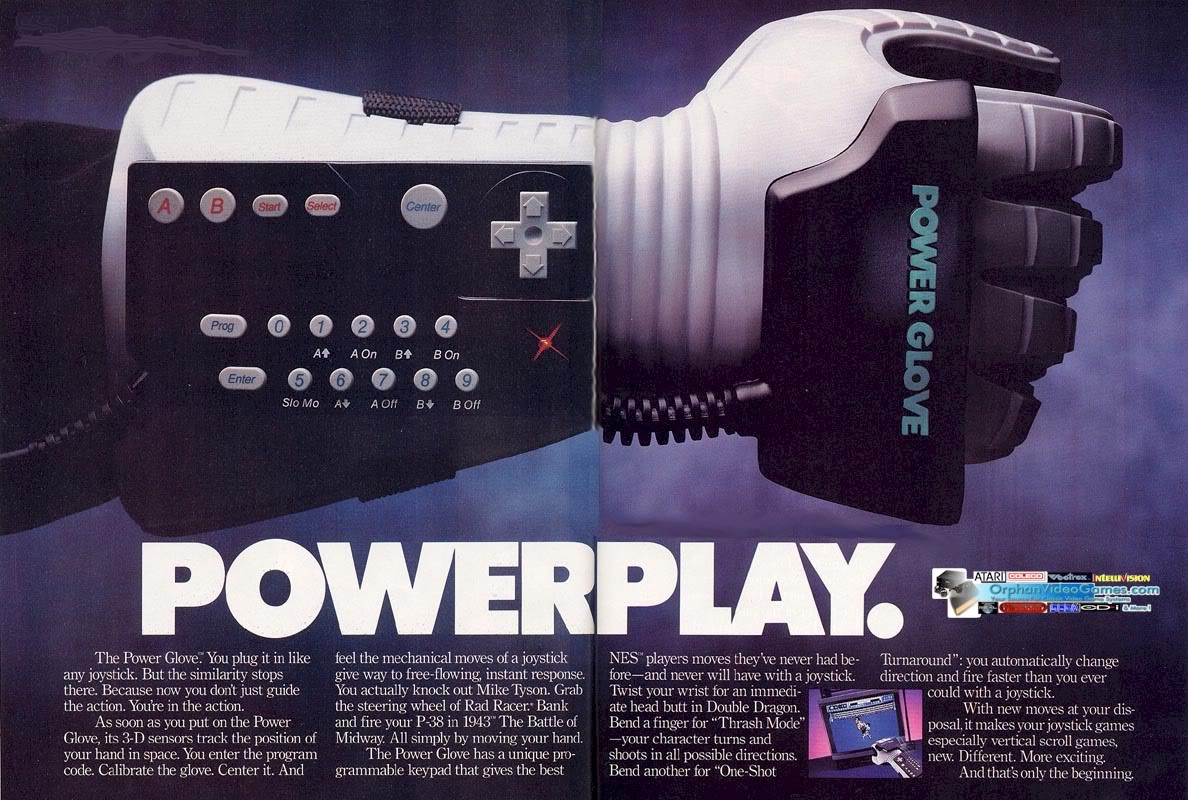
Power Glove

The Power Glove is probably the most famous of these old peripherals, likely because it's "sooo bad." (For the record, that's "so bad" like Lucas from The Wizard would say it, not like everyone who has ever used a Power Glove would say it -- though that definition of "so bad" applies here as well.)

A funny thing about the relationship between the Power Glove and a modern Wii Remote: they're pretty much the inverse of each other. Instead of a motion control device that wraps around our hand, we now have a motion control device that we wrap our hand around. 

Of course, the Wii Remote takes advantage of technological innovations like the accelerometer and the sensor on the television. More importantly, the Wii Remote has gobs of good software built specifically for it. The games built for the Power Glove -- like Super Glove Ball (made by Rare, of all companies!) -- were, in a word, terrible. 

What the Wii Remote owes the Power Glove: The importance of proprietary software and a lot of money spent on research and development.


Sega Activator

"FULL BODY ACTION" is a quote off the box of the Sega Activator peripheral, and I hope that Microsoft adopts it as their slogan for Natal.

Like the U-Force, the Activator was an infrared controller, but this time you stood inside an octagon on the floor that shot infrared beams into the air that you could interrupt with hands, feet, animals, and private parts. These interruptions would be then interpreted as button presses. Essentially, it was supposed to turn sweet real-life air kicks into sweet video game air kicks. 

There's one problem with that idea: it's stupid. The games that the Activator worked best with were still designed for a regular controller, essentially turning the Activator into nothing more than a huge, cumbersome controller laying on the ground. The Activator wasn't really about turning your motions into actions. It was about pressing buttons on a magic, infrared controller with your body. 

Natal fixes that by using a camera, but it doesn't fix the problem that my sweet air kicks don't look sweet to anyone else -- and to be honest, I don't even think they're that sweet. 

What Natal owes the Activator: The important lesson that the body is not a controller.


Power Pad  

It took a long time for video game companies to remember that the Power Pad controller for the NES was actually a success.

The Power Pad was a floor-mat controller that had twelve A and B buttons laid out across it. Nintendo packaged it with World Class Track Meet, which allowed players to mash on those buttons with their feet to complete each mode in the game. It was simple, it was fun, and it worked. 

But after the Power Pad, no company took advantage of the fact that gamers liked jumping around foolishly as long as the foolish jumping around was accurately translated into the game -- until Komani's Dance Dance Revolution took the arcade world by storm.

Konami later moved the DDR dance pad from the arcade and ported to the home in essentially the same form as the Power Pad. Nintendo took notice and transformed the dancing and mashing into the Wii Fit Board. 

What Wii Fit and the DDR dance pad owe the Power Pad: Proof that gamers don't hate body control peripherals. They just hate body control peripherals that don't work.

 
Problem? Report this post
JEFF GRUBB'S SPONSOR
Comments (18)
Default_picture
February 10, 2010
When I was little, I used to have both the Power Pad and World Class Track Meet. I remember being both thrilled and pissed off at the same time because I didn't know how to use it, but shit still happened in-game. Never got my hands on a working Power Glove... Yet.
Default_picture
February 10, 2010
This brings back memories of the good old days of tech that never really worked for gaming. I had the Power Pad and Power Glove in the past. The Power Pad was fun for 5 minutes until I got tired of running in place so I would just use my hands to punch the buttons on the Power Pad. The Power Glove entertained me more playing with it not connected to the NES. My imagination was pretty good back then. I am just glad that these days the tech that was built on these past peripherals are actually functional and not filled with empty promises
Twitter_new_31
February 10, 2010
Your air kicks are totally sweet. Never doubt yourself, bearded one. Great blog man. I can't even tell you how many peripherals I've purchased over the years, 90% of them being terrible. I even owned four of those game link cables for the GBA/GameCube, which I never did end up using.
Default_picture
February 26, 2010

XBAND sounds awesome.

Default_picture
February 26, 2010

I have to give a huge shout out to Jeff for remembering XBAND, since so few gamers (let alone a lot of my colleagues in the media) remember it.

It's the only reminder I have of an era when I was actually good at online games. :p

And in retrospect, XBAND was full of foul-mouthed obnoxious racists back then. The difference was that they had to type instead of just yelling into a mic.

Img_20110311_100250
February 26, 2010

@William God I wanted it so bad as a kid. It must have been in Gameplayers or EGM where I saw the full-page advertisement for it. I had no idea how to get one, though. 

Img_20110311_100250
February 26, 2010

@Sterling Yeah, it really did just vanish. I guess that is what happens when something doesn't reach critical mass. Thank you for the shout. 

Default_picture
February 26, 2010

Man, I still want a power glove. I wonder if I could get away with wearing it to work...

Profilepic
February 26, 2010

I'd like to think that whoever at Sega was responsible for the Activator was a huge fan of the Roll 'n' Rocker. Sad that there could probably be an entire article about "huge, cumbersome controllers laying on the ground."

Img_20110311_100250
February 26, 2010

@Steve I would be endlessly grateful if someone cooler than I would make it socially acceptable to wear power gloves in public. 

Default_picture
February 26, 2010

XBAND was rather doomed from the start, based on what I can piece together. It's very, very hard to find information on it, even from veteran writers who were around at the time.

A little over a year ago when I was still at GameSpy, I interviewed James Goddard, who's credited with creating Dee Jay, but more importantly for me, created WeaponLord, a little-known 16-bit fighting game designed from the ground-up to work with XBAND. Although the timeliness of the review was set to coincide with SF4, I was very happy to get somekind of background on making games for one of the US' first online console gaming services.

It sounds like the plan (release in a handful of US markets and reverse engineer existing games) could only work for so long. There was no support from publishers, so a team of engineers had to crack the likes of Madden, NHL, the Mortal Kombats, Super Street Fighter II, and a handful of other games (I think SNES had Super Mario Kart, but I played on Genesis).

A lot of my peers had never heard of the service because IIRC, it was available in NYC, Philly, DC Metro, Atlanta Metro, LA, and SF Bay Area.  I'm just culling that from the MySpace group of ex-XBAND players that was floating around a few years back, and my memories of who I could play against.

Back then, you had to pay extra for nationwide games, because your telephone provider charged long distance to play. I went to high school in Atlanta, so most of my opponents were from the surrounding suburbs. I often wonder what happened to some of my buddies and adversaries I encountered online during the summer of 1995.

If you can't tell, this article is making me very nostalgic. :)

Img_20110311_100250
February 26, 2010

Yeah, Super Mario Kart worked great because it was so simple, but all of the more complex games caused the engineers a lot of problems. I can't imagine having a crew of engineers constantly working on breaking down the code for every game that was released. That had to have been expensive. 

Default_picture
February 26, 2010

I'm still quite surprised that a full-sized bodysuit (ala Robocop) has never hit the market. I mean, everyone would get one, right? Right?

Default_picture
February 26, 2010

Where's the Super Scope at? That thing looked like a Nerf gun on steroids. Played like shit though.

Default_picture
February 27, 2010

I used the Xband for one month. The only game I played was one of the EA NHL games but there was too much lag to really enjoy the game. I've got it here in front of me now. It was made by a company called Catapult Entertainment based in Cupertino, CA. THQ distributed for them. They charged $7.95/month or $39.75 for six months. There was also a one time account setup of $4.95. If I'm understanding this correctly, that only covers 32 connects a month. With dial-up I imagine disconnects were common. Each additional connect after 32 would cost 25 cents. I'm not sure about the long distance charges as someone above mentions, it's been so long since I used it :) I lived in Connecticut at the time though, far from any major city.

Img_20110311_100250
February 27, 2010

Yeah, I only played my friends Xband and Super Mario Kart worked great and nothing else that I tried did. It all got better as the engineers broke down the code, but I never got to see that improvement. 

Shoe_headshot_-_square
March 01, 2010

I'm happy to say, I've never owned any of those!

Waahhninja
March 02, 2010

My cousins had the power pad. Beating all the track and field events was ridiculously easy with two 8 year-olds on both pads and jamming as fast as possible. Our character was a devil on the track.

You must log in to post a comment. Please register if you do not have an account yet.