
Online passes are good for gamers and developers

There184
Wednesday, February 08, 2012

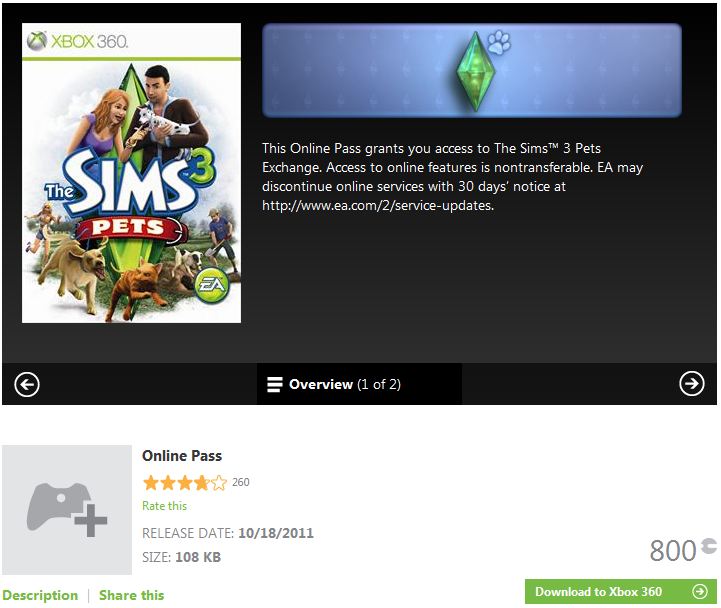
The Sims 3 Pets' online pass

"Fuck secondhand buyers." "Whatever. I don't mind." These voices in favor of online passes are too loud and too quiet, respectively, and they're the sentiments I usually see on this side of the debate. Some of the nay party’s arguments are flawed, too, so skip the next paragraph if you know what I’m talking about, then take in my case for the ayes.

For those who don’t know, online passes allow access to the online part of a game. This is typically its multiplayer, although it may constitute later DLC. Publishers slip cards with a single-use code in with games, and sell them as downloads (usually for about $10). They help get some money out of people who buy games secondhand, either through that fee, or by persuading them to buy an unused copy. (Misleading applications of the "online pass" label to locked, offline features (see Kingdoms of Amalur: Reckoning) are not what I'm talking about here.)

Not every secondhand sale constitutes revenue lost to the developer, but running a multiplayer service for paying customers costs as much as it does for everyone else -- developers actually do lose money this way. Bungie, for example, holds detailed Halo statistics on racks of servers, they regularly change game modes to ensure variety, and they keep cheaters from ruining the fun through vigilant policing. These servers and staff cost money. When developers add to Xbox Live or PlayStation Network services, they have a right to demand compensation. And even if a studio would survive anyway, it’s not fair on those who support it financially to subsidise those who put a drain on it -- at best it's unfair, at worst it increases game prices for those who support developers.

The main argument against online passes is that they detract from the experience for gamers. It’s short-sighted just to say “fuck the used market -- they’re not our customers” because companies’ reputations hinge on how much enjoyment they give gamers, paying or not. But how much do passes ruin things? For $10, a used game is as good as new. And entering a code is a tiny, one-time inconvenience for everyone else.

If passes were unavailable to purchase separately, or extortionately priced, that argument would be valid. But anyone who prefers secondhand can still save money and fully enjoy their games.

For games with small audiences or poor multiplayer features, online passes would spoil everyone’s time by reducing the population of players. For example, The Darkness’ lack of blockbuster status and fun deathmatches led to hardly anyone being online. I was glad to have found anybody at all to hunt achievements with. I mean play with. Starbreeze’s next game (Syndicate) won’t have a pass, probably for at least one of these reasons.

Might not be fun or popular, won't require a pass.

Used-game buyers often argue that the money they save on pre-owned games can be put towards future purchases of unused games and downloadable content, allowing them to take small risks on games they might have missed otherwise, and reward the developer later. This only helps those who intend to make sequels or similar games, or plan to release premium content after the game’s launch. Dice, for instance, could be happy paying to support multiplayer for someone who bought a used copy of Battlefield: Bad Company, if that person liked it enough to pre-order Bad Company 2. A used copy of the same developer’s Mirror’s Edge, on the other hand, won’t drive a sale for a sequel that isn’t coming. And they can’t rely on it to drive Battlefield sales -- one can’t expect to enjoy an online shooter, just because it’s from the same people who made a narrative-heavy platformer.

That costs money

Let's entertain the notion that GameStop deserve to sell a game more than once. They still can. Let the price of a sealed game equal X, and the price of its used counterpart equal Y. Let A be the money given to whoever trades in the game, and B be any further discount they feel like adding.

X - $10 - A - B = Y

So long as Y stays above the cost of shelf space, they can continue to profit from others' creative efforts while offering nothing in return.

Decrying every single defensive move against used games hurts the legitimacy of complaints against far more harmful practices. Batman: Arkham City’s Catwoman DLC and Prince of Persia (2008)’s epilogue (downloadable for those games’ first owners) constituted significant components of concise stories, but were unavailable to the minority with unconnected consoles; PC gamers with too many machines, or who reinstalled it too many times, had to beg EA’s customer support to play Spore; and several of Ubisoft’s games won’t even launch without a connection to their DRM servers.

Having to type in a code, or download a small file for a reasonable fee, to play online is nowhere near that level of inconvenience or injustice.

It’s all very well to want carrots instead of sticks, but Microsoft, Nintendo, and Sony control online distribution to consoles, and developers can’t compete at retail with alternatives that will always be just a little cheaper with barely any degradation over time (cars fall apart -- used games work as well as shiny, new discs). It’s easy to not see the ethical difference between paying someone for their own work and paying someone else, when both are legal and highly visible. And giving an in-game carrot exclusively to customers takes it away from the secondhand market and unfairly punishes everyone without a broadband-connected console.

Developers and publishers must minimise the inconvenience of used-game countermeasures, or accept a loss. Online passes achieve that minimisation, and developers shouldn’t be expected to support online play for people who aren’t their customers. Those without broadband connections can’t get online so won’t miss anything, and used-game buyers can fully experience their games without being extorted. Gamers can be happy they aren’t subsidising somebody else’s online play, and can demand support for online games whether they buy used or not. Everybody wins.

 
Problem? Report this post
ALEX MARTIN'S SPONSOR
Comments (6)
Avatarheader
February 08, 2012
Used game purchases aren't lost money for developers with multiplayer servers. When a game is bought, they get their money, and a slot of sorts is made. If that game is resold, the original owner gives up their slot in multiplayer and cannot play any longer. Meanwhile the used game buyer receives that slot in his stead. It's basically a transfer of multiplayer licenses; there are not more people playing mp, it's the same amount, just with a new person.
There184
February 09, 2012

If someone stops playing a game, they stop putting a strain on the service. If they decide to get some free money by selling something they've got the most out of, the new owner puts a strain on the service that otherwise wouldn't exist.

If developers intended a multiplayer game to be infinitely playable, they'd charge a subscription fee, support it with ads, or go for a freemium model.

Default_picture
February 09, 2012

The strain would still be there on the server regardless of if the game was bought new or used. When a used purchase is made there isn't a magically created player that is putting stress on the servers along with the original owner.

There's one spot per game on the server. So if the original owner gives up the game their spot goes along with it. They've already paid for the game, the service, and everything there so why should someone who is getting the game second hand have to repay for something that has already been paid for? Even if the original owner hasn't been playing you're implying that once they decide to stop playing that should be it. What's the difference between them suddenly picking the game up again or someone else playing in their place?

Not only this but what about people who rent games or borrow them from friends? Locking them out of content that is on the disc is wrong in my opinion. I've got friends who borrow games, I borrow games from them as well and not being able to access everything is incredibly annoying. This is especially true when I'm trying to gauge if I want to make a purchase or not.

There184
February 09, 2012

The strain wouldn't be there, because the person selling the game has got bored of it and isn't playing it any more. The publisher considered that when pricing the game. It's not the same as selling a WoW account that's designed to be used indefinitely.

Game makers expect gamers to play for a finite amount of time, so they charge a fixed amount. They might pick it up again later, but that's not the same as coming to it without having played it before and tired of it because it's not going to take as long to tire of it again.

The problem of rented games should really be sorted out with rental services -- publishers sell rental copies of games to those services, so they could give them a supply of pass codes if Gamefly, LoveFilm, etc. paid for them. And there's nothing stopping you from lending your Xbox Live account to people you trust.

Default_picture
February 09, 2012

So I'm paying for a fixed amount of time to play online with a game I purchase new? I didn't realize that. So when exactly does this timer run out where I've paid for my time on their server? A month? Two months? A year? Or are we going to use a vague term like "When you get bored with it?"

If we're going vague then what's the difference between my spending time with a game online and someone else? The same level of "stress" is there on the server one way or the other. There isn't two people accessing a game suddenly at the same time when before there was one.

The idea of Online Passes is purely designed to get another $10 out of your pocket because the publisher feels they need more money. Instead of supporting a system like this and embracing it like you have why not go a different route? What route am I talking about? Well the route that developers like Valve, CD Projekt Red, and even Obsidian take. Developing a product and supporting it after release with updates and content that makes owning the game new worth while.

This also helps to combat piracy as well.

I'm not interested in a system that hinders my gameplay experience, that allows developers and publishers to lock out content on the disc and impact the product I receive. To further point to how pointless these online passes are Gamestop gives them out for some games. For free. So the exact place that these companies are trying to combat is giving out their passes to play their games online for free with used sales.

There184
February 10, 2012

Gamestop has to pay for the passes to give them out. So they're just hiding the cost of the online pass by including it in the price of their used games. Passes aren't designed to "combat" anyone -- they're designed to fund an online service. EA's just as happy selling an online pass to Gamestop as it is to a gamer.

You pay to play as long as you want, not for as long as you want and the indeterminate number of owners after you want. There's precedent for this in any other pass you buy -- you can't sell an all-day parking ticket to someone else when you're done with it, or let someone into a theme park on your ticket when you've ridden all the rides. That would be abusing a system designed to charge everyone equally for the right to use a service without worrying about time constraints. It would be unfair on other paying customers and would lead to higher ticket prices if left unchecked.

No, there aren't two people accessing a game when there were previously one -- there is one person accessing the game when there were previously zero.

Valve can afford to support their games for a long time because there's no such thing as second-hand games for them. They lock the entire game behind a pass. How is that better than an online pass that leaves the offline segment unlocked?

Like I said in the article, I do support developers that support games after launch -- that's what multiplayer is. And I don't see how a used copy of the Witcher or the Orange Box is less worthwhile than an unused copy if the developer doesn't restrict the benefits of its continued work to its customers.

It's easier to see the benefit of an online pass when it leads to something tangibly new, but that doesn't make the maintenance of launch content worthless.

And online passes don't hinder your gameplay or make content inaccessible to you -- they just charge you a fair price for it.

You must log in to post a comment. Please register if you do not have an account yet.