

Separator
Perspective in Pikmin
Awesome_center_redux_2
Sunday, October 10, 2010

Long time reader here, first time poster. I wrote this a while back but thought I should try throwing it out here and see what you guys think. It's my attempt to discover just what I find so remarkable about the Pikmin franchise. Any critical feedback about my writing is welcome but I'm more interested in just talking about Pikmin in an intelligent manner, which I'm sure will happen here :) .
[IMG]http://img.photobucket.com/albums/v190/Human_Nature/pikmin-1.jpg[/IMG][/center]
 
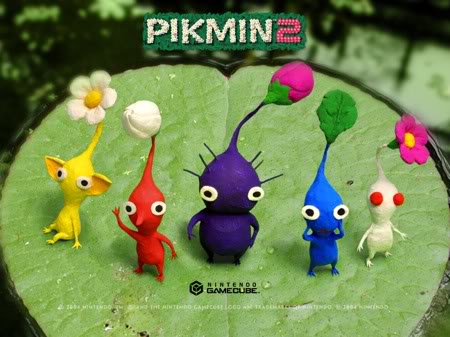
There’s something really special going on in the Pikmin franchise. It’s not just the fantastic mechanics, character and challenge in the series (proving unequivocally that Strategy games can work on a console) but something much deeper, something more human.
 
Which is surprising; for a series that has you controlling a microscopic alien on Earth, avoiding goggly-eyed enemies and herding colour coded carrots to help you in various ways, you feel a whole lot of empathy towards Olimar. He's a likable little alien, racing around the planet, blowing his whistle like there's no tomorrow and otherwise being adorably ridiculous. However, it's Olimar's journal entries at the end of each day and his appraisals of everyday objects (in our lives) that made me emotionally connect to Olimar. It’s why I think Pikmin 2 is so special.
 
It’s remarkably warming to hear Olimar’s journal entries because, while they are often hilarious, they also made me see the objects of his analysis in an entirely new way. While it may sound absurd to say my opinion on a something as simple as a bottle cap has changed because of Olimar, I believe it’s a testament to the quality of the writing found in Pikmin 2 that it did. The fact that every item Olimar finds in his journey is what our society would typically deem to be rubbish, but are incredibly valuable to Olimar’s people, speaks volumes about the theme of the game and our culture. It also perfectly demonstrates just how alien Olimar & Louie are.
 
[center][IMG]http://img.photobucket.com/albums/v190/Human_Nature/572px-PikOlimarPluck.jpg[/IMG]
[i]Tap A, A, A, A![/i][/center]
 
This alien perspective is further explored through the game’s randomly generated “Caves”; areas of the levels which temporarily stop the clock and let Olimar and Louie delve further and further down tunnels in search for treasure. Each descending level of a Cave can be wildly different to the last, taking place in kitchen tiled rooms, underground grottos and childish pencil drawings and toys. In my first playthrough, I simply dismissed these sections as typical absurdist Nintendo charm, a charm that they perfected in the 2D Mario games of old, but further playthroughs revealed something much deeper. I was looking at these levels through the eyes of a human when I should have been looking at them through Olimar’s. What Olimar sees is a world that is completely different to his own. That the designers chose to represent this perspective through fragments, bits and pieces of ordinary human objects, which are in some cases completely out of their normal environment, is a stroke of genius. None of these objects and environments makes sense to Olimar or Louie so there placement, and even displacement, represents that. Even the enemies Olimar & Louie faces are reminiscent of Earth insects and bugs, normally covered with strange armour, wielding sharp claws and even sharper teeth. Again, the familiar is skewed just enough to effectively demonstrate an alien perspective of our world.
 
[center][IMG]http://img.photobucket.com/albums/v190/Human_Nature/800px-All_Enemies.jpg[/IMG]
[i]Of course not all of the enemies are reminiscent of Earth insects...[/i][/center]
 
However, what I found most fascinating about the Pikmin franchise is how much it doesn’t tell us. Is the planet we’re exploring Earth? Why exactly then, aren’t we there? Each dropped item attained by Olimar & Louie encourages the player to further explore the land in hopes of an answer, but no answer is given. You eventually start to treat each item Olimar & Louie finds with the same amount of enthusiasm they do; pieces of a civilisation long since past. The history of this civilisation, and its ultimate fate, is kept a mystery to both Olimar and the player. For all the knocks Nintendo gets for it’s weak story telling, this is masterfully subtle, dense and even heartbreaking.
 
[center][IMG]http://img.photobucket.com/albums/v190/Human_Nature/pikmin_battery.jpg[/IMG][/center]
 

There’s something really special going on in the Pikmin franchise. It’s not just the fantastic mechanics, character and challenge in the series (proving unequivocally that Strategy games can work on a console) but something much deeper, something more human.

Which is surprising; for a series that has you controlling a microscopic alien on Earth, avoiding goggly-eyed enemies and herding colour coded carrots to help you in various ways, you feel a whole lot of empathy towards Olimar. He's a likable little alien, racing around the planet, blowing his whistle like there's no tomorrow and otherwise being adorably ridiculous. However, it's Olimar's journal entries at the end of each day and his appraisals of everyday objects (in our lives) that made me emotionally connect to Olimar. It’s why I think Pikmin 2 is so special.

It’s remarkably warming to hear Olimar’s journal entries because, while they are often hilarious, they also made me see the objects of his analysis in an entirely new way. While it may sound absurd to say my opinion on a something as simple as a bottle cap has changed because of Olimar, I believe it’s a testament to the quality of the writing found in Pikmin 2 that it did. The fact that every item Olimar finds in his journey is what our society would typically deem to be rubbish, but are incredibly valuable to Olimar’s people, speaks volumes about the theme of the game and our culture. It also perfectly demonstrates just how alien Olimar & Louie are.

Tap A, A, A, A!

This alien perspective is further explored through the game’s randomly generated “Caves”; areas of the levels which temporarily stop the clock and let Olimar and Louie delve further and further down tunnels in search for treasure. Each descending level of a Cave can be wildly different to the last, taking place in kitchen tiled rooms, underground grottos and childish pencil drawings and toys. In my first playthrough, I simply dismissed these sections as typical absurdist Nintendo charm, a charm that they perfected in the 2D Mario games of old, but further playthroughs revealed something much deeper. I was looking at these levels through the eyes of a human when I should have been looking at them through Olimar’s. What Olimar sees is a world that is completely different to his own. That the designers chose to represent this perspective through fragments, bits and pieces of ordinary human objects, which are in some cases completely out of their normal environment, is a stroke of genius. None of these objects and environments makes sense to Olimar or Louie so there placement, and even displacement, represents that. Even the enemies Olimar & Louie faces are reminiscent of Earth insects and bugs, normally covered with strange armour, wielding sharp claws and even sharper teeth. Again, the familiar is skewed just enough to effectively demonstrate an alien perspective of our world.

Of course not all of the enemies are reminiscent of Earth insects...

However, what I found most fascinating about the Pikmin franchise is how much it doesn’t tell us. Is the planet we’re exploring Earth? Why exactly then, aren’t we there? Each dropped item attained by Olimar & Louie encourages the player to further explore the land in hopes of an answer, but no answer is given. You eventually start to treat each item Olimar & Louie finds with the same amount of enthusiasm they do; pieces of a civilisation long since past. The history of this civilisation, and its ultimate fate, is kept a mystery to both Olimar and the player. For all the knocks Nintendo gets for it’s weak story telling, this is masterfully subtle, dense and even heartbreaking.

And that is why I felt so compelled to write this article. Sure, both Mass Effect and its sequel have fantastic narratives with a compelling cast of characters, but did you ever once feel like you were talking to real aliens in that game? Or feel genuine terror of landing on an uncharted land (maybe it’s not really the game’s fault though, it’s quite difficult to feel terror when you’re packing a large arsenal of dangerous weapons)? Both Pikmin titles managed to immerse the player completely in the role of an alien looking out into a new world, seeing and experiencing the unknown. That the world in question is so similar to that of our own makes Nintendo’s achievements even more impressive.

 
2
BITMOB'S SPONSOR
Adsense-placeholder
Comments (3)
Snapshot_20100211_14
October 10, 2010

I love this article, as I completely agree with the series being overlooked in its narrative scope. Olimar is a fantastic character - so are the Pikmin. I agree that Pikmin 2 did make this better, but man I wish it had kept the time mechanic. It not having it gave the game no purpose to me.

Nick_hair
October 10, 2010

Pikmin has one of the best atmospheres around. Thank you for reminding me of that. Now I want Pikmin 3 -- badly.

Awesome_center_redux_2
October 11, 2010

@ Shawn - I see Pikmin and Pikmin 2 complementing each other rather nicely as each one has what the other doesn't so to speak. The original Pikmin is more like a puzzle game as it's nigh on mandatory to plan out your days precisely and multitask to the wazoo to get things done in time. On top of that you need to treat your Pikmin a bit more carefully as you usually can't spend a day farming (at least on your first run through) them if you make a horrible mistake and let a bunch of them die.

Pikmin 2 focused a bit more on the combat side of things, giving you ample time to complete things and throwing in another two variations of the little guys. You also got those hilariously overpowered spray which helped out immensely,  you could spend as many days as you want creating a legion of different coloured Pikmin and finally Nintendo seemed to tighten the combat system considerably. You could stun some enemies with careful tosses of your Pikmin, your purple Pikmin could just flatten the smaller bugs and the White Pikmin added a terribly sad way of finishing off your foes.

I quite like both of them equally to be honest. I'm really curious to see how similar or different Pikmin 3 is to the other two though.

You must log in to post a comment. Please register or Connect with Facebook if you do not have an account yet.