Home
Home

I appreciate the cleverness of these PETA ads (people are clearly putting a lot of work into them), but I think the way they always seem to be just as critical of video games as they are of animal cruelty seems like a very poor choice. They're already trying to antagonize people, so why bother antagonizing people that haven't done anything to hurt animals?
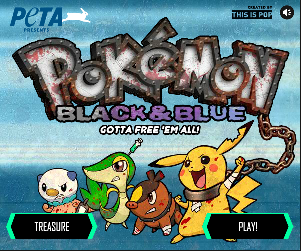
I’ve been meaning to write something for Bitmob for months now. Perhaps a discussion of immersion, a critique of live systems, maybe some reviews. A lot of things have been brewing in my mind, but with this new Pokémon Black & Blue game that PETA released last week, I am enraged and finally motivated to speak out.
I never thought much of PETA before. Yeah, the group’s intentions are good, but I don’t personally support much of what they’re doing (at least not to the point of actually pledging support). But now, I might just hate them forever.
If you haven’t heard, Pokémon Black & Blue (hereafter PB&B) is a parody game that PETA released to coincide with the launch of Black 2 and White 2 last weekend. The player controls several abused Pokémon in battle against their former masters with equal parts civil disobedience and over-the-top comic violence.
Offensive, ignorant, and ill-conceived, this mockery of a game is a half-hearted attempt to portray Pokémon as something that it absolutely is not.
What PB&B really boils down to is a simple misconception: the notion that the Pokémon series is about capturing animals and forcing them to fight each other, willingly or not, for your amusement. Anyone who has seen a single-paragraph synopsis of the Pokémon games might reach that conclusion, but this dismisses all aspects of the presentation of the game’s fictional context.
Honestly, it’s almost grating sometimes how explicitly and forcefully the characters in Pokémon tout friendship, teamwork, and love between trainers and their partners. You’d have to play one of the games without reading anything to miss that. PB&B is actually more grating in this department, though, since the entirety of the in-game dialogue is essentially one big repetition of “Pokémon have feelings, too!”
Have you seen the cartoon? The very first episode shows protagonist Ash risking his life to protect his Pikachu, which sparks their friendship for the entire series. If I recall, any trainer in the series who isn’t best friends with their Pokémon is promptly defeated by someone who is. Plus, there are boatloads of people who own/befriend Pokémon but don’t battle with them.
Because nothing says “obey me” like altruistic self-sacrifice.
But it’s not just about the misconception of Pokémon itself, it’s about the misconception of games in general. No matter the perspective a player has, a game is just a game.
Best described by the concept of the “Magic Circle,” a game takes place within artificial barriers from real life in which actions and their outcomes are assigned meaning and value based on context independent of the real world. Reasonable players can recognize this distinction and play the game in such a context.
In the world of Pokémon, capturing and training wild animals is valuable and promoted. Doing so leads not only to success in battling but also success in friendship, learning, science, economy, and more. Maybe in the real world these actions do not yield the same outcomes and aren’t attributed the same values, but the game is separate from reality.
What PETA is doing, then, is trying to interpret the fictional world of Pokémon with a real-world perspective (a very particular one at that). This breaks the Magic Circle and changes Pokémon into a different thing entirely. This different game just so happens to be PB&B, yet it is branded as though it were any other Pokémon game.
So, if PETA is really opposed to the values of Pokémon but can’t approach them in thier proper context, they must really mean to target the nearest real-world equivalent: pet ownership. Domesticated animals have been removed from their natural environments (captured) and taught to perform certain tasks like hunting, racing, or rolling over (trained) for our entertainment or our own benefit (battled, etc.). Plus, real animals are much less equipped to prevent humans from abusing them than Pokémon are. Even a Caterpie stands a reasonable chance of asphyxiating someone with a String Shot.
If PETA doesn’t separate Pokémon from reality, isn’t PB&B just a statement against pet ownership in general? Heck, maybe they staunchly oppose pet ownership already. As I said, I had never paid PETA much mind before, but after playing Pokémon Black and Blue I won’t even bother to find out.
Along with other sites, GamePolitics.com includes a concise look at PETA's views on the game.