Home
Home

If there’s anything that James Cameron’s underwhelming intelligence insulting blue people fighty flick 'Avatar' has shown it’s that 3D can make money at the box office. In the movie's wake, CES was dominated by advances in 3D home technology and has ignited a debate amongst gamers as to whether 3D is the next big thing to hit videogames. Of course, us being a fickle bunch, we are mostly forgetting that 3D imagery was giving us headaches way back in 1995…
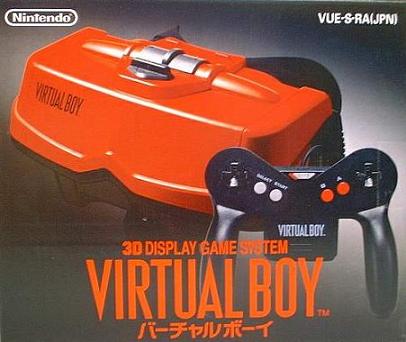
Playing Virtual Boy is a unique experience. It starts with peering into the machine and seeing images burned into your retinas via an eyepiece that obscures all peripheral vision. Forget Nintendo’s recent drive to get families in front of videogames together- with a pair of headphones, this is the most solitary gaming experience there is. Potentially the most hazardous to your health, too- while claims of the machine causing blindness have sunk into the mists of urban legend, the included safety instructions are quite stern (though amusingly illustrated)- and this is the only games machine I know of that automatically pauses itself every twenty minutes to get you to take a break lest your brain refuses to process any other colour than red.
The monochromatic display was the cause of some derision from critics back in the day- with people clamouring for a colour update to the six year old Game Boy, why was this black and whi- oops, sorry, red?
The answer’s down to how the VB produced images. Uniquely, when you’re playing on a Virtual Boy, you aren’t looking at a CRT or LCD screen, but through a lens at two LED arrays- one for each eye, which creates a stereoscopic effect. The LED light is reflected around the bulky headset by a pair of mirrors that oscillate at high speed to create a picture- you can actually hear the motors driving them hum ominously if you listen closely to the machine. While blue and green LEDs were being developed in 1995, they didn’t provide a bright enough image to be used in the VB, and that lead to the monochrome.
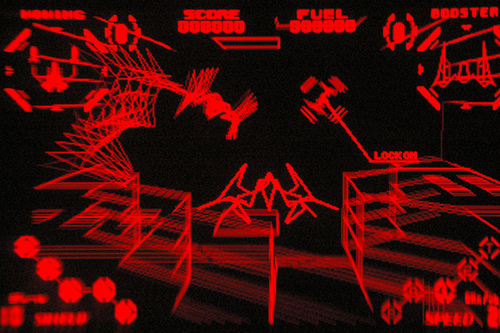
With the individual approach to engineering and moving parts involved with the system, it’s amazing the thing worked then, let alone still works fifteen years later; although collectors have to be careful with it lest the mirrors inside get cracked- the Virtual Boy doesn’t take game rage kindly. The 32 bit processor inside makes graphics of around SNES quality- the machine’s capable of Super Nintendo style mode 7 sprite scaling and filled polygons, though we never saw much poly based stuff in the machine’s short life. The VB’s creator (Gunpei Yokoi of the original Game Boy fame) was on board with the idea of games entering 3D space (in terms of game play rather than just the imagery- a sidetrack, but the games press is going to have to come up with different notation to distinguish 3D images from 3D- as – opposed- to sprite based games) and that’s reflected in the controller. A bizarre piece of kit, the VB controller's two face buttons and pair of triggers are joined by tandem Dpads- the second of which being designed for camera control or strafing like the N64's C buttons or today's dual analogue setups.
The controller also houses the six AA batteries required to power the system. So, this was a handheld to replace the Game Boy? Well, no. For one this was hardly pocket sized, but Nintendo never meant this to replace anything. Like the DS was originally intended to be, VB was the third pillar of Ninty's money making platform alongside Game Boy and the Super Famicom/N64. While the DS failed in its mission by being ironically too successful, however, VB failed by not finding an audience at all, really.
Why? Well, let's look at the handy dandy console death checklist. Dearth of decent games? Nope. The VB has a crazy small game library- only 22 titles released worldwide, 19 in Japan, where I'm writing this, and fourteen in the States- but a lot of them are Really Rather Good. Teleroboxer is like a first person Punch Out- but in 3D, and is damned fun. Warioland is typical NCL classic platform game design, with the usual humorous nods you'd expect from the character. Before the machine was discontinued, Rare was working on Donkey Kong Country and Goldeneye for the Virtual Boy, and there were plans for a dedicated follow up to the Game Boy Mario Land games. Even the VB's worst titles are merely mediocre as opposed to downright shocking, Bullet Proof's V Tetris having nothing spectacular about it whatsoever and leading you to question why you would want to play Tetris on aVB when you could play it on something that wouldn't cause headaches. Oh, wait, what's item two on the list?
Ugly and obscenely difficult to use hardware? Now you're talking- and here's something that's remarkably relevant as it pertains to the 3D gaming debate today. VB is enjoyable in small doses, the automatic pause function giving you cause to return to the real world every so often, but certainly I find looking into its light too long to make me feel slightly woozy- the same issue I had with 'Avatar' in the cinemas and that thousands will inevitably have with 3D gaming regardless of whether expensive fancy TVs are being used, or expensive TVs in conjunction with ugly chunky glasses.
Ugly and chunky, that is, like the VB headset, which looks especially awful since Nintendo at some point in '95 decided Yokoi was taking far too long and spending too much R'n'D Yen on making the thing, telling him to just push it out to die as is. It lead to the outer case of the unit, and it's focus control slider looking like a Fisher Price toy, and the ugly font on the logo being used to increase brand awareness of the N64, which at that time was still titled Project Reality. A planned head strap was never released, which means playing VB requires you to use an awkward stand that's not as adjustable as you'd like. Half of the challenge of playing a game is finding a comfortable way to look at the thing, and failure leads to your 3D induced headache being compounded. Here we are fifteen years later, and with the most popular 3D solutions still being ugly and occasionally weighty glasses, I'm not optimistic about 3D's immediate future.
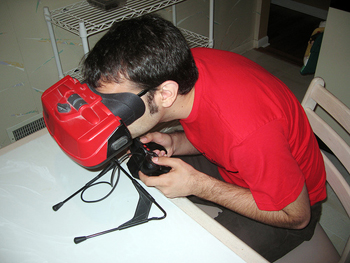
For those looking to collect VBs today, I found mine in a second hand store in Tokyo complete, boxed and with ten games (half of the entire software library, remember) for 9,500 Yen- about 100 USD- although, I was pretty lucky. For all its failings, I'm amazed with how much fun it is, and saddened at it's life being cut short at only five months- being in production from July of 1995 to December of the same year. The short lifespan of the system has even lead enthusiasts to begin an attempt to catalog every Virtual Boy serial number in existence- you can aid their quest at http://www.vr32.de/modules/news/. It's a sad story, but not at all surprising- there's a chilling warning here to gaming's big guns that perhaps a 3D reality should remain virtual until tech can catch up.