

[This is merely one of many personal observations and I, in no way, presume to have any uncontestable insight into such a top. I urge anyone and everyone to both refute and backup my claims… Mainly backup, though.]
It’s tough to argue that a large portion of why we come crawling back to a franchise has to do with the narrative. Sure, games have other qualities that are just as addicting, but the reason we have stuck with franchises such as “Resident Evil” for so long is because we want to know what those feisty ex S.T.A.R.S. members are up to. The main reason why there are a God-only-knows amount of Final Fantasy titles is definitely not due to the break-neck speed of the gameplay.
Games have the potential – in my opinion, anyway – to be the dominant form of visual storytelling. Are they? I don’t really think so. Will they be? Undoubtedly. However, there are a few puzzles that games themselves have to solve before that already-anticipated “Citizen Kane” of games is born.
"God of War" is one of many games known for it's great story and gruesome action.
I find it quite unfair to compare video games to other mediums, such as film, however I find it justified when games take so much of their inspiration from it. While similarities between the two are quite apparent, there is one large distinction that I couldn’t help but notice: most games only seem to progress their narratives through action and violence, whereas films have a great variety of ways they push their plot forward.
I will admit it’s considerably more difficult to blame games for such a fault, as they are an active form of entertainment, rather than a passive one like film. And you may say that games aren’t really games without player-induced actions, but I mean action in a less technical sense and in a more general sense. This then begs the question: can a game convey an interesting and well-written story without the use of violence? Must we only be able to get from A to B by shooting hordes of baddies and beating the snot out of mobs of ninjas? Some would say that traditional adventure games did a fine job of avoiding this, however, considering the fact that that genre has arguably gone the way of the dodo, they no longer seem to be as applicable in this day and age.
I’m not going to pretend as if I have the answers, because I don’t. I merely would like to provide an interesting perspective on game narratives. It’s rather difficult to think of a popular and acclaimed title that doesn’t base its gameplay on pummeling, shooting, or running over the opposition. And you may ask me, “Why is that a problem?” To which I would state the problem is, well, restriction.
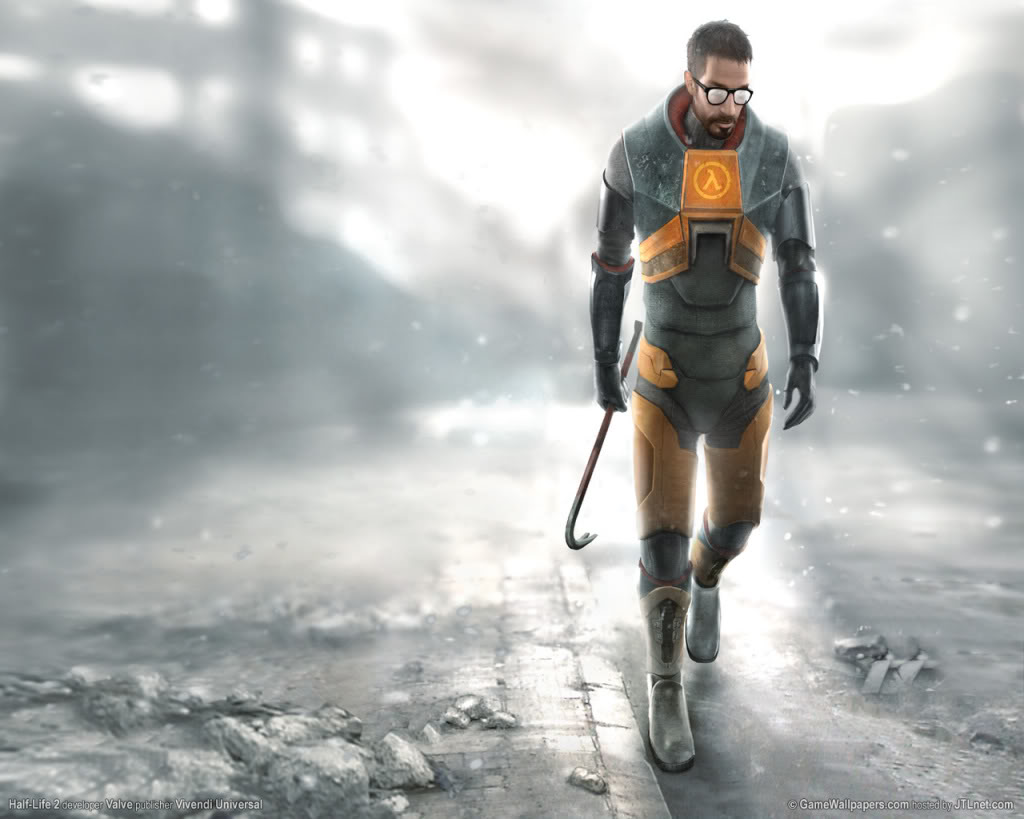
Even humble theoretical physicists are required to bust a few heads.
The reason why it’s nearly impossible to find someone who hates film is because of its accessibility; there is something out there for everyone. Minus the age argument, it’s considerably easier to find a non-gamer because not everyone enjoys the suspense and action of games. When a medium locks itself into a degree of such linear delivery, not only is it difficult to branch out to a larger audience – not that the industry needs to, with it’s billion of dollars – but it’s also difficult to provide a larger variety of story types.
I must stress that this is merely in regards to how games deliver their narratives, not in regards to the genres themselves. Games tend to have a larger variety of genres than other mediums, simply because genres in games are split between both gameplay types (FPS, RPG, RTS) and story types (Sci-Fi, Fantasy, Horror). However, the core method of driving these genres is relatively unvaried. I always enjoy pointing out that the difference between drama in games and drama in everything else is the fact that, in everything else, people cry, in games, people just die.
Again, I’m not trying to claim that I have an answer to this inquiry, or that it’s even that large of a problem. What I am trying to do, though, is to point out the deadlock that game narratives are in, to get you to think about it, and, who knows, perhaps eventually do something about it. Do you have any interesting ideas that could potentially grant us that “Citizen Kane” of games? How do you think games could change to convey a story in a different way? Better yet, can you even imagine playing a game where action didn’t drive the story?
There's a reason why this isn't titled "Top 10 Persuasive Conversations in Video Games."
With that said, I leave you with a bit of a parting challenge: try to think of a critically acclaimed and financially successful game with a narrative that did not feature any sort of action or violence in it, whatsoever (even cartoon violence). That means no gunplay, no pugilism, and no things that go boom. Good luck.