Home
Home

We've finally reached it: the "anti-Mario." QWOP is a platformer (sort of) which makes so little sense that it gives us pause.... Are we sure we want everything to be as real as possible?
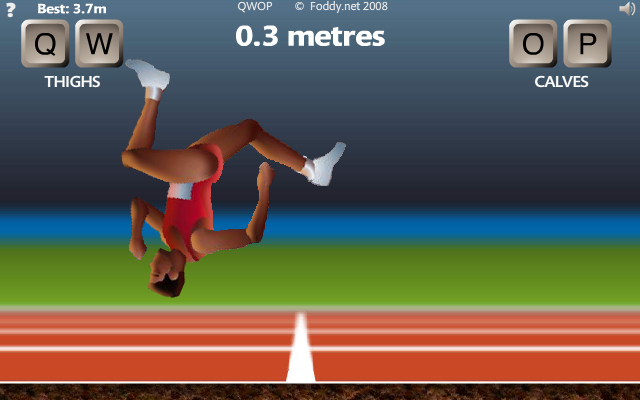
QWOP: It’s the newest meme taking the Internet by storm (er...sort of, anyway), with articles and videos praising its hilarious, bizarre, and addictive gameplay. If you're unaware, QWOP is a Flash- and iPhone-based title in which you control a titularly named Olympic sprinter. The problem is that you manipulate his individual leg movements with keyboard keys: "Q and " "W" control his thighs, while "O" and "P" control his calves. It's all very unintuitive, and the whole thing ends up looking like an absurd marionette dancing down a racetrack. You can play it here.
QWOP sucks the player in with its weirdness and humor, but I find myself fascinated with how such a simple idea completely deconstructs how we control in-game characters. I would even go so far as to say that it should be required reading for any industry professional caught up in the current obsession with new input devices.
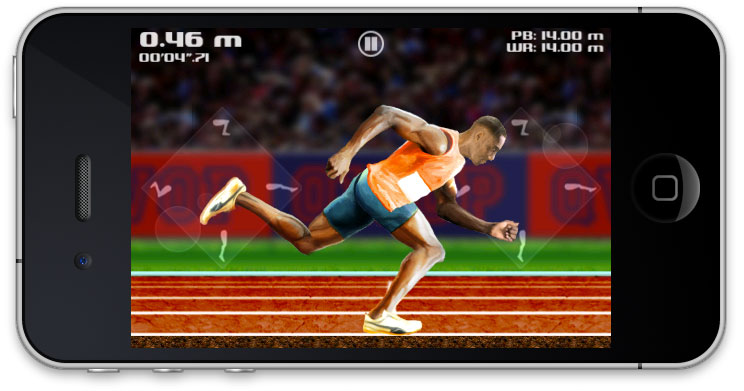
Qwop comes from a perpetually snow-covered country that has no racetracks to practice on. He is eager to run, but doesn't know how. The player has to help him win an Olympic Gold Medal -- and he's only four buttons away from victory. The graphically improved iPhone version features an even more elegant (?) control scheme: Each leg has four positions the player can cycle through.
The design idea and the humor of QWOP come from the same place: It is nearly impossible to make Qwop run properly, so he tends to jerk around, crouching, leaping, and sticking his legs out like a sort of Minister of Silly Walks.
In order to get forward momentum, the player often finds new manners of "locomotion," such getting low and crab walking or frantically hopping around. I recently set a new personal record by using a jumping, scissoring leg motion for 100 meters. It's a feat I haven’t since been able to replicate.
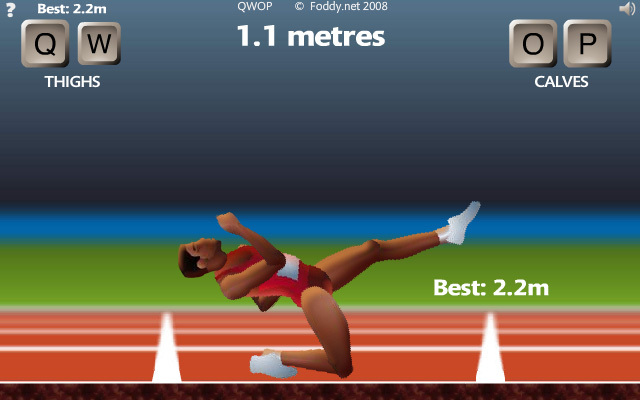
Bennett Foddy created the game by taking running, an action usually assigned to one button like "right" or "left," and turning up the specificity of control until it no longer resembles natural movement. When operated perfectly, QWOP very accurately portrays human kinesiology, but by assigning a muscle group to each button, Foddy shows us how control over a video game can become so comprehensive that it is no longer playable, or more importantly, enjoyable.
An obsession with control has come to define the current generation of gaming. Home devices like Kinect, Move, and Wii have found ways to interpret physical player input as character action, and touch interfaces are now the mandatory status quo for mobile gaming.
When developers promote new titles, they often refer to a “higher degree” or “new level” of control. They constantly give us new input schemes that are more "dynamic" and "veritable." QWOP, in an incredibly fun and hilarious way, shows us that proximate control has its limits -- limits that make a game fun and usable. It also takes the oldest form of virtual control, the keyboard, and recreates it in a completely new and frustrating way: Make a guy run; that's the impossible task.
Allowing me to shake my body, wave my hands, yell, or push more buttons doesn’t automatically make for a better experience. It takes skilled developers and astute design choices to deliver controls that are truly new -- not more options.
Wii, 3DS, Kinect, Move, and iPhone applications are hovering all around us, and a lot of it no longer makes sense, despite the original core ethos that begot them: simplicity. Developers are slapping on new modes, so that we can try out established franchises in new and uninteresting ways. They are giving us the option to tilt and lean -- actions which seem "real" -- but which are two of the worst interfaces I’ve encountered.
Without focusing on a smooth experience or having the restraint to cut bad ideas, companies are releasing straight-faced versions of QWOP for Kinect -- and other motion-controlled platforms -- right now, without irony.
So please, let this unpracticed, yet bold, sprinter be a guide for the industry: Give players too much to do, and you may force them to crabwalk their way through an experience.