Separator

Why difficulty and narrative go hand in hand

Default_picture
Sunday, February 12, 2012

It’s funny how I can enjoy a game like Braid so much yet still have so many fundamental disagreements with its creator’s view of game design.
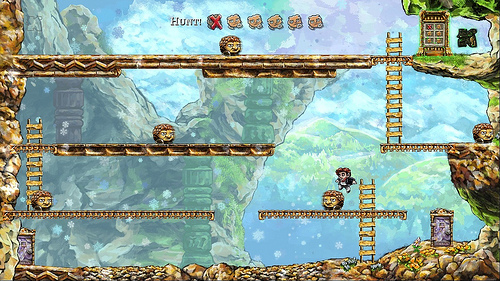
Jonathan Blow's Braid

Jonathan Blow makes a number of thought-provoking points during his hour long lecture, Conflicts in Game Design. Though I would love to dissect and discuss every little idea he brings up, there’s one argument in particular which really stuck with me.

In regards to straight-forward narratives in gaming, Blow argues that story and challenge are at odds. While the narrative wants to progress, the difficulty of video games push back. To him, this relationship is so unsound that it inherently prevents good stories from being expressed in the medium.

I respect the developer’s opinion, but I absolutely do not agree with it.

A game’s difficulty and the challenges it presents its audience doesn’t impede story; it is story.

In a simplified context of traditional narrative, a successful story is built on a risk/reward system. The protagonist wants something to happen and with each decision and step they take, they either get closer to realizing that outcome or get pushed further back.

An outside force or event usually starts the process -- knocking the protagonist’s life out of balance -- but the character in question is the one that ends it. Throughout the story, they try to regain the balance in their life by making risky decision against antagonizing forces that they believe will turn the tide in their favor. Obviously, small risks are taken first, but they build to a last resort which holds huge implications for the character and ultimately defines who they are.

In this sense, video games are perfect for expressing an involving story. The player isn’t supposed to empathize with the protagonist like other mediums; they should be the main character as if everything is happening directly to them. It’s not good enough to simply tell the player the huge risks the main character’s taking. In a video game, the player needs to undertake the task themselves and experience the risks firsthand.

My interpretation comes from worshipping the SNES as a child, watching Quentin Tarantino movies behind my parents’ backs, and reading great books like Story by Robert McKee and Stephen King’s On Writing with gaming in mind. I’m also well aware that a great story can come in many different ways and interpretations can be a lot less formal than mine.

But this framework helps me understand why a seemingly well-designed game like 2008’s Prince of Persia failed to engage me. Having the Prince’s partner, Elika, save him from certain doom throughout the game eliminates the need for frustrating game over screens and endless load times. But at the same time, it rids the world of consequences, so I’m free to take as many risks as I want. Nothing in the world intimidates the Prince, making sure the gameplay is void of any emotion. Getting through a section feels like work, and though the game has a fairly lovely story, it fails in the framing of a video game.

Mind you, by difficulty, I don’t mean enemies that spam cheap attacks or being a target for every grenade in Japan. True challenge in a video game comes from familiarizing yourself with a gameplay system, and then having your prowess tested just enough through situations exclusive to that structure. A game doesn’t need to kill the player hundreds of times to be considered challenging, but the developer can’t be afraid to push their players past their limits.

In Resident Evil 4, I only died a few times during my initial playthrough, but every moment of that game was wrought with tension because of the excellent pacing. Through gameplay, the developer illustrates early in the game the basics of dispatching an enemy, how to use the environment to your advantage, and to be effective with your weapon.

The player soon engages in a battle of survival in a small village packed with hostiles. You burn through your limited inventory quick and eventually find yourself facing down a handful of villagers with nary a prayer left. You fought an exciting, adrenaline-pumping battle, but it’s obvious you have failed as the villagers inch ever closer to you.

But then it ends.

The Ganados are drawn away from the battle, leaving you with shot nerves and soiled trousers. Right from the outset, the player learns to respect the game’s challenges and fear death, making their journey and accomplishments that much more rewarding. The game is so memorable because it consistently pushes the player to the brink but allows them to use their wit and determination to succeed without dying multiple times.

RE4 is a testament to how the steady progression of difficulty can help elevate a gaming experience to new, visceral levels. The story is definitely on the goofy side, but the emotion of fear it sets out to invoke in the player is as potent as any horror film or book.

Blow has a few good arguments, but in the grand scheme of things, I don’t believe this is one of them.

 
Problem? Report this post
MATT PEREZ'S SPONSOR
Comments (4)
Bmob
February 12, 2012

I am also in disagreement. Perhaps it's because I mostly stick to JRPGs, but I find that a lot of video game storytelling is based around the challenge. Overthrowing Fal'Cie rule in FFXIII is a challenge, and one that would be pathetic without the gameplay also providing that challenge, for example.

It could also be that I'm just addicted to Football Manager (I am, truly) but I'd go one step further, and suggest that challenge alone can create a decent narrative. I have been writing career updates for various Football Manager iterations for years now, and every successful career has involved some kind of challenge. All careers that failed to write their own story were those where no real challenge presented itself.

I know this is probably just me being an ass (and I accept any responses to that effect) but I really didn't like the storytelling in Braid. After hearing so much about the indie darling, I was thoroughly disappointed. Part of that was actually because the challenge element was in conflict with the story, but I feel that's because they were vastly different... as such, not a fault true to all video games, but a fault true to Braid.

Default_picture
February 13, 2012


You look at old classic games and a lot of the thrill and excitement came from overcoming the challenges the games presented. It made finishing the game that much sweeter.

I absolutely see where you’re coming from with Football Manager. Some of the greatest stories in history come from two teams competing against each other. Seeing the Flyers overcome all the turmoil of their 2009-10 season and eventually make it to the Finals was incredible. A team like that is far more interesting than one that cake-walks to the Finals.

You look at movies like Inception, and the film wouldn’t be half as great if everything went according to plan. If the characters didn’t go through all the crap that they did, then you’d end up with The Twilight Saga where nothing happens for two and a half hours.

With Braid, it’s interesting because you can’t die, but the game is quite complex and challenging. I personally thought the challenge made the story that much more vibrant. Obviously, clearing a puzzle with no help is gratifying, but I thought it worked so well alongside its theme in the end. But I see where you're coming from.

Lolface
February 13, 2012

Although I've never played Braid, and I'm not familiar with Jonathan Blow's argument, I can see where he might be coming from. Conflict is central to every story, and I do agree with him that the game pushes back while the narrative tries to progress. After all, every game is trying to kill me, and I think that's part of the problem.

In a game, if I am in fact to become the main character, then his/her actions are my own, as well as his/her triumphs and failures. But what happens when I do fail? In other passive mediums, like novels or movies, main characters fail all the time, and some times main characters can even die. But in games, the main character (almost) never dies. In Halo: Reach, I died dozens of times, only for the game to reload so that I could reach the end where I die. Just about every game is like that. When you die, you get a game over screen, God gives you a Mulligan, and you're off on your merry (murderous) way.

However, failure kills any sense of immersion. In Uncharted 2, the opening scene has Drake holding on to bits of a train as the train hangs off a cliff. As the player, it's your goal to guide Nate through and around the train to the safty of the snowy cliff above. It's a thrilling scene that is keeps you on the edge of your seat as the train creaks and rattles and falls apart around you. You can fail this section, however, and once you do, you have to start at the begining, and once you start playing through it again, that thrill is lost. There is no more sense of danger, just mechanical platforming to get to the next stage.

The same can be said about games with unskippable cutscenes. Yeah, it was cool the first time, but if I died, the scene is just annoying.

In that sense, I can absolutely see challenge getting in the way of story.

On the other hand, facing challenges, and succeding is as thrilling as it is immersive. By succeding, you feel more like the character you're playing as, and the narrative doesn't have to stop and rewind for you.

However, sometimes it does have to stop and rewind. I don't think this prevents good stories from being told in games. The original Deus Ex told an excellent story, as did Portal 2. Heavy Rain even bucked the trend with perma-death (even if the story was stupid and the game was an 8 hour QTE).

Default_picture
February 13, 2012


I definitely see where you’re coming from. With video games, there are so many variations that it’s tough to pinpoint what the best solution is. You’re absolutely right that dying in a game really hurts the immersion and eliminates some emotional value. You also make a good point in saying how for certain games, dying won’t kill immersion, or it’s built into the game. Limbo is a great example of this, since dying is part of the game mechanic.

That’s why I have so much respect for games like Resident Evil 4, Zelda: Link to the Past, or games that don’t have a difficulty setting (I know it makes games more accessible, but it takes balls to only have one setting and have it work out). You don’t die often in RE4 or LttP, but there’s always that sense of fear and looming danger, making success so sweet and immersive. It makes surprises that much more startling. I vividly remember running away from the giant stone statue in RE4. I just barely managed to clear that section in one go and it was exhilarating.

In the Resident Evil Remake, I didn’t want to enter certain rooms because I was low on ammo and health, and I wasn’t sure if I left a Crimson Head lying on the ground, ready to pounce up and kill me. You don’t get that feeling in any other medium, and it comes from great pacing and handling the difficulty well.

Obviously, knocking pacing out of the park is one of the developer’s biggest challenges, but when they pull it off, it creates classics in my eyes.

You must log in to post a comment. Please register if you do not have an account yet.