Home
Home

Y'know, if Superman 64 had come out in 1978 -- the same year Superman: The Movie hit theaters -- it would've been hailed as an amazing triumph of technology and gameplay. Instead, releasing 22 years later, it's widely regarded as the absolutely worst video game ever made, mainly because it is. What changed? Simple: expectations.
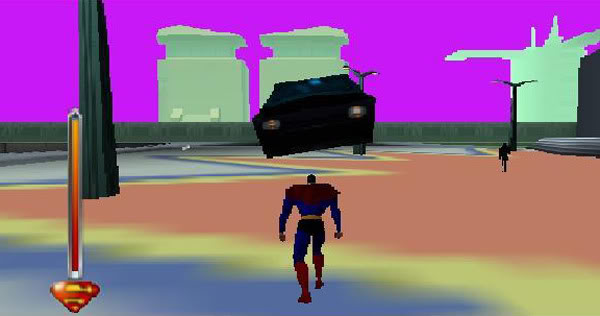
I bet you never thought graphics could be so photo-realistic.
Video games and super heroes both nail the same wish-fulfillment center of the geek brain, so putting those ingredients together should be a simple recipe for awesome. Not so, it turns out. Even after a few scattered success stories, "superhero video game" carries a certain stigma, much like "video-game movie." Sure, they generally aren't top-tier releases with superstar designers and budgets north of $80 million, but those aren't barriers any game needs to cross in order to rock. Something else stops these titles from finding an audience, even when the subject has a solid fanbase.
Again, chalk it up to expectations. Superhero games tend to fail because they break the fantasy.
We've got very specific ideas about our icons. We've personalized them, internalized them, we know exactly who they are, what they act like, and what they do. And then a developer walks into the room and does something else. Superman, Batman, the X-Men, Spider-Man, all of those instantly recognizable icons have their own version of the uncanny valley, and we recognize falseness the second we game it. If you're going to put me behind the wheel of a Wolverine, I've got to feel like the uberbadass. Instead, I usually feel like the handicapped version of Weapon X.
Technical advances don't exactly help, either. In 1978, we might've accepted a Superman who just few around and used superbreath in a 3D pseudo-Metropolis. Now we need him to lift a bus, zap Lex Luthor in the face with heat vision, and fly faster than a speeding bullet. Preferably all at the same time.
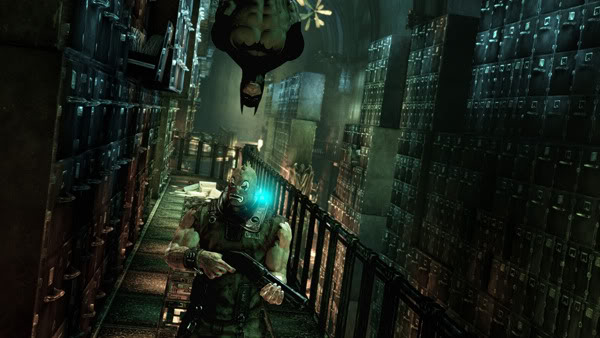
You missed a spot.
Oh, you'll find exceptions. Batman sure as hell felt like Batman in Arkham Asylum. You got to play a supremely trained fighter with an arsenal of gadgets at his disposal. Done. But the vast majority of games based on any comic book you've heard of fall far, far short. Superheroes just have a tough time living up to our vision of them...until you remove the expectations.
I can name you a dozen lightning-themed comic book characters, but Infamous didn't star any of them. Its protagonist, Cole, started with a clean slate. So did Viewtiful Joe, or Freedom Force. And since they all arrived sans any baggage, they had a chance to impress me on their own terms. On the other hand, when I first heard DC Universe Online wouldn't actually let you play as anyone from the DC Universe (outside the Legends PVP challenge rooms), it sounded like an executive brainstorm that nobody had the guts to call out as incredibly stupid. How do you have a game with "DC Universe" in the title and not leverage that incredible catalog?
When I finally played the game, I got it. DCUO goes the City of Heroes route, making you create your own hero/villain, and then puts you to work alongside those DC headliners you've known your whole life...and slowly earn their respect. That feels so incredibly cool.
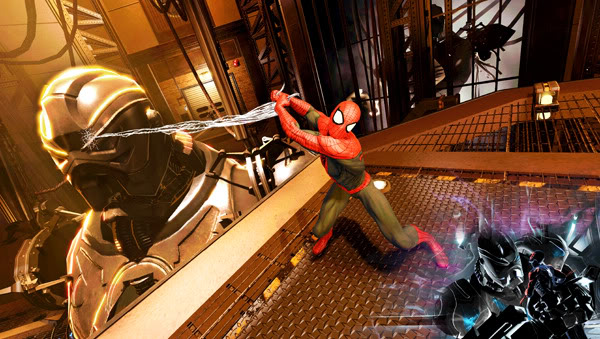
New Olympic sport: Shogun Warriors Tug O' War.
What brings this to mind are all the superhero games I just saw at WonderCon. Most keyed into upcoming movies -- which offer problems of another sort -- but I somehow suspect Captain America: Super Soldier and Thor: The Video Game can't help but fall short. I even got my hands on Green Lantern: Rise of the Manhunters on the 3DS and had a brief shock of glee when I found out Hal Jordan could fly around the levels. Then I hit a wall with no obvious way to get to the underground chamber on the other side. Uh-uh. Wrong. I power-ring myself a Honda-sized drill and go where I want.
And yet, I also watched a demo of Spider-Man: Edge of Time, developer Beenox's follow-up to last year's Shattered Dimensions. Most of the gameplay doesn't change, save for new, character-specific special abilities. For Amazing Spider-Man, that's an evasion move where he dances around enemies at blinding speed, like he's toying with third-rate muggers who think they stand a chance. For the first time -- maybe ever -- I saw Spider-Man move like I know he should.
So maybe there's hope.