
 The local arcade of the small Mexican pueblo of San Ignacio Cerro Gordo was a frequent hang-out spot for a four-year-old me, as well as many of my brothers and cousins, who at the time were more or less my only friends. The dark walls of the arcade were lit only by monitors, and much of the chattering one heard was drowned out by frequent video game sound effects and dialogue. There were many kinds of games available, but the most frequent, by far, were the kinds of games that thrived on human interaction: fighting games. The dialogue heard was hardly coherent; it consisted of yells of ridiculous moves and long-winded death cries. The lighting-fast nature of their competition made fighting games the clear favorite at my local arcade. When one person challenged another, it would be over within 99 seconds, and the victor would move on to next opponent; a mandatory pace when there was always a few quarters or personal items on or next to the machine indicating the next person in line.
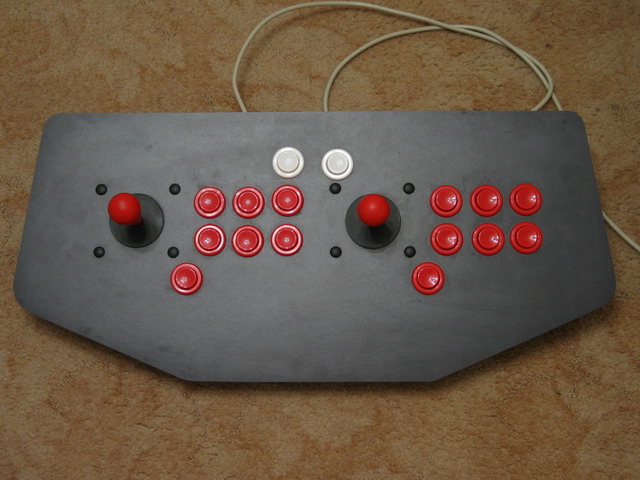
There was another element that made fighting games superior to the driving sims and gimmick light-gun games: the arcade stick. The six-button layout and bat or lollipop-shaped joysticks were mashed and jostled constantly from the opening to closing of the arcade. The buttons were responsive, and the stick reacted as fast as the hand that twirled it, or so it seemed. Players would make due with broken parts, which were rarely considered a handicap; if you couldn't move in a certain direction of use a certain move, it was your fault, though it didn't stop many a player from whining. The controllers were always perfect, and failing to use them effectively, flaws or not, was considered user error.
I was never old enough to effectively use these awe-inspiring machines. I watched people's hands move about the buttons and sticks frantically, and would try to emulate those gestures when someone begrudgingly gave me, the youngest person in the group, my turn. My spastic flailing at the machine never won me any matches, though it did get some laughs from the older kids. What I never learned back then was that there was a method to these people's madness; between all of the fancy arm positions -- crossing one's hands so that the right hand was using the stick and the left hand the buttons, holding a slightly clenched hand right above the buttons for supposedly faster reaction times -- people knew what they were doing. I could only admire their performance art from afar, and worship at the altar of the mighty arcade cabinet.
I've never owned a arcade stick. When Super Street Fighter II Turbo arrived in our family's home -- through the purchase of a cartridge at a flea market that actually had a Mortal Kombat II label on it -- we had to settle for the D-pad and stick buttons of our Super Nintendo controllers. This is where I learned to play fighting games, and how I still play them today. Street Fighter 4 caused my forgotten appreciation of the arcade stick to return, and I almost bought one, but I knew that I would only hinder myself. I'm a native D-pad player; I know how to perform most of the combos possible with arcade stick as quickly with a PS3 controller.
Many people's fondness for arcade sticks comes from the fact that to them, it's the only way to play fighting games. Though I'll likely never share in such a culture, I can still appreciate the role of such a controller in fighting game culture -- it makes the fighting genre seem like the field of the specialist simply through the interface, though this appreciation never helps when everyone has tournaments using the 360 version of a game, which is no way to fight.


Tuesday, April 06, 2010


Well said, my friend. I recently bought BlazBlue: Calamity Trigger and I found myself reminiscing about arcade sticks as well. I never was any good with them and to be honest, I feel like an amatuer fighting gamer because of it. The fighting games I got good at were Dead or Alive 2, Tekken, and I do feel like I am getting somewhere with BlazBlue.
I feel encouraged after reading your ideas, that it's okay to be a D-Pad fighting gamer. Thank you for that.
Great read. If I were you I would stick "controllers" to your tag so that it can get on Andrew Hiscok's controller prompt.
http://bitmob.com/articles/bitmob-wants-you-to-write-about-controllers
I would get an arcade stick if I could afford it and get a few other goals out of the way first. I mostly play fighters anyway, and some characters like SF4's Gen and C. Viper are hard to play without the stick's precision. Then there's how some button combos like "all three punches" have to be mapped to a button to get it consistently, like Zangief's lariats or Ultra combos.
I tried to learn an arcade stick for street fighter 4 since my rooomate bought it (and then never uses it, the nerd) but I just can't wrap my head around it like I can a D pad. No idea why. It's probably the same as why i hate keyboards in PC games. Just didn't grow up with it.
I bought a stick. At first, I was like many of you out there, thinking that I could not perform well on one. Until I sucked it up and started playing in arcades.
Nowadays, I can't play without one.
If I could get the hang of a stick I would like it. I mean with the PS3 controller I have medium punch on a damn bumper. That's very limiting. Still i'm not really that hardcore into fighting games because they are so hard to learn to play on any level other then 'get beaten by everyone you fight online' so I have never bothered to learn because it isn't worth it to me until a fighting game is either easy enough to learn or good enough at teaching me that I can thrive in it.
For me, an arcade stick requires some weight behind. Or more accurate attached to it. If I were to get a modern controller, I think I would have to attach 20 lbs of lead to it. It needs to be anchored, as it were.