
Separator
An Insider's and Outsider's Views On Movie-Licensed Games
Default_picture
Sunday, December 06, 2009

Editor's note: Like Steve, I've also worked on the development side of the industry, and I've seen cases where license deals quite literally shoved titles out the door long before they were ready just because the contract stipulated a specific release date. That's not the only reason licensed games tend to suck, but it's one of them. Steve goes into detail on some of the other reasons, but he also explores some solutions with the help of his friend -- a movie buff who's also a casual gamer. -Fitch
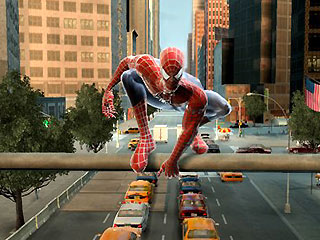

Spider-Man 3As a gamer, I've been around long enough to know that the vast majority of movie-licensed games are garbage, and I generally assume they're not worth playing unless I hear otherwise. My views aren't uncommon among the gaming populace, which raises this question: Who's buying these games?

Obviously, plenty of consumers do -- otherwise, the movie-licensed category would've died long ago. But in stark contrast to critical reception, many of these games sell quite well.

It's an easy enough question to answer, though: Non-gamers buy these games. It's the folks who see Spider-Man 3 in theaters, enjoy it, hear there's a Spider-Man 3 game, and think, "Oh, cool -- more Spider-Man 3! I do have that PlayStation 3 thingie that I use to watch Blu-rays and play Guitar Hero."

So, how do we change this attitude?


One of my good friends is a bit of a movie buff. But even at best, he's what you might refer to as a "casual" gamer. As a kid, he owned an NES, and in college he had a PlayStation 2, but he's never been that into gaming. But since he enjoys movies and occasionally plays games, he's bought and played quite a few movie-licensed games over the years.

Prior to being heavily influenced by my own attitudes and opinions, my friend bought, played -- and, for the most part, enjoyed -- quite a few terrible movie-licensed games on the PlayStation 2. The way I've rationalized his enjoyment of those games is that his only point of reference were games he played 10 years earlier on his NES. Basically, he didn't know what a good "modern" game looked like!

But after my friend met me and became exposed to some quality games, he started to be a bit more cautious when it came to his purchases. Not only will he check with me prior to buying a game, but he'll also even get on the Internet and look for game reviews on his own.

Recently, we've also gotten into discussions on why so many movie-licensed game are of such poor quality. In my opinion, it usually boils down to a few factors. I can't speak definitively here, but I can offer a certain perspective as someone who's worked in game development.

First of all, I'm fairly sure a good portion of the development studios agree to make a licensed game as a way of generating income for the studio. Depending on the contract, it's entirely possible that the publisher will pay the developer a baseline rate regardless of how many units sell (and perhaps some royalties if the game sells more than X number of copies). So, without a direct financial incentive, it's not too unreasonable to believe that developers don't put all of the necessary effort into making these games.

Secondly, I wouldn't be too surprised if publishers are aware of the fact that quality tends not to be of much of a determining factor when it comes to licensed games, so they're likely to hand the deal off to the lowest bidder -- often an untested developer.

Thirdly, as a developer, you're usually at the mercy of the license-holder, who'll often have the final say on what does on doesn't make it into the game -- but this also depends on the stipulations of the contract. Lastly (but also most importantly), developers are often under immense pressure to ensure that the licensed game's on store selves by the time the movie hits the theaters. My guess is that most movie-license deals aren't made until the film itself has been green-lit and entered the early stages of production.

And, from what I've heard, the average production cycle for a movie is somewhere between a year and two years, while the average production cycle of current-generation games is between two and three years. So, speaking in terms of averages, developers who make movie-licensed games have a year and a half to create something that would normally take two-and-a-half years.

Unfortunately, I don't foresee this model changing in the near future. After all, it makes money -- money that comes from nongamers who aren't nearly as concerned with overall quality as hardcore players. But maybe there's hope. For my fellow developers, I'll leave you with a quote from my friend:

"I think the big difference, from a layperson's perspective, is that the games that follow the movie's plot fail to capture its spirit, while the movies that capture the spirit are much more enjoyable to the fans. At the end of the day, players want to live through their favorite characters -- they don't want to relive a movie."

 
0
BITMOB'S SPONSOR
Adsense-placeholder
Comments (8)
Default_picture
October 28, 2009
Most of the people I know that play mostly licensed games are so casual in their gaming that many have never actually beaten a game. I think you've hit the nail on the head when it comes to reward over investment. No need to make the product any good as long as it has the 'G.I. Joe' label.
In fact, this philosophy bleeds over to the quality of the movies as well- keeping 'G.I. Joe' as an example.
Default_picture
October 28, 2009
I know from working at Hollywood Video for 3 years that parents buy or rent the more "13 and under" licensed material because it's quick, easy and no need to think beyond, "Billy liked Ratatouille so I'm sure he'll be quiet and out of the way for at least 20 hours in the next few months if I just hand it to him!" Parents who don't much care about games and kids who don't know any better make up a good 80% of this. High school and college are filled with people who own a system but only use it to play sports games with their friends or the one license everyone around them talks about that year. They don't seem to really be a part of the culture or care to, for that matter.
Dan__shoe__hsu_-_square
December 05, 2009
Great perspectives. I liked your quote from your friend, too. Seems spot on.
Default_picture
December 06, 2009
i worked on a movie title last year and from my experience i would say your assessments are fairly on the mark, with a few notes.

So, without a direct financial incentive, it's not too unreasonable to believe that developers don't put all of the necessary effort into making these games.

i can't really see why this would be the case. any self respecting designer wants to make as good of a game as they can even if they know they have time and resource constraints that don't let them make an ideal title. besides, if the film does well you want to be tapped to do the sequels which is easier if you made something that's at least decent (and more importantly, done on time).

I wouldn't be too surprised if publishers are aware of the fact that quality tends not to be of much of a determining factor when it comes to licensed games

believe it. marketing is pretty advanced at large publishers and they have all kinds of formulas that take this sort of thing into account. the primary motivating factor is that the insane amount of advertising that is already associated with the film and the possibility of crossovers directly and provably translates to sales. on this particular game we had things like 7-11 tie ins and even hilarious stuff like discount coupons that were on some brand of sausages that was sold in the midwest. very little of that would be possible for a non-movie game unless it is one of the very largest titles.

My guess is that most movie-license deals aren't made until the film itself has been green-lit and entered the early stages of production.

yep, exactly the case.
Img950653
December 06, 2009
I don't want to jinx it, but I would hope that with Hollywood making a more serious effort to be faithful and diligent with regards to comic book IPs, a continued effort to maintain the same care with their video game counterparts would follow suit. The recent Batman flicks, as well as Arkham Asylum, come to mind.
Franksmall
December 06, 2009
Well, I would have to add that I do buy movie games sometimes, and that some can be very good. I thought the recent Wolverine game was a very good example of taking a proven formula, adding on a license and making a good game.

The best thing to do with a licensed game is to approach it skeptically and try it before you buy it.

Lots of critics seem to judge licensed games before even playing them, which is understandable since many are crap. There are also those rare times that they ignore anything good about these games because they are so prepared to look at the negatives.
Default_picture
December 06, 2009
A couple of more pointers. I'm a developer, haven't worked on a movie license, but have had talks with movie studios about this.

The studios want a good product, not a good game per se. A certain quality level is desired to keep the IP from being tarnished. They are very much aware that the short dev cycle doesn't help, which is why they prefer a developer who's done movie licenses before.

From a developer's point of view, obviously everyone's out to make a good game, but few manage to deal with the reality of a 12-month dev cycle (plus post production). You need to be able to discern just what are the cool focal points of the IP immediately, have tools and tech ready to go and jump straight into production with very little time for pre-production, with an excellent eye on an achievable scope and cutting soon and often. That is not an easy task.

A studio is only as good as their latest release - nobody in this business I know is about putting out any old crap. Sometimes you just don't have a say in the matter. Mouths to feed and so forth.

I've been positively surprised by the attitude at the movie studios, though. They are aware that new movie licenses are hard to pull off successfully, but they have a stable of past releases, as well, which could be made into cool games without these strict time limits. Again, it's all about the IP and their quest to keep them current and relatable.
Default_picture
December 07, 2009
Hollywood thinks of games as the same as any tie-in merchandise. A video game to them is nothing more than a 'digital t-shirt' that costs 60 dollars and it gets the time and resources allocated to it according to that mind set.

The majority of the consumers who buy these bad licensed games are either non-gamers who never go to game sites or parents who have children who like a certain movie, walk in to a store and say 'mommy mommy I want the *insert well marketed film* game!' completely oblivious to what they are asking for.
You must log in to post a comment. Please register or Connect with Facebook if you do not have an account yet.