Home
Home

Our latest Bitmob Roundtable features a crew of community members breaking down the much-beloved, much-maligned genre of Japanese role-playing games. Join us!
Hello, everyone! It's time once again for a Bitmob Roundtable, where we grab a bunch of Bitmobbers and discuss an important topic in today's gaming industry. This week, we tackle a whopper that's been on everyone's lips lately: the state of the Japanese role-playing game.
I rounded up fellow Bitmob community members Daniel Feit, Jonathan Oyama, and John Michael to debate the current JRPG climate. If you look at their profiles, each one has explored the genre in unique ways, and I recommend you browse their thoughts further after you read our discussion.
And as always, you can post your own opinions in the comments.
Bitmob: To preface things, tell us a little about your tastes in JRPGs.
Daniel Feit: I would say that I am "rediscovering" JRPGs after years of denigrating them based solely on my memories and expectations. Like all PlayStation owners, I was overwhelmed by Final Fantasy 7, and when it was done, I just didn't want to play another game like that. It got so bad that I would dismiss games on description alone: "Oh, that sounds like Final Fantasy; I'm done with those sorts of games." While I have yet to return to that famous series, I have in the last year come to terms with my continued interest in the genre.
John Michael: I'm not as into strategy JRPGs as much as the old-school, party-based stuff. And with a few exceptions, I don't play that many action RPGs. I like big, epic settings with long, epic stories. Also, I'm a Final Fantasy nerd, but I'm not such a fanboy that I can't admit its faults. I've been playing games in this genre since I could read.
Jonathan Oyama: I'm a huge fan of JRPGs. I've been hooked on them ever since I played Final Fantasy 6. I've actually played the original Final Fantasy, but Final Fantasy 6 was the first one that showed me that JRPGs could include Street Fighter moves and all sorts of other weird things in combat. I played Chrono Trigger, most of the Final Fantasy games, and I've just gotten myself into the Persona series two years ago. I don't often play strategy RPGs. I couldn't get into Disgaea's goofy throwing system. However, ever since Record of Agarest War, I'm slowly getting hooked on strategy RPGs.
Oh, and I loved playing the more action-based RPGs like Secret of Mana. I like The World Ends With You, but my stylus hand always gets really sore when I play it. And I'm a fan of the Tales series even though the original Tales of Phantasia is a pain to deal with. I've also played through Dragon Quest 1 and 9. I liked the original Pokemon Red and Blue, but I can't really play the new games as well. I guess it has to do with that old-school graphical style.
Jeremy Signor: As for me, I would say that I like all kinds. I used to be able to play anything in the genre and like it, just because it connected with me in a way other games didn't. I even played a good deal of not-so-good PS1 ones like Legend of Dragoon and Legend of Legaia. But as I grew up, I soon learned what made a good one stand out from a bad one, and what made the unique ones so different, giving me a great deal of hindsight on past games I never used to have.
Bitmob: What do you all think about the most recent releases in the genre? Are things as bleak as people say?
Daniel Feit: I would say that no genre is ever as bleak as people say it is. What's wrong is that the high-profile releases -- like ones from Square -- are looking stale, and sales have dropped off. Hence the doomsaying.
John Michael: Yeah, we're not looking at an end-of-the-world apocalypse situation. But from a North American standpoint, it's tough not to see that both the quantity and quality of the titles that do make it here are diminishing.
Jonathan Oyama: I actually think that JRPGs are just having trouble adjusting to the new console landscape. Ever since Kingdom Hearts 2 and its extremely complicated storyline, people have been a little afraid to pick up another JRPG.
Daniel Feit: Part of the console problem is the major shift in Japan to handhelds. Companies that used to work on PS2 moved on to the PSP rather than PS3.
Jeremy Signor: I suppose that releases have slowed even for small publishers, but I don't know if the decline is significant enough to be worried about it. Sure, a lot of titles get relegated to niche publishers like Atlus and XSeed, but if you love the genre, you'll seek them out.
Jonathan Oyama: A lot of the companies are afraid to take big risks. I mean, if Nintendo hadn't backed Dragon Quest 9, it probably wouldn't have gotten such a big reputation. We still get some pretty good RPGs, like The World Ends With You and the handheld Shin Megami Tensei games. And I still haven't picked up the Atelier Iris series, but I've heard good things from reviewers.
Daniel Feit: Risk is a major factor now. Localization takes more time and money than ever before.
Jeremy Signor: The problem is we're living in an economy where companies can't afford to take risks. The reason games like 7th Dragon didn't get picked up is because of how difficult and money-intensive it would be to localize, not to mention how it wasn't part of a bigger series at the time.
John Michael: It's definitely a risk/reward thing. Who is going to have the balls to try something new and exciting when you can just make a game using an old formula that has made you money? After Final Fantasy 12 I thought we would see something really daring with Final Fantasy 13. Instead, Square Enix seemed to decide that something similar to Final Fantasy 10-2 was the way to go.
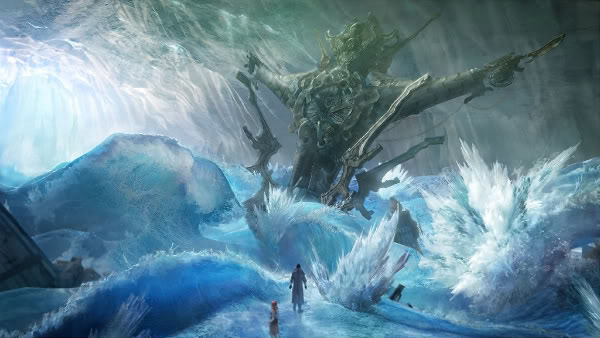
Jonathan Oyama: I think Final Fantasy 13 was a brilliant update to the FF10-2 system. I hated how that game forced me to move really, really quickly. In comparison, FF13 improved those battle components with things like paradigm shifts and chain-move queues. But it is taking a while for them to adjust to the new high-definition landscape.
Jeremy Signor: I actually loved 13, but it was definitely a pragmatic game, born of necessity and the difficulty of adjusting to the HD era. I don't think a lot more are going to be following that pattern, though, because Monster Hunter means companies have no reason to.
Daniel Feit: Risk aversion is messing with both sides of the ocean. In Japan, the companies don't want to take a chance on HD development, and they don't want to stray too far from their target audience, so you get a lot of handheld, samey-looking JRPGs that appeal only to a narrow group.
In the US, localization is seen as a risk because of the niche appeal plus the fact that handheld games aren't selling very well. One can only hope that the PSP Remaster series and the Vita encourage more Japanese publishers to try working with new platforms. That or they embrace downloadable distribution, though I have my doubts that will ever happen.
Jeremy Signor: Another issue is how some Japanese companies make a new engine for every game they create when everyone else goes with reusable ones. The reason 13 took so long was because Square was trying to make the White Engine, so it didn't have to make another one for future games. I don't know how many other Japanese companies are doing that. Konami is creating the Fox Engine for similar reasons, but it doesn't make JRPGs anymore.
Jonathan Oyama: I think the problem deals with storyline elements as well, though. I mean, Disney reportedly couldn't figure out the story of Kingdom Hearts 3 for the life of them.