Home
Home

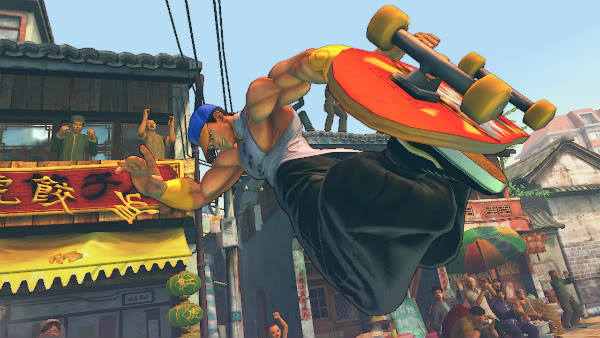
Balance between characters has always been a key part of modern fighting games. So why did Capcom design the latest installment of its premier franchise with clear kings of the ring in mind?
With the release of Super Street Fighter 4: Arcade Edition, Capcom intentionally made new characters Yun and Yang the standout warriors of the game. These twins had versatile offenses backed up by safe special moves, strong mix-ups, great damage potential, and decent defensive options.
The competitive community has had to deal with these kung fu masters since the game came out in arcades. But I also wondered what these two mean for casual or intermediate players. So I rounded up four Bitmob members to discuss the issue with me.
Together we talked about character balance, the tier lists players use to rank characters, and what companies should focus on when developing these fighters. Here is the full transcript, complete with footnotes for new players who are unfamiliar with the scene. For the abridged version, click here.
The community members are (in order of appearance):
- Jonathan Ore, a Toronto resident who writes for Bitmob and the local site Dork Shelf. He hasn’t entered any tournaments but follows the scene.
- Alex Spruch, a tournament player whose most recent event was GVN Winter Brawl 5 in Philadelphia, Pennsylvania. He writes for his own website, Spruchy.com.
- Chase Koeneke, a two-year Bitmobber who enjoys fighting games at a casual level. He also hosts the World 8 podcast.
- Daryl Bunao, a former tournament player from Northern California who has played at two Evo tournaments. He is an intern at Anime News Network and a former content producer for the Super Smash Bros. site All is Brawl.
Defining Balance
Chris: Since we're talking about character balance, we should start off by asking what your definition of a “balanced” fighting game is. Is it when every character has a fair change of winning? Is it when not everyone is viable, but you still have enough diversity to accommodate different play styles at a high level?
Jonathan: In pure theoretical terms, I think the former is true, where every character (save outliers like joke characters and A.I. bosses) has the same chance of winning against any other character...if the players are at the same skill level. Diversity of play style is more a comment on character depth than outright balance.
Alex: To me a balanced fighting game is when every member of the cast has options to deal with anything that might be thrown at them. Sometimes a character might not have the best answer (and that's what differentiates one character from another), but as long as they have some sort of options in all situations, then a game is that much closer to being balanced. It's when a character has the best response to everything that imbalance starts to show itself. A game can be balanced while not being as diverse, but conversely there have been fighters that have featured wild rosters that were not the least bit balanced.
Chase: I think the latter definition is more apt, but I don't begrudge a fighting game that balances all of its characters. As long as a variety of styles are available so that everyone can find something that works for them, I think you've got a winning formula.
This question seems more pointed to one-on-one fighters though. When it comes to games like Marvel vs. Capcom and Tatsunoko vs. Capcom, the idea of tiers starts to hold a bit more weight.
Daryl: I feel that a "balanced" fighting game offers the players an assortment of characters that should have an equal -- or at least what the community calls a “4-6 match-up” -- with the other members of the game's cast.
Chase: This is really why I prefer tag-style games. In a game like Street Fighter 4, every character is put under a microscope – which is why I believe the Yun and Yang controversy is getting so much press – but in a game like MVC, characters can be used more situationally (like how I use Haggar mostly for his assist and rarely for his fighting ability).
Alex: Yeah, but in a tag-game scenario, you're just putting characters under even more scrutiny by seeing what they offer with assists and DHCs (Delayed Hyper Combos). Also, tag games aren't free from grossly overpowered characters that can turn the entire match around (see: Dark Phoenix).
Jonathan: Yeah, MVC3 sort of throws game balance into a different sphere of discussion. Assists versus on-point, team orders, team synergy – it all becomes something that a single top-to-bottom list can never fully explain.
Haggar and His Amazing Lariats are the worst of the worst. I loathe facing down that every time I see him in the VS screen.1
Daryl: The problem with tag-team fighters such as MVC and TVC is that there are multiple variables that can happen at any point in time that can completely sway the match of a game. Personally, I dislike that kind of play, because it overshadows the hard work it takes to build a lead or mount an incredible comeback. Back in the day, if you were close to death, it meant a lot of work was needed to steal a victory. Though in this case, it's more about player skill than actual game balance.
Chase: I'm not saying tag games are perfect, but I do think they allow for more flexibility instead of a game like Street Fighter, or even Smash Bros., where a player can have a giant disadvantage right from the outset.
Yun and Yang vs. The World
Chris: I think Chase and Daryl both have points, though you can argue that in a vs. game, your team is really one "character" made from three parts that work together.
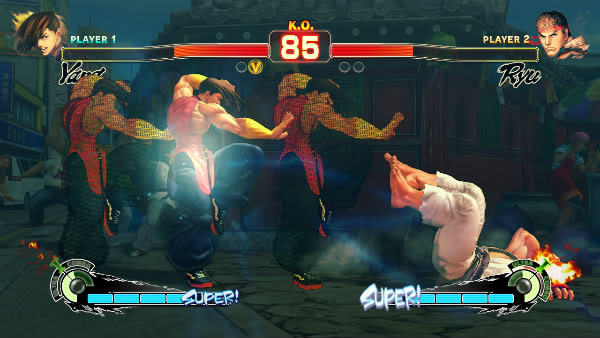
Going back to what Alex said about balance, are Yun and Yang characters that have answers to everything to the point that they marginalize the rest of the roster?
Alex: Hah, I'm glad you picked up on that, Chris, because that's exactly what I was going for. Yun and Yang are overpowered specifically for that reason: They have the best answers for absolutely everything. I don't think it marginalizes the roster, but it's definitely to a point where it makes the twins more appealing than any other character in the game.
Jonathan: Speaking of "giant disadvantage," I can't help but think of fighters like the Naruto games, where the characters' strength was directly proportional to their power levels, or whatever, in the anime itself. That was almost a positive of those games for that particular audience, though. The idea of barreling through every other competitor with Itachi in a Naruto game was horribly unbalanced, but it was a selling point.
Chase: That's a good point. When story starts to factor into these kinds of games, being unbalanced can be a good thing. Anyone know if Dragon Ball Z: Budokai did something similar?
Daryl: When it comes to characters displaying heightened abilities, the general fear that gamers can allude to is the dominance of Magneto, Storm, Sentinel and maybe Cable in Marvel vs. Capcom 2. What I would like to say is that both Yun and Yang are new characters, and it will take some time to fully determine whether or not the rest of the SSF4 cast can find tools to counter the twins.
The reason why Magneto, Storm, and Sentinel dominated the tournament scene for MvC2 is that, over time, competitive players would sign their souls to these characters just to come out on top, thus creating a following of like-minded players. If Yuns and Yangs start topping tournament listings and all the top players migrate to them, which I doubt, then there could be some knee-jerk reaction to prevent the game becoming a one-sided fight.
Jonathan: Yun and Yang are problems for sure, but I'm fairly sure they represent a unique problem in that they were designed to be stronger than the rest of the cast from the outset. I think the designers' intentions were to make them very appealing because the rest of the cast had been playable in SF4 for up to three years already, so it would easily shake up the roster and how other players reacted to them. Compare them to Evil Ryu and Oni, who generally didn't re-write the book on how people are playing the game.
Daryl: Chase, I remember playing one of the Dragon Ball fighting games, and if someone played a weaker character storyline-wise (like Krillin) vs. the ultimate form of a boss character, the boss character would simply do more damage and have greater defense. It may not be fair, but it tries to replicate an already existing plotline.
Chris: Actually, the DBZ talk has a point: It is a selling point for Goku to be so much stronger than, say, Cell Jr. And this feeds into this discussion: Since, at the end of the day, Arcade Edition is a product, you could think of Yun and Yang as a selling point for arcade goers, who tend to be of a higher skill level.
Alex: I don't know if time is going to change anything regarding the twins. The game has been out in Japan since December, and the only weak match-ups for the twins have been Zangief and Sagat (I think Fei Long might do decently as well).
Jonathan: Do tournament results and compiled tier listings really matter to a fighting game beyond the die-hard enthusiasts, though? Character imbalances, except for the more outrageous, egregious examples, don't really manifest until we're talking about players of high skill and execution, who know the ins and outs of most or all possible match-ups. For most players who play online or among friends casually and don't enter into tournaments, it's a basic case of "more skilled equals more wins," regardless of the character used. Right now in Arcade Edition, I have as many problems with a good Abel player as a good Yun player in my skill bracket.
1Vs. games like Marvel vs. Capcom 3 are designed around team synergy. Some characters, like Dante or Magneto, are meant to be your main fighter (on point). Others, like Haggar, are lousy on point but have a great partner assist that helps your main fighters (in this case Haggar’s invincible lariat).
Delayed Hyper Combos are when you cancel your first character's super attack into your second character's super. It takes at least two super meter bars to perform, but it's the safest way to tag someone in.
Dark Phoenix is Phoenix’s transformation super move. You need all five super meter bars and your opponent to KO Phoenix to activate it, but Dark Phoenix is obnoxiously powerful. When coupled with the game’s X Factor ability boost her only weakness is human error.