Can horror games truly haunt us?

Default_picture
Thursday, October 27, 2011
EDITOR'S NOTEfrom Rus McLaughlin

For me, the big downfall of horror games is in the casting. I'm less scared when playing as a well-armed badass with regenerating health and freaky mutant powers that I use on anything that moves.

Remember watching a horror film as a child and feeling afraid even after the film ended? Then, when bedtime approached, you’d cut out the lights and leap under the covers in one swift, pre-planned motion. Those terrifying possibilities had invaded your mind. 

Why can’t games do that?

I can be completely immersed in games like Amnesia, Fatal Frame, and Silent Hill and feel frightened by them. But once I stop playing, all that fear goes away. On the other hand, when I watch films like The Ring, The Strangers, and Paranormal Activity, a few jump-scares might get me, but that’s about it. When I start thinking about them later on, however, that's when they get me. I don't leap under the covers anymore, but I’ll admit to leaving the radio on or sleeping with my back to the wall after watching a good horror flick.

Can scary games truly haunt us they way horror movies do? Maybe...but they generally start with three big disadvantages.


Setting

Movies typically exist within the real world, whereas games have original locations. When someone or something invades a home in a film, it reminds you that bad people can try to harm you and your family. Because films typically use the real world -- our world -- as their environment, they’re already pushing the boundaries of the fourth wall.

Horror games typically utilize more extravagant places, such as the wierdness of Silent Hill or more outlandish sci-fi settings. While these can be scary, it's tougher to imagine ourselves in them. I will never wake up in Silent Hill, nor will I ever set foot on a space station.
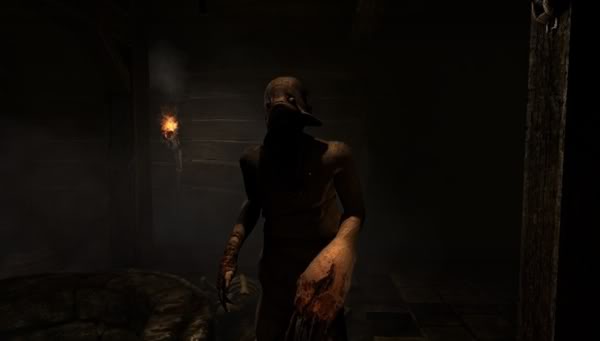
Amnesia the Dark Descent

Even when games like Condemned: Criminal Origins and F.E.A.R. use realistic locales, they stumble into a different pitfall....

Plot

Horror games tend to weave much more elaborate tales than movies do. F.E.A.R., Condemned, and the Resident Evil series have crazy stories that may or may not make any kind of sense. Either way, I’ll never deal with government conspiracies, special powers, or Umbrella's evil-corporation shenanigans. Those things never leave the confines of a game.

Sometimes horror films use more elaborate setups, but more often they keep it simple. The Strangers' basic (albeit overused) plot goes like this: A couple rents a secluded cabin in the woods and is subsequently attacked by masked hooligans. When asked why they’re committing these atrocities, they reply, “Because you were home.” That’s it. In The Descent, underground monsters attack spelunkers. Why? Because that’s what underground monsters do.

Resident Evil Operation Racoon City

Those plots aren’t noteworthy, but most people hold an instinctive fear of the unknown, and everyone gets genuinely uncomfortable at the idea of having their home invaded. I also now feel some ambivalence about going on a spelunking trip.

Presentation and interactivity

Games have a way of constantly reminding us that we’re playing -- what else? -- a game. Health bars, ammo counters, and inventory screens constantly intrude. If more games got rid of these tropes the way Dead Space did, there’d be one less barrier between the character and player. But here's another: I don’t actually interact with anything in the game. I interact with a controller, which then tells Alan Wake what to do. That also removes me from the action.

Dead Space 2

I’m frightened when enemies surprise Alan, but I don’t fear for my life. If anything, I fear for Alan’s life, and I can't say I do that every time. Six enemies attack him, but what's Danny up to?  I'm sitting comfortably in a chair with a controller in hand, making Alan shoot the bad men down. Sometimes I'm only afraid that I'll have to restart at the last checkpoint, and that's often the only thing at stake. This happens as many times as necessary. I will beat the game, and Alan will emerge (somewhat) triumphant, because that's the only possible course of events.

Films give viewers no power whatsoever. You can root for someone, but the writer and director ultimately decide their fate. That's something an audience has in common with a typical horror-movie character: powerlessness. We’re reminded of our own fragility when that character dies. Not Alan Wake’s. Not Isaac Clarke's. Ours


In order for horror games to transcend our screens and linger in our minds, they must abandon many of the elements that make them entertaining experiences. They'd have to strip down to the basics. Relatable characters. Common settings. Simple mechanics. More importantly, they should craft a strong connection between what happens in the game and what's happening in the gamer's real life. Play on the primal fears that we never feel truly safe from, even from the comfort of our own beds.

What elements do you think horror games need to instill a lasting fear?

 
Problem? Report this post
DANNY CONCEPCION'S SPONSOR
Comments (11)
Default_picture
October 09, 2011

Nice article! In my opinion, a horror tactic that works well across all media is the purposeful omission of details and information. To explain further, this happens when a reader (or viewer) is given a creepy situation and is only supplied with vague hints of the underlying cause. This causes the reader  to unconsciously fill in the gaps with the scariest thing that the reader can think of. It's such a great tactic because the reader supplies his own content from his imagination and, in essence, scares himself. Plus, by not supplying a concrete cause for the spookiness, it allows the author to write a story that can scare the most amount of people.

This occurs a lot in internet "creepypasta," or creepy copy-paste stories. For example:

"The next time you wake up groggy and tired, don't move. Take a glance at your mirror; if you're lucky, you might catch a smile."

and

"Real population of Earth: You'd be surprised to learn how few actual people there really are in the world. "

Default_picture
October 09, 2011

If you watch every State of the Union Adress since it's been filmed and available on tape, you'll see that halfway through--exactly halfway through--the President always says the same word. Most say it under their breath during the standing ovations, but some are forced to work it into the speech itself.

What's the word? You don't want to know.

----------------------------------------------------------------------------

If you take any Swiss Franc note and expose it to microwaves, it will curl up and ignite. Once it's cooled down, you'll find a fine powder that, when ingested, will kill you painlessly. A 10 franc note has enough poison to kill a family of four.

-----------------------------------------------------------------

"Daddy, I had a bad dream."

You blink your eyes and pull up on your elbows. Your clock glows red in the darkness—it's 3:23.

"Do you want to climb into bed and tell me about it?"

"No, Daddy."

The oddness of the situation wakes you up more fully. You can barely make out your daughter's pale form in the darkness of your room. "Why not sweetie?"

"Because in my dream, when I told you about the dream, the thing wearing Mommy's skin sat up."

For a moment, you feel paralyzed; you can't take your eyes off of your daughter. The covers behind you begin to shift.

Default_picture
October 09, 2011

To truly succeed, horror games need to creep us out, to make us feel a lingering discomfort after we've put down the controller and turned off the system. I've never had that experience with a game. I've had plenty of great jump scares, but no lasting shivers. 

Even in other media it seems like a rare feat that only the masters can accomplish. 

Default_picture
October 10, 2011

Too many horror games get obsessed with details. I get pretty tired of how every game tries to make things seem real by using the first-person perspective camera. The truth is that we will feel even more scared if the characters face a situation that is frightening and realistic enough.

For instance, the Resident Evil series didn't grip me until I played the fourth installment. They relied a lot more on the actual characters to create the survival drama of a dreadful situation, rather than the scientific conundrum of the Umbrella Corporation. Resident Evil 4 executed this by using getting realistic character models stuck in situations with little chance of surviving.

It's really hard to get people stuck in these situations. I think it's also hard to do it without using awful controls or grainy graphics, but the developers need fleshed-out characters with deep backstories to make this more possible.

Default_picture
October 10, 2011

I agree with all of you.  Unanswered questions do cause me to fill in the blanks myself.  I was recently reading about The Dark Knight, and how Christopher Nolan didn't want to do an origins story for the Joker, as it would make him less powerful in the eyes of the viewer.  

While it's not a horror film, I do see a connection between that idea and what both Fox and Jonathan are talking about.  We never know where TDK's Joker came from, and it makes him that much more intriguing.

Shoe_headshot_-_square
October 27, 2011

Very good article. Kinda makes you think!

Utopianacht-100x100
October 27, 2011

right now I got scared a lot with Dark Souls and those dark forest... the fear of dying.. and the fear of loosing all my souls... two weeks ago I was playing Fear2.. and wasn't scary at all...

Profile
October 27, 2011

I can't give a fair opinion since I'm a wuss. The Suffering scared me for crying out loud!

Default_picture
October 27, 2011

Interesting read. In general, I think that games ought to tell more personal stories...better for us to relate. This attitude would serve a number of previously untapped (or imperfect) genres like horror.

Default_picture
October 28, 2011

Good Article! Though I have another 2 reasons precluding the lasting impression.

Reason #1-You almost never complete the game and experience its story in one sitting. Usually, most gamers will save and quit at a safe area or checkpoint, then come back at a later time. This in turn would be like stopping the movie every few minutes in which there is no forseeable scares, then returning in a few days to rinse and repeat. It definitely reduces the creepiness and lingering effect. 

Reason #2- Game engines aren't good enough yet. Yes, I know graphics aren't everything, but when was the last time you were truly scared of an animated movie? For me, it has yet to happen; all the movies that truly had a lasting effect were live action films. Furthermore, simple things like glitches pertaining to the audio or stutters in the graphics can ruin the much-needed sense of immersion. 

Default_picture
October 29, 2011

Good points Joe.  I never really thought about how play time factored in.

You must log in to post a comment. Please register if you do not have an account yet.