Home
Home

Ethan approaches Dark Souls from a literary point of view and demonstrates how narrative, gameplay mechanics, and world design all express and reinforce the themes of death and rebirth in glorious harmony.
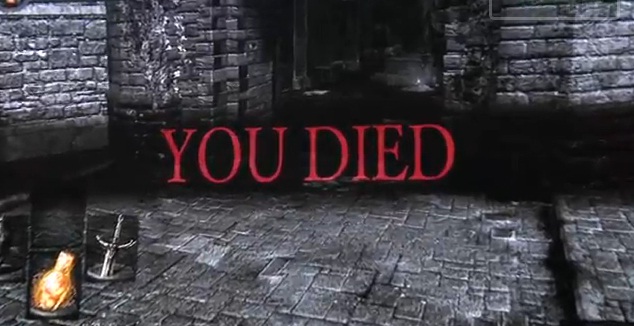
Dark Souls, developed by From Software and released in 2011, redefines the idea of death in video games. In fact, death is integral to the game in every capacity, including its gameplay, minimalist story, and how the character interacts with other players online.
Dark Souls takes place in a world that is on the verge of death, only to be reborn in a new "Age." As it explains at the beginning, the current "Age of Fire" is ruled over by these god-like beings who use the power of souls to keep all-powerful bonfires lit across the world, with the implication that these bonfires grant immortality for these god-like beings.
The game begins towards the end of this Age, where the Lord of Cinder, Gwyn, notices that the bonfires were waning and first sacrifices his status as a god to keep them lit. When this fails, he then curses humans with a "dark sign," which forces them to be reborn as undead after they die, thus trapping them in a cycle of dying/rebirth until one of them manages to become powerful enough to sacrifice himself to the fires, and thus keep the Age of Fire from ending.
The only problem with this is that eventually, the humans afflicted with the dark sign end up going mad and eventually just become zombies who will mindlessly attack anything. Your player is one of these undead -- in fact, the "chosen" undead who will be able to supplant Gwyn and either choose to end or prolong the Age of Fire.
Sounds confusing? It really is, but we'll get to the story soon enough. I didn't even really do the full story justice, but it is a very long, dense, and confusing narrative to pick up in one blog post.

This theme of death and rebirth permeates through every facet of this game. Let's start from a gameplay aspect: The game is a third-person, action role-playing game -- and one that is infamous for its perceived difficulty. In fact it may be one of the most difficult games that I have ever played.
Dark Souls is an open-world dungeon crawler, where the dungeons intersect with one another in one gigantic world and where the player is free to move from one to the other (for the most part) as he unlocks them. It is a massive world where the player is one tiny, insignificant speck in it.
He can adorn himself in armor and the best weapons, but even with great equipment, the player lives in a world where large demons and hordes of zombies lurk around every corner; where every place is laden with traps, ambushes, and other horrible surprises that often result in instant death. Interspersed are larger boss creatures, usually massive in size or great in power, whose fights, even with the best preparation, are incredibly testing of one's skill.
And from a gameplay aspect, you are just a weak, pathetic human who must traverse all of this in order to complete the game. The player's life and stamina bars are incredibly small -- usually a few good hits from even the weakest of enemies can put him in danger of dying. Thus, it becomes imperative for the player to continue to adapt to whatever situation he is in as each new area requires modifications to equipment, the character's statistics, and play style.
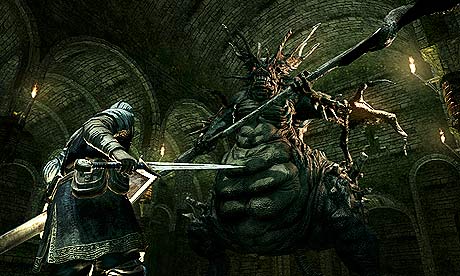
Even with the stats optimized, the player still feels vulnerable in most battles; most powerful weapons have slow attack animations, leaving the player wide open after swinging, as does drinking the "Estus Flask," which is the player's health potion for the game. Death is never very far away whenever one plays in Dark Souls and can come at any time (the game doesn't even allow you to pause!).
Needless to say, the player will die many times over the course of the game, and each time he does, he loses all the souls he has collected (the games currency, which is gained from killing other enemies) and is reborn back at the last bonfirewhere he rested. Further, all the enemies in the area will also respawn whenever the player decides to rest at the bonfire.
This makes resting at certain areas a precarious gamble as one can easily become stuck in a dungeon with no easy route out. For all of its difficulty, though, the game is frustratingly addictive since when you finally conquer a tricky section or boss, it really makes all of those times you had died really worthwhile.