La-Mulana vs. Dark Souls: Which has the best approach to difficulty?

Default_picture
Wednesday, October 17, 2012
EDITOR'S NOTEfrom Rob Savillo

A little frustrated with Dark Souls at all? Alexander argues that La-Mulana, an exploration-focused platformer in the Metroidvania style, better approaches character death in this game design analysis.
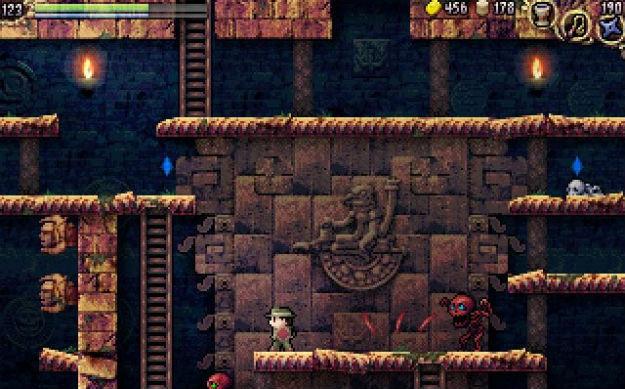
La-Mulana vs. Dark Souls

Part of what makes a video game great is how it teaches the player. Even difficult games like La-Mulana and Dark Souls teach you how to overcome deadly challenges. Both are equally hard and rewarding to explore, yet Dark Souls is more punishing in death while La-Mulana retains the fun of exploring after death.


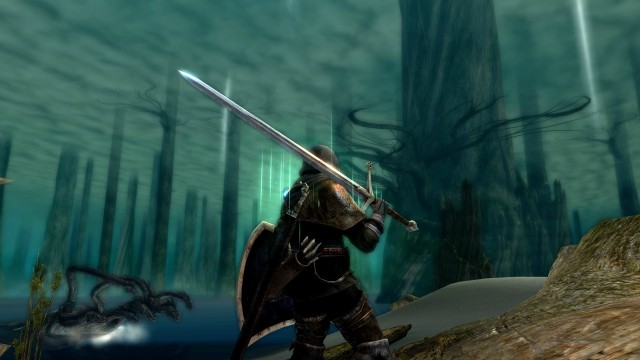
Dark Souls offers amazing areas to search. In Dark Souls, you explore the undead ruins of Lordran, where great treasure is hidden behind dangerous monsters. Some locations that you can visit are the low-level-yet-tough Undead Burg and the silent beauty of Ash Lake.

However, Dark Souls twists its rules to punish you. An autosave feature is always in effect, which prevents you from making multiple save files for a single character. Another penalty comes from valuable resources like "souls" and "humanity" being lost with each death.

Hence, Dark Souls is like a hard arcade game, demanding that you to replay at the cost of resources.  You need souls to improve your character and gear. Yet each death robs you of your souls and requires you to do the annoying "corpse runs" that were never fun in Diablo II. If you die again before getting to your bloodstain, you lose your dropped souls and humanity. You will have to spend time doing boring runs, like gathering 7,000 souls in Darkroot Garden.
On the other hand, La-Mulana is more lenient with saves and death. You can have multiple save files used at different locations. So if you are stuck in the Mausoleum of Giants level, you can reload a save from the surface level. Plus, when you die, you only lose money and weights (i.e. keys) earned after your last save.

Both games are great at encouraging exploration. In Dark Souls players might find a nice sword next to a dead dragon (and then die). La-Mulana might open up new paths with a stone giant falling asleep next to a ladder when a puzzle is solved (or the stone giant falls onto you).

Unfortunately, the fun of exploration is halted in Dark Souls when a player dies. Both games start you back at a checkpoint upon death. Yet with Dark Souls players will need to get to their bloodstain if they want to get their souls and humanity back. The player has to navigate through the same monsters, traps, and locations just to reclaim what they lost.

La-Mulana keeps the flow of exploration engaging even after death. You don't lose all of your money and weights gained after a save point to a tough boss fight, and you don't have to run back to the area to reclaim what was lost. If an area is too difficult, you can explore another part of the ruins and solve different puzzles.

Video games would be boring if players are not learning anything from them. In the case of Dark Souls and La-Mulana, these are games teaching you that exploration and death can become the norm. But how to make that death engaging is where the games separate. La-Mulana keeps you exploring for new challenges after death. Dark Souls is a game that asks you for more of the their time with each death.

 
Problem? Report this post
ALEXANDER KRAUS' SPONSOR
Comments (9)
Robsavillo
October 17, 2012

I have to disagree strongly here. While I really do want to check out La-Mulana at some point, your description of how the game handles character death and save files is deterring. It sounds very archiac at this point, especially so after the Souls games have shown how to do it better.

You're essentially arguing that players should be allowed to engage in save scumming to circumvent the game's design. I love that the Souls games have autosave enabled by default because that means that the consequences of your decisions have meaning. In the words of game designer Keith Burgun: "If you can reload after making a bad choice, then that choice gets no chance to have effects on the game."

But I really don't understand the distinction you're drawing here. Even though Dark Souls sends you back to a bonefire on death, the game only resets monsters. Items you've found, conversations you've had, doors you've unlocked -- all of that remains after death. And this gives the game world more permanence. In the case of La-Mulana, reloading a save means not only killing the same monsters again (which you criticize Dark Souls for but not La-Mulana) but redoing everything you had done after your save. That means refinding items, reopening doors, etc. That's archaic.

And I think you put too much emphasis on souls and humanity. Sure, they're an important currency in Dark Souls, but they do not gate you from progress at all. The videos of players beating the final boss as level 7 characters is evidence enough -- Dark Souls is primarily skill-based, not stat-based.

Default_picture
October 17, 2012

"And I think you put too much emphasis on souls and humanity. Sure, they're an important currency in Dark Souls, but they do not gate you from progress at all. The videos of players beating the final boss as level 7 characters is evidence enough -- Dark Souls is primarily skill-based, not stat-based."

Exactly. Leveling up really doesn't mean anything in DS. It's more important to learn the reaction times and patterns of each foe. Losing your humanity and souls suck, but it's not the end of the world and it never hindered the game for me. I thought it was just punishment for whenever I was too hasty or actin' a fool.

Default_picture
October 17, 2012

Strong words, Rob, but we clearly see a difference in opinion between the two games.

Could a player save-scum in La-Mulana?  Yes.  Would it get them further then making a bad decision?  Not really.  A tough boss fight in La-Mulana is not going to get any easier because you reload from a previous save - it still remains just as hard.  Similar to the puzzles and traps that are in Dark Souls.  The player needs to build awareness of patterns in boss battles and recognize clues with puzzles to progress further.  With save-scumming, that could be used to exploit RPG mechanics to get a character the best loot, hoard XP, and tackle the least difficult monsters in the game.  The save-scumming example, to me, would only apply if a game was randomly generated like Torchlight II.  La-Mulana and Dark Souls are pre-designed with fixed monster spawns, items, puzzles, and levels.  So a player thinking that if they can save-scum in La-Mulana to get ahead - i.e. trying at a previous save point and expecting the random generator to go in their favor - is the definition of an idiot.

I also think you are confusing player experience versus inexperience with the value of "souls" and "humanity".  You claim Dark Souls is a skill-based, but it is also an action RPG.  Every player starts out with a weak character when they start the game - the hardcore fans of Dark Souls, and newbies that are not familiar to the game.  Some might have good equipment (Thieves starting with the Master Key) that hardcore fans are aware of, but a newbie isn't aware of this.  They are just trying the game out for the first time, completely oblivious to the core mechanics of the game.

Thus an inexperienced player might find value in these resources.  They find a nice weapon next to the undead dragon in the Valley of the Drakes, but can't wield it right?  Go farm up some souls and level up.  Start as a naked cave-man and would like to get some fire-proof armor?  Gather some humanity to grind on the monsters in Undead Burg.  They think they need more resources - like any other RPG teaches them - so they focus on getting to a higher level by spending their souls.

Yet, as you stated, hardcore fans of Dark Souls will shake their head no at this.  "Silly player!" they say, "Souls are not meant for that!  Just go explore this place to get some better gear and you won't die so much."  Dark Souls never tells a newbie player these are worthless in the long-term, but they only learn through trail and error or by listening to hardcore fans like this.  So they are stuck with a level 150+ sorcerer with 100 points in Intelligence, frustrated that their build and choices are not the right ones, and so they have to make a final decision:  Continue on with a broken character confirmed by many hardcore fans, or just restart from the beginning with the "experience" they gained with their first build.

This is the big difference between La-Mulana and Dark Souls:  Flow.  Both games kill you frequently and require you to learn from your mistakes.  But with Dark Souls there is no going back with that auto-save feature and no way of removing all of your souls based upon what hardcore fans claim.  Newbie players that decide to restart obstruct the "flow" of the game, unable to explore further but tread through the same areas, respawned monsters, other previously explored areas before they can find the new locations.  Dark Souls is a skill-based game - but also a game that encourages exploration.  La-Mulana keeps that constant stream of areas to explore flowing even if the player dies multiple times, and Dark Souls does this as well.  But Dark Souls is snickering like a sadist Dungeon Master behind their DM screen, knowing that the player is slowly dooming themselves every time they get another level up.

You're right that the player doesn't lose all of their hard-earned items and skill-based experience when they die in Dark Souls, but many will be pissed that they have to restart at the beginning again because they didn't know how to use their souls.

Robsavillo
October 17, 2012

Save scumming is just reloading to erase the effects of a poor decision. You talk about holding onto multiple save files just in case you put yourself in a poor position, which basically means redoing parts of the game so that you are ahead of where you were before you reloaded. You're undoing the consequences of your decisions.

It sounds like La-Mulana just ends at a "game over" screen when you die, and that's a shame. That's completely archaic design, a leftover of the arcade era. Dark Souls instead makes death a part of the gameplay loop -- dying doesn't halt your game. It has consequences, but you're not forcing your character through a place again as if it were the first time.

Some of your points on stats and difficulty for new players were covered in this game design analysis by Robert Boyd. The Souls games actually turn experience points and leveling upside down. And it should become obvious as you put points into your character that leveling is not as worthwhile as you thought: Each successive level costs many more souls while at the same time providing you with diminishing value. Each level increases your character's stats less and less but costs more. This also discourages farming since your time investment is worth less and less as you progress.

Observant players will notice this and adjust their gear strategy accordingly.

I'm also really confused by your flow argument. Wouldn't having to load a save be the explicit act of breaking flow? You're forcing the player to do the same exact things over and over as if each time is the first time. Dark Souls actually has flow because, as I mentioned, death is woven into the gameplay loop.

Who are these newbies that are starting new characters because they lose a bloodstain? I've never heard of anyone doing that. What would be the point? Starting a new character or continuing with your current one would be essentialy the same thing. In fact, it seems to me that starting over would be worse, and it would be unwise since there are really no points in Dark Souls where you can become trapped in a corner.

Default_picture
October 17, 2012

How is a "game over" screen archaic, and how does this not apply to the "You Died" screen in Dark Souls?  I agree with you that this is a leftover from Arcade games, but I believe Dark Souls follows this rule more than La-Mulana.

Yes, when you die in La-Mulana you are sent back to the title screen.  But you still restart at a previous checkpoint similar to the bonfires in Dark Souls.  Both make you lose your previous location, such as in the middle of a boss fight and getting it down to half health.  However Dark Souls, keeping you in that game loop, will remove your souls and humanity upon death.  This reminds me of arcade games.  They keep you in the game loop and ask "do you want to continue?" along with holding out their hands for some change.  Otherwise you are sent back to the title screen, with wasted time because you couldn't afford another continue.

When I think of La-Mulana I also think of Super Meat Boy or I Wanna Be the Guy (IWBG).  Equally hard games, requires skill to survive, but lacking in RPG mechanics, unlike Dark Souls.  Super Meat Boy doesn't have a game-over screen but IWBG does, yet both are easy to restart from a previous checkpoint.  La-Mulana is similar in concept.

As for your mentioning of Robert Boyd's game design analysis, that is my point with experienced, hardcore gamers versus inexperienced, newbie gamers.  Let me put it another way:  If Dark Souls turns the idea of experience points and level ups as a negative penalty compared to other RPGs, then why allow players to use that mechanic?  Why remove the souls (experience points) when they die?  What harm would there be if these archaic RPG mechanics were removed from the Souls games?  As you, other hardcore fans, and myself know:  Nothing.  As you established, this is a skill-based game that doesn't rely on statistics, right?

You claim there is no way a player can get trapped in a corner in Dark Souls, yet this use of RPG mechanics is that corner.  Fans of RPGs (like me) who are newbies to Dark Souls will get ourselves trapped in this corner.  We believe that the next area is too high level for us, so we spend the souls on that system you defined is a penalty and not a blessing.  Newbies are slowly digging themselves into that corner each time with a level up.

Another question to you:  When does a newbie learn about this trap-like RPG mechanic in Dark Souls?  Is Robert Boyd's article available as a free item to read in the game?  No, newbies learn it from experienced, hardcore gamers to Dark Souls.  There are Youtube videos of experienced gamers to Dark Souls taking down the final boss with a level 7 character.  Newbies seek help in Dark Souls after dying with shame using a level 70 character.  And here they learn that all that investment, farming for and hoarding of souls, is a pointless effort.

If what you are saying is true about the RPG mechanics in Dark Souls, then this has to be abhorrent RPG I ever played.  I'll accept Dark Souls having a good difficulty scale along with La-Mulana and Super Meat Boy if it was a skill-based game, as you claim it is.  Yet it still has those level ups, those experience points, and the stats determining how much you can carry before you cannot roll around anymore.  Players will screw themselves over if they fall into this RPG trap.  They can't undo their "mistake" you and other hardcore fans are calling them out on because of the auto-save feature.  So should newbies just grit their teeth and trudge forward in Dark Souls, or restart with the "wisdom" bestowed upon them by hardcore gamers?

I choose a third option:  Screw Dark Souls and just play a better "hard" game, like La-Mulana or Super Meat Boy.

Robsavillo
October 17, 2012

You said it yourself: "Game over" sends you to the title screen. "You died" doesn't do that. After you die in Dark Souls, the game world has changed -- it now contains your bloodstain. Dying in Dark Souls is always forward moving. Going back to the title screen and reloading a checkpoint is going back in time. That's the very definition of breaking flow. You're saying that La-Mulana stops the game and backs up. I'm telling you that Dark Souls continues forward even when you die.

Players won't screw themselves, and Boyd explains why in his analysis. That's the point I was making. The stats in Dark Souls cannot be a trap because they ultimately don't matter that much. It's Boyd's third point, and the subhead sums it up succinctly: "It's difficult to truly mess up your stat progression."

And I think players learn this intiutively just from playing the game. If you're paying attention to the mechanics and how they interact, it becomes obvious that you can't screw yourself with stat progression.

You're still putting too much emphasis on souls. They are your currency, sure, but not having them doesn't impede your progress. And if you want souls, you can easily get them. They are the most abundant resource in the whole game!

The bloodstain mechanic isn't really a corpse run akin to Diablo, either. You don't drop your weapons or armor or items or anything like that (you keep all that stuff). The only thing you do lose (but have the option to reclaim) are two renewable resources. The bloodstain is a way to create tension on your second attempt through an area.

And one thing that death in Dark Souls can never take away is your own personal progression as a player. Your better understanding of the game mechanics should see you through to the end eventually.

Default_picture
October 17, 2012

"Another question to you:  When does a newbie learn about this trap-like RPG mechanic in Dark Souls?  Is Robert Boyd's article available as a free item to read in the game?  No, newbies learn it from experienced, hardcore gamers to Dark Souls.  There are Youtube videos of experienced gamers to Dark Souls taking down the final boss with a level 7 character.  Newbies seek help in Dark Souls after dying with shame using a level 70 character.  And here they learn that all that investment, farming for and hoarding of souls, is a pointless effort."

I disagree. Newbies don't learn it from experienced youtubers unless they've decided not to play by the game's rules and learn the proper way to play it on their own. I would argue that Dark Souls isn't really concerned with newbies at all. Think about its advertising. All of it based around the challenge that you cannot be this insurmountable opposition. There's the joy in Dark Souls. If you get a kick out of that, it works for you. If you don't, you move on to something else. I wouldn't say that  Super Meat Boy (I can't speak for La-Mulana) is a better "hard" game. It's just different.

Default_picture
October 17, 2012

I have to disagree too. Where Dark/Demon Souls shine is exactly the mechanism of having to reach your corpse again, after you die.  Its the 'do I dare to turn this corner, or do I flee back to the Nexus/bonfire' attitude that gives the game its edge that any save-enabled game cannot. If it's easy to simply save anywhere, there is no risk of going around that corner. If an unbeatable boss awaits you areound the corner, but you can simply go back to a savegame, where is the risk?

There literally is no fun in that at all...

164509_184978324846425_100000027754882_677051_4358835_n
October 17, 2012

I was just thinking of Dark Souls' difficulty recently, but not in connection to La-Mulana  (which I've never heard of). I was comparing it to XCOM. I'm currently playing XCOM in Ironman mode, normal difficulty, and find the single save file just as stressful as I did in Dark Souls. But unlike Dark Souls, XCOM doesn't feel as soul crushing. Even with a team full of rookies, little funds, and several countries gone, I still feel a shred of hope. I lost all hope in ever defeating Dark Souls a long time ago.

You must log in to post a comment. Please register if you do not have an account yet.