Home
Home

When people played the first fighting games, they probably didn't expect them to evolve with deep storylines on the dramatic level of Blazblue. Even today, some gamers wouldn't say that fighting game plots are the most memorable. However, the current fighting game narratives are much more epic than the comedic centerpieces they used to be.
With this article, I'm hoping to show how the one-on-one fighting game's story mode developed from humorous cartoons to serious tales of heroism and courage. This article will show how the story started as little more than a way to reward people for plunking in all their money to beat the boss. It eventually developed to the point where it would captivate gamers with long, branching serial novels where fighters fought friends and villains in long-time rivalries.
The entire concept of the fighting game story started way back in Japan, in which Capcom was unsuccessfully competing against SNK's powerful MVS (Multi-Video System) in the coin-op wars.
Street Fighter 2 - March 1991
Developer: Capcom
Platform: Arcade, Super Nintendo, Genesis
When Capcom released Street Fighter 2 on the CP system arcade board in 1991, it changed every part of the fighting game by revamping the graphics and including the first actual dialogue in head-to-head fighters.
Most people probably wouldn't call it much of a story, since the only real dialogue came in a short sentence after a player defeats another character.
Still, the dialogue is a far greater development from the earliest fighting games, Yie ar Kung Fu and Karate Champ. Street Fighter 2 was one of the first fighters where the characters actually spoke to each other through on-screen text.
The endings, on the other hand, were a little silly to watch. They looked like Mickey Mouse cartoons with pixelated icons. They were more like simple rewards for the players who plunked in all those quarters to beat the boss.
Fatal Fury - November 1991
Developer: SNK
Platform: Arcade, Super Nintendo, Neo Geo, Mega Drive
Other companies immediately tried to replicate Capcom's success. SNK was one of those companies, releasing the first Fatal Fury game in only a few months after Street Fighter 2.
SNK was lucky to hire Takashi Nishiyama and Hiroshi Matsumoto, two planners of the first Street Fighter. Although Fatal Fury played more like a better-looking clone of the old Street Fighter, it featured a much richer narrative.
In Fatal Fury, the protagonists are trying to clear the streets of crime. Terry Bogard, Andy Bogard and Joe Higashi are buddies who travel around the fictional city of South Town. Their mission is to take out Geese Howard and his criminal empire of thugs.
Fatal Fury had a pretty inconsistent storyline. Players only uncovered the story after so many battles. It also still included the goofy section where the fighters win a trophy at the end.
It was a step in the right direction though, because it introduced the concept of an unequivocally evil bad guy at the end of the game. SNK's later fighting games would end up carrying this idea in numerous other fighting games.
Mortal Kombat - October 1992
Developer: Midway
Platform: Super Nintendo, Genesis
Many American companies produced fighting games to try and mimic the success of Street Fighter and similar Japanese fighting games. Only Midway was able to capitalize on this genre with its fighting game franchise, Mortal Kombat.
It's hard to take Mortal Kombat too seriously. Most of the characters end up getting killed multiple times anyhow. The story tended to poke more fun at the concept of fighting games in general, with some goofy, implausible endings told in text boxes.
One of the characters, Johnny Cage, had one of the funniest conclusions in a fighting game. He was lucky enough to survive the next tournament and he supposedly produced the Mortal Kombat movie and it's many sequels.
At the time, it was a pretty funny joke. Then the Mortal Kombat movie came out and made this ridiculous joke a reality. As the series developed, the story slowly developed into a dark, post-apocalyptic tale. Unfortunately, the franchise fell out of favor when one of its 3D sequels, Mortal Kombat 4, failed to meet expectations in 1997.
With the success of Mortal Kombat vs. DC Universe in 2008, people gradually started to return to play this franchise again. Ironically, American audiences remembered this game more for its comically violent approach to the martial arts genre. After all, it's too hard to take a fatality too seriously.
Ranma 1/2: Hard Battle - December 1992
Developer: Atelier Double
Platform: Super Nintendo
Not too many people have heard about this fighting game, developed by a relatively unknown Japanese company named Atelier Double. Unlike other fighters, each character in Ranma 1/2 had their own unique story to follow.
In this game, all of the characters from the Ranma 1/2 anime are fighting in a tournament held by the principal of Furinkan High School. The grand prize is one wish of their choice. Each character's path was told in incredible detail with still images and clever dialogue throughout the entire game.
The fighting system wasn't as spectacular as the narrative, but Capcom and SNK adapted these unique storytelling styles in many of their later games. Eventually, Arc System Works developed this storytelling method to an even greater extent.
Samurai Shodown - August 1993
Developer: SNK
Platform: Arcade, Neo Geo, Super Nintendo
SNK didn't realize the potential of the fighting game storyline until 1993, when they released Samurai Showdown for the Master Video System arcade machine. Rather than settle with using still images to tell the entire story, Samurai Showdown used the actual character sprites in the ending.
Samurai Showdown didn't just tell a boring story about a fighter winning the tournament. In this game, still images and animated sprites were coordinated with a wide variety of dramatic music text dialogue.
This game was a pivotal step forward for the story mode. For once, players could actually connect with these characters in a deeper storyline. Each fighter had their own unique way of leaving like a legendary samurai. The most clever endings included a cameo by Mai Shiranui from Fatal Fury 2.
Bushido Blade - September 1997
Developer: LightWeight
Platform: Playstation 1
Most of the early 3D fighters are embarassing to watch nowadays, because the technology wasn't nearly as advanced as the powerful consoles of today. They were more popular for the 3D polygon figures, which looked far more impressive than the skeletons of Virtua Fighter 1.
Many of the characters look like polygon mannequins by today's standards, though. Even the voices sound like they were slapped on without any focus on a relative plot.
With all that said, Bushido Blade was a small step in the right direction. It was developed by a virtually unknown developer named LightWeight and published by Square. Each character in the game usually had something interesting to say. The fighters even moved in sync with the voice acting.
As for the story, it didn't make much sense. It was more interesting than the endings to Namco's old Tekken games, though. I still think Kazuya's ending in Tekken 1 was disturbing in the wrong way, but that's for another article.
Street Fighter Alpha 3 - June 1998
Developer: Capcom
Platform: Playstation 1
As the popularity of fighting games shifted to 3D fighters, developers had to come up with more innovative ways to make their 2D fighters stand out. Although Capcom updated their franchise's graphical style in its Alpha series, they didn't actually evolve their storytelling methods until Street Fighter Alpha 3 came out.
In many ways, Street Fighter Alpha 3 proved the absolute importance of the story in next-generation fighting games. Whereas all the previous Street Fighter games kept used boring still images and text blocks, Street Fighter Alpha 3 integrated all the storytelling devices that were established by numerous games in the past.
Chun Li and Charlie turned into secret agents who bombed M. Bison's secret base of nuclear weapons. Ryu and Ken became longtime friends. Sakura held a special place in the story, as one of Ryu's biggest fans. It was a classic comic book story, but it expanded the entire universe of the fighting game with side stories and a villain with supernatural powers.
This wasn't the first time that a fighting game tried to pull off this type of dramatic story. King of Fighters '97 pulled off an equally epic story involving evil blood and some guy named Orochi. With a popular franchise like Street Fighter, though, the comic book style narrative became cemented an essential part of a fighting game.
Soul Calibur - July 1998
Developer: Namco
Platform: Arcade, Dreamcast
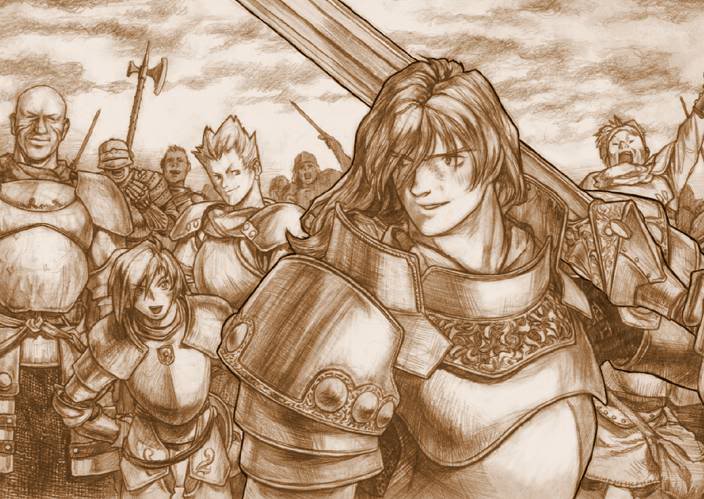
Most of the 3D arcade fighters didn't have any sign of a relevant story until Namco released Soul Calibur. Rather than playing a cheap, computer-generated cut-scene, this game integrated long sequences with voices and 3D polygon characters.
It still wasn't the most spectacular tale. Every storyline culminated with the battle against the ubiquitous fighter named Inferno, who looked more like a humanoid flame character. Still, the use of hand-drawn still images made the ending look much more attractive than the dreaded Tekken endings.
The Dreamcast version's mission mode also brought attention to a fascinating trend of fan fiction in fighting games. In this mode, gamers could play out a scripted role as a warrior traveling around the globe in search of battles.
Battle Fantasia - 2007
Developer: Arc System Works
Platforms: Arcade, PS3, Xbox 360
3D graphics grew in popularity throughout the 2000s era. This was an awkward time in fighting game history, in which 2D fighter developers tried adapting their characters into a 3D polygon environment. Yet, a lot of the 3D games just didn't have the same spark and personality as those in the 2D era.
Arc System Works approached this problem in a more challenging way. They tried adapting their own unusual characters with more artistic, cel-shaded polygons with outlines on their skeletons. The artwork was spearheaded by Emiko Iwasaki.
Although the gameplay wasn't especially original, Arc System Works tried especially hard to make the story more exciting. Rather than set it up like a comic book story, Battle Fantasia's story mode played out more like a visual novel. Players could open up new scenes by either winning with a super move finish or by losing.
It was a major step forward from the Guilty Gear games, which only used generic still images and dialogue. Arc System Works liked the story so much that they decided to adapt it into one of its more mainstream fighting games, Blazblue.
Blazblue: Calamity Trigger - 2009
Developer: Arc System Works
Platform: Arcade, Xbox 360, PS3
In many ways, Arc System Works re-envisioned the fighting genre as more than just a visual novel or a fan fiction RPG. The story mode of Blazblue was literally a shock to the system, with gorgeous drawings from a well-known anime studio named Gonzo. During the cutscenes, the characters moved their lips in sync with the voice actors.
The story was a massive epic, involving a time loop and a violent apocalypse. The second Blazblue release, Continuum Shift, continued the storyline with the characters. The franchise literally became an anime series in itself, chock-full of unlockable images and downloadable extras.
Even though Blazblue isn't as well-known as Street Fighter 4, the emotional depth of the story reached heights that we may never see in another fighting game.
Gamers in the 1990s probably didn't expect such a action-based genre to base much of its success on dense, emotional storylines. With the newest generation of fighting games, almost any visual style is possible. The consoles have all the heavy-duty technology it needs to tell any story imaginable.
Perhaps someday, gamers will have the opportunity to design their own fan fiction quests with people all over the Internet. Cyberspace still holds a surprising wealth of fun opportunities.
Do you have any questions about fighting game stories? Any problems with the games chosen for this article? Feel free to ask the author in the comments below.