THREEVIEWS
One topic. Three opinions. One author.
The "Video Games as Ebert Art" debate has, for some, been played out. For others the discussion has really only just begun. "We", Kevin John Frank, examine movie critic Roger Ebert's role in this debate as compared to our own industry pundits.
Frank calls Ebert's commentary "ill-informed at best, troll-tastic at worst." Kevin feels some of Ebert's points "miss the mark but ring true on the whole." John claims that Ebert's opinion of games should be considered just a "voice among many".
FRANK: We've been trolled.
After reading Roger Ebert's
original 2005 blog proclamation that games can't be art I was inclined to believe that his narrow opinion of video games was just that, an opinion. Strengthening that belief was Ebert's
fair sampling of dissenting opinions distilled from the overwhelming number of responses to his comments. My take away was that this critic believed what he said and articulated it as best he could given his limited exposure to video games.
In 2007 Ebert took on Clive Barker's counter argument presented at the Hollywood & Games Summit keynote address. In his
blog response Ebert admitted to being rash with his previous 2005 indictment, but his unwillingness to give games a college try, while still deigning to discuss them, was troubling.
He wrote to Barker, "What I should have said is that games could not be high art, as I understand it. How do I know this? How many games have I played? I know it by the definition of the vast majority of games. They tend to involve (1) point and shoot in many variations and plotlines, (2) treasure or scavenger hunts, as in "
Myst," and (3) player control of the outcome. I don't think these attributes have much to do with art; they have more in common with sports."
Equating videogames to sports and generalizing most games as either shooters or collect-a-thons seemed reductionist, but on the whole the debate was intelligible, if not one-sided. N'Gai Croal's own
Level Up '
fisking' of the Ebert vs Barker match-up deftly dissected the problems with most of Ebert's reasoning but two points stood out.
Ebert doesn't play games and therefore doesn't review them --
well, not often anyway. I started to question whether his disdain of most games as unworthy of serious consideration -- or play time even -- was undermining his critical voice. Despite that inkling, I let it go because everyone has a right to their opinion.
Then along came a tweet with a link to Ebert's latest blog post, "
Video games can never be art". Flamebait if I ever saw it, but I reserved judgment and started to read.
Upon finishing Ebert's rebuttal of
Kellee Santiago's earnest and insightful, if meandering, musings on an industry of which she is actually a part of, I felt totally trolled. He spent the first half of the article condescending to Santiago's grasp of art history and insinuating that his sense of taste was better than most. When Ebert finally got around to discussing her example games -
Waco Resurrection,
Braid &
Flower -- he laid bare to anyone in-the-know that he is not someone in-the-know when it comes to gaming.
Somehow I still wanted to give Ebert the benefit of the doubt; mainly because his piece was still lucid and well written. I proceeded to refresh myself on the past articles and see if there was something I might have missed. While scouring the archives and following the threads of this tale I came to a shocking realization.
Ebert believes that even when measured using his own 'opposing thumbs', most films are not art either. "
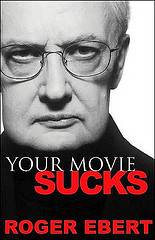
Your Movie Sucks", his book and blog section, relies heavily on this sentiment. One of his favorite quotes by fellow film critic Pauline Kael also echoes this belief. "The movies are so rarely great art, that if we cannot appreciate great trash, we have no reason to go."
Why then was Ebert again painting all games as unworthy if he already believed the same thing about most films? Why was he rehashing a topic of which he knows nothing of consequence when he had already said everything he could dare say? Why couldn't he admit there might be even a handful of games that could be considered art?
Hits, of course. The amount of response Ebert's frank comments garnered the first time he posted this edgy viewpoint may have actually surprised him. The next time, his after-the-fact tango with Barker seemed basically justified because Barker openly put him to task. But Santiago only dropped his name in passing and this current tirade did nothing but make Ebert look ill-informed at best, troll-tastic at worst.
For me the most inflammatory and insulting part of the article was Ebert's challenging rhetoric in his conclusion. "Why are gamers so intensely concerned, anyway, that games be defined as art?"
Why are we concerned? Really!? It's a silly question. People fight against your position on this because of your dismissal of a medium that has deeply affected them. If Ebert were some random curmudgeon on a message board or blog it wouldn't matter, but he isn't. He's "important". People listen to Ebert.
As one of the 3700+ commenters on his latest traffic driver put it "I'm sure MANY theater critics panned film at it's inception, but how many continued to pan film without ever watching one?" If there were critics that still had this modus operandi I don't think it would be a stretch to call their style "trolling".
KEVIN: It seems we still need to refine our skill, focus and critical voice as an industry.
When a non-gaming critic like Roger Ebert approaches this topic I can't help but feel like the old guard of media is passing judgment on our fledgling industry. In Ebert's case this isn't exactly true though.
Ebert has often embraced the "new" and championed emerging trends in media. He currently communicates his critical views via an
Internet web blog for instance. True that it is largely out of necessity, but I believe that even his proximity to this technology adds to his relevance and credibility.
Where other critics have panned oft-maligned media like comics or animation he has embraced them. However he hasn't given them a free pass. Ebert is not opposed to gaming he just feels that, as they are now, video games have not shown the caliber of legitimate art.
I certainly do not agree entirely with Ebert's approach. Some of the problem appears to be semantics. Also, his admitted lack of game knowledge makes him ill-suited to offer deep criticism of this medium. To be fair though, since his first feedback commentary in 2005 on this topic, Ebert has
conceded that games might be art, but they are just not high art.
Throughout his various diatribes Ebert has posited two valid arguments that stand outside his experience with video games. The first is that games are interactive and it is this interactivity that makes the act of playing a game preclude it's existence as high art as we know it.
He writes "Video games by their nature require player choices, which is the opposite of the strategy of serious film and literature, which requires authorial control. I am prepared to believe that video games can be elegant, subtle, sophisticated, challenging and visually wonderful. But I believe the nature of the medium prevents it from moving beyond craftsmanship to the stature of art."
The second argument is more of a challenge -- one that cannot be easily overcome given the matter-of-fact nature of the first argument. Ebert has
repeatedly cited that no one has or will be able to provide a gaming corollary for the greats from other accepted artistic disciplines, at least not in our lifetime.
He says "No one in or out of the field has ever been able to cite a game worthy of comparison with the great dramatists, poets, filmmakers, novelists and composers."
I agree with the premise of both of these arguments against games as art. Games aren't art; they are something other than art but just as poignant and impactful. It is the interactivity of games that sets them uniquely apart from conventional art and thereby demands an evolved lexicon to describe them. Communicating why interaction elevates games beyond craftsmanship is the semantic problem.
Given the newness of the medium the industry's own critical opinions are arguably just as juvenile. Games reviewers and critics often stumble when trying to convey why a game is "good, bad or arty" even when addressing their core audience. It seems we still need to refine our critical voice as an industry. There needs to be a way to evoke the craft of game design and development in a way that is just as understandable as movie making, composing, painting, writing, or dance.
As for worthiness, even "great" games such as
Ico,
Portal, and Flower cannot deny their essential game-ness. When debating with someone who doesn't play games, the standard definitions of appreciation do not always apply. We cannot hope to have a non-gamer understand the medium without first trying it hands-on. That means getting them to
want to try it. To ensure this happens we need to ease barriers to entry.
I am not endorsing the dumbing down of games, but for many reasons video games are often inscrutable. Accessibility and comprehension can definitely be improved. Game critics are our ambassadors at the gate. They have the best shot at changing the public opinion.
In his response to
Kellee Santiago's
TED talk Ebert asks, perhaps rhetorically, why gamers care to have games considered as art at all. I believe the contention for game creators, critics and players is that we want to be taken seriously by the world at large. The majority of the gaming milieu is not yet "general admittance" despite casual gaming's in-roads. Grasping for the brass ring of art seems like an obvious path to this mass acceptance.
However, we seem compelled to emulate our big brother film when we should be embracing and touting our unique strengths as games. That's why Ebert's appraisal misses the mark but rings true on the whole. The real nugget of truth I see in this very astute man's criticism is that what we need to do is become better at showing what games are made of, not how we are like movies.
Maybe we won't achieve "art status" in our lifetime but perhaps that shouldn't be the goal. With or without mainstream or elite acceptance, if we acknowledge our shortcomings and strive toward excellence, in the next forty years, we can create and promote our own distinct masterpieces.
Instead of putting our energy into convincing the high art critics of the world how great we are, let's use a tact even Ebert can get behind; "Show me, don't tell me."
JOHN: Game critics are key to fostering an environment of artistic relevance. Roger Ebert is not.
There are enough creators, developers, and reviewers within the games industry that believe games are not art that I don't think it is necessary to demonize a relative outsider for holding this belief.
Ebert's is just one voice among many, and a respected one at that. But for every dissenting voice there is another that can champion the cause.
Kellee Santiago's TED talk opened with the assertion that
games are already art. Her talk wasn't pitch perfect but, as per TED's mission statement, it was still an idea worth spreading.
I believe that the essence of her presentation was a reminder and call to action for those of us that understand that "games are art", encouraging developers to make more games that highlight potential artistry. Just as important though was her attempt to relate to a non-gamer audience.
Although it was
also her goal to "engage people outside of the "choir" to come to their own conclusions", I think she did her argument a disservice by evoking Ebert's name. Is there not a plethora of excellent game critics whose thoughts might have been used to sway the crowd?
Unfortunately this is another instance where the game industry shows it's young age. How many outside of the "choir" know these commentators by name? Still this lack of notoriety shouldn't stop us from looking to our own pundits when reflecting on the relevance and impact of games.
Kotaku's Stephen Totillo spent
a lot of words in his recent response to Ebert trying to frame himself as a peer before telling the movie critic to mind his own business; movie criticism. However I think his strongest point was made early in the article when he said
"Defending video games as an art form...[is] like a 26-year-old trying to convince his parents that he's a grown-up."
He's right. We shouldn't have to prove anything. We only need to be what we already are: authoritative specialists that can shape our own future.
Edge's N'Gai Croal has been
linked to this debate with Ebert as well, but he also has his
own strong views about the industry's ability to create and discuss their art. When asked in a 2007 Game Critic interview why developers aren't more vocal about defending video games as artistic expression he replied that
"Developers themselves are either inarticulate about the artistic nature of their games, unsure about whether their games are truly artistic, or both. They're inarticulate about their artistry because the vocabulary surrounding their craft is both highly specialized and incomplete. They're unsure about their artistry because video games aren't a long-established medium, like painting or sculpture, and video games aren't primarily a narrative medium, like the novel or film. This results in a fairly narrow, impoverished conversation about games in the public sphere."
It would appear as though game critics are key to fostering an environment of artistic understanding and relevance. Unfortunately much of games writing often focuses on the style of previews and reviews that may as well have fallen out of a press kit.
Genuine, quality games criticism is a rarer breed. It's certainly not as widespread as mainstream criticism is for books, movies and music. It's no wonder we often look to outsiders for approval, but this need for acceptance rubs many gamers the wrong way. And rightly so.
G4's Adam Sessler mounted his
Soapbox to address Ebert's post, but surprisingly he didn't entirely disagree with him. However, his rant was nonetheless supportive of gaming.
"It's not that important that we turn video games into art...There is a lot of value in video games and we don't need to look to...those people in the ivory tower, those people who are caretakers of all that is important in culture to actually deem it worthy. It is worthy by virtue of it's own success."
Gamasutra contributor/EA designer Jeff Preston's 2008
response to a lesser known Ebert attack on games -- a
Hitman review no less -- offered this advice:
"My suggestion to my fellow gamers is not to piss on Roger Ebert, as tempting as that may be. Instead of adopting a philosophical or aesthetic strategy, we should adopt a political one. Even if I thought Ebert had a coherent conception of art, there is little to be gained by engaging him in an essentialist debate. Instead, we should...focus on creating the conditions in which video games can be viewed as art."
Gamasutra's Features Director Christian Nutt refines this notion by suggesting that the "is-it-art" question is not the point and need not be answered with a silver bullet solution. He proposes
a new approach that is more subtle and incremental. Nutt says
"Rather than worrying that you can't turn your licensed kids' platformer or space marine murder simulator into art, think about what you can do to make its creative palate a little bit more expansive; to make its characters and dialogue a little less stupid; to make more concessions to an audience just a smidge wider than your marketing-decreed target."
Perhaps if we listen to our own experts and critics, even if games do not become universally acknowledged as an art form, we will eventually discover the ways in which games can transcend the question of "Are games art?" altogether. That's a future that can happen whether Roger Ebert agrees or not.
You've read "our" views. What is your perspective? Give "us" your feedback.
Kevin John Frank is a writer and critic of games and perhaps art, if ever the twain shall meet.
Contact him at quippster at gmail[dot]com or on Twitter @quipp.