Home
Home

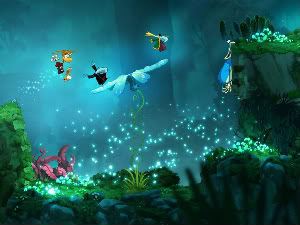 Rayman: Origins vs. New Super Mario Bros. Wii is an interesting matchup. The two games represent some of the finest high-production 2D platformers to have come out recently. Though New Super Mario Bros. Wii has defined the genre as of late, Rayman’s latest outing helps to move it forward.
I’ve mentioned this connection when previously writing about RO, but I figured it would be worth expanding on. Though these titles came out about two years apart, the genre (as far as full retail games goes) has been relatively silent over the past couple of years. It’s only natural to compare them in these categories:
Extra lives and save points
The multiple cyclops-door checkpoints spread throughout Rayman: Origin’s levels, along with unlimited continues, make dying a non-issue. Finding the secret rooms and coins while trying to rescue enough Lums for a medal in each stage, especially later in the game, was consistently a solid challenge. Not having to worry about how many lives I had freed my mind up to focus on exploring and platforming.
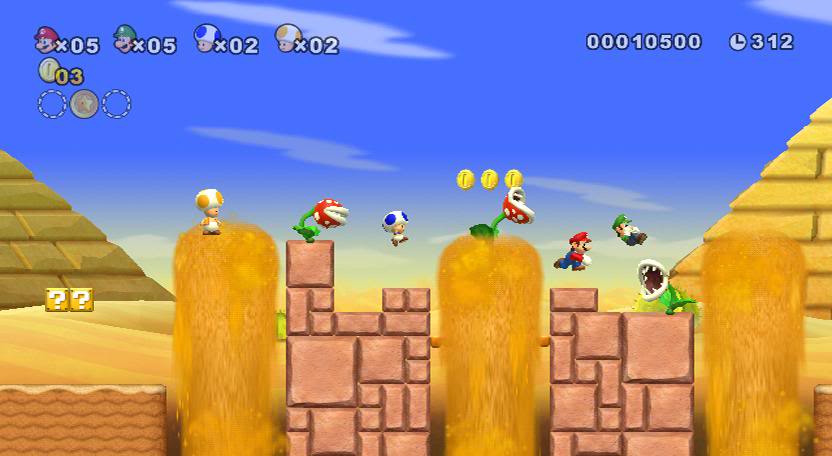
Contrast this with NSMBW’s seemingly arbitrary extra-lives system. Most skilled players usually have little difficulty getting to the maximum 99 with all the available ways to earn bonus 1UPs. This also makes dying not that big of a deal, but then what’s the point in having extra lives at all? It got to a point where I didn’t even bother collecting coins anymore, because 100 of them wouldn’t convert to any more lives past the max.
1UPs mattered in the original Super Mario Bros. where players started with only three at the beginning of each session (later changed to five for ported versions) and had to really earn each additional one. But in NSMBW, they’re just so plentiful and easy to save up that for skilled players, extra lives have become pretty meaningless. I vote for either making them scarcer or taking them out altog.
Of course, the Super Mario Bros. games wouldn’t be what they are without the iconic 1UPs, so I don’t want to necessarily hold that against them. The difference between the two games just helps me to appreciate Ubisoft’s decision to not go with a lives system in favor of checkpoints. It feels like a natural extension of a modern gameplay mechanic.
Power-ups
Am I the only one who had trouble with the power-ups inventory in NSMBW? I hardly ever wanted to use the rare upgrades, like the penguin suit or mini-mushroom, in fear of not having them for when I was in dire need. But when I finally did bust them out, I’d usually take a hit within moments and lose the power-up before I could really use it to my advantage in the stage. Then I’d cuss out my Wii.
Sure, wearing a specific pair of overalls was never mandatory to get through the game, but it made finding secret coins and exits a lot easier. Many times, I would try and muscle my way through as regular Mario, if possible, just to save me the hassle of having to play extra cautiously in order to hold onto a prized power-up. Naturally, I’d typically have to attempt reaching the secret places many more times, but for some reason doing it the hard way seemed easier and less stressful to me...especially considering my usual cushion of 99 lives.
Thankfully, RO doesn’t even bother with temporary power-ups. You unlock new moves as you progress through the game, but you keep them permanently. So when you hear the Electoon’s cries for help from a hidden room, you know your character already has the abilities he needs to access it, so long as you, the player, can identify which wall to vertically run up or where to jump and hover from to get there. You’re not left feeling like you're stubbornly avoiding an easier yet finite way.
Co-op
Anyone who’s tried out NSMBW’s multiplayer knows how much of a pain it is to try and have more than one character jump on a small platform at the same time. Someone is going to get bumped. Plus, accidentally shaking the Wii remote too quickly could result in picking up one of your teammates, then throwing him down a bottomless pit when you were only trying to put him back down. Sure, the chaos can be fun at first, but if you’re trying to play seriously, it quickly becomes tiresome.
RO avoids these clumsy mechanics. The characters are free to run alongside each other without colliding. You also have to push a button to punch your teammates (no throwing), so the antagonizing is intentional more often than not. Four players running around simultaneously can still be pretty hectic, but at least everyone is a little bit more in control.
Better yet, with no extra lives or temporary power-ups, all players are always on a level playing field, skill levels aside.
Graphics
Most people would be quick to point out that it’s not very fair to compare these two games graphically since NSMBW came out two years before RO. I agree to an extent, but both Nintendo and Ubisoft show with these titles that they’re striving for colorful worlds and characters over realistic ones.
I would compare NSMBW's visual style, which is toy-like, bubbly, and has a wholesome vibe to it, to Super Mario World's. RO, on the other hand, with its expressive, hand-drawn visuals, is more reminiscent of the sequel, Super Mario World 2: Yoshi's Island.
Picture a giant, disgruntled bird boss with tiny wings; underwater caverns with smiling, bioluminescent fish and elongated, life-stealing claws lurking in the shadows; and ice levels filled with piranha-infested fruit punch and spiky slices of oranges, for example.
Thanks to Ubisoft’s new UbiArt engine, the developer’s artists could more easily transfer their drawings and visions directly into Rayman: Origins. I would love to see Mario’s comic-style concept art (seen in the older games’ instruction manuals) similarly translated more authentically into a game. Or Nintendo could particularly get away with adopting this style for a Yoshi’s Island update. But until then, I have to hand it to Rayman for really pushing the boundaries of what an epic 2D platformer can look like.
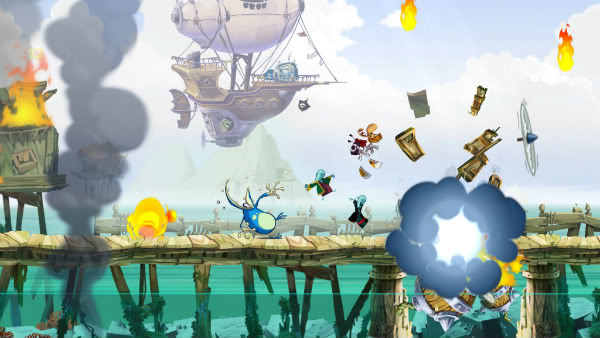
I hope that the advances in game design that Ubisoft is making to the genre will push Nintendo to respond with something more creative with its next installment in the NSMB series. For too long in this console cycle, Mario hasn’t really had any competition in the (non-downloadable or portable) 2D-platformer category. Rayman: Origins won’t be able to compete with New Super Mario Bros. Wii in sales (or branding), but when it comes to design, Ubisoft is going for a new high score.