Game Journalists Should Drop Preview Coverage

Bitmob_photo
Wednesday, June 02, 2010

Editor's note: Chris highlights an issue with games journalism that media scholars Robert McChesney and John Nichols have long recognized as a problem with the mainstream news press -- reliance on official sources. Much preview coverage for games easily falls into this trap because publishers and developers hold all the information, which gives journalists an incentive to play nice in exchange for access. -Rob


Junkets. Junkets. Junkets. I notice from time to time that everyone loves to jump on the complaining bandwagon, and junkets are the latest victim of this annoying reunion tour.

"The reason games are so expensive is because publishers give journalists these Hawaiian vacations!"

Of course it is -- that's just how marketing chooses to spend their money. Hell -- as someone with a background in marketing, it's a damn good idea that probably works. Public relations will always think of stupid crap to spend money on in order to garner attention for a game. If they didn't do junkets, then they will simply think of something stupider to waste their budget on.

I don't have a problem with these junkets, and they don't destroy the integrity of the people attending them. My problem is with preview coverage in all of its forms. Announce the game and show me an occasional trailer -- that's all I need. Do we really need an eight page cover story talking about how realistic the sweat on the character's faces is, and how the director's fat, sweaty wife inspired him to go the extra mile?


Apparently we're only 240 sweat glands away from crossing the uncanny valley!

When I was a kid, I couldn't write very well. My mom told me I was stupid, and my grandparents were convinced I was a homosexual. The memory motivates me to write on Bitmob and give you hilarious articles! Are you still reading? Why? Nothing derails a video game preview faster than boring stories about the developer's personal life -- I'm totally kidding by the way, my mom never told me I was stupid.

"Want to know what's even better than Kratos' new weapon, The Nemian Cestus?"

"You bet I do!"

"My kid's soccer team!"

Video games aren't done until they're done, and hopefully they're ready when they're released. I've learned that it's usually impossible to know how a game will turn out until it actually pops out of the oven and people play it.

First day purchases and pre-orders have burned me enough to know that I can't trust game previews. If I were three years younger, I might have gone out and bought Lost Planet 2 or Alpha Protocol, but now I like to think that I know better. As an informed buyer, I do my best to only buy great games -- a quick glance at my collection will hint that I've failed miserably at this task.
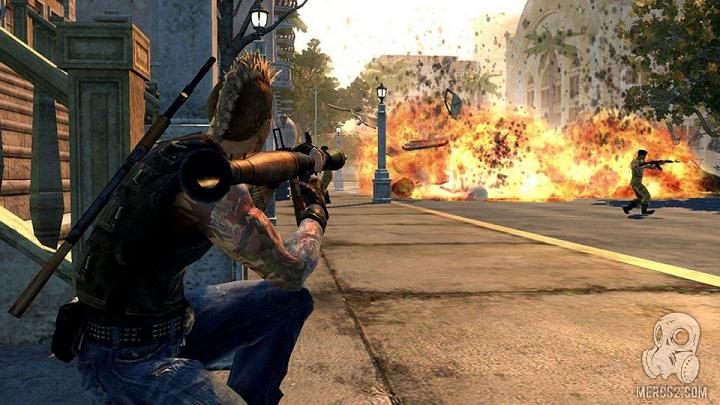
Mercs 2Mercenaries 2: Expectations in Flames

Last and certainly least, public relations has too much power; publishers force journalists to cruise down optimism road until the game ships. Only at that point do they get to release their pent up feelings and tear into the final product.

If they hint at their true impressions too early, well, there goes their review copy. This makes it very difficult for the audience to tell what's actually happening with the game, and it's not the journalist's fault. I'm sure the developers showed them the best possible fifteen minutes they could.

As far as I'm concerned, previews have boiled down into nothing but extensive advertisements with a bit of editorial flare. I don't see the journalistic side of the industry evolving any more in this department -- on the contrary, it's stagnating.

If I see one more preview that says "my only concern is that this fifteen minutes of fun won't last for a full gaming experience," I'm going to unsubscribe from that magazine or delete that website from my favorites instantly. I'm not going to call out any publications specifically -- except for Game Informer. Their previews are terrible.

Do I have a reasonable solution to this problem? No. My solution was to write this article. What's yours?

"My only concern is that if they don't fix the game, it'll be broken."


I'm a comedian, writer, electrical engineer, and all around awesome person! Follow me on Twitter.

 
Problem? Report this post
BITMOB'S SPONSOR
Adsense-placeholder
Comments (17)
Assassin_shot_edited_small_cropped
May 29, 2010

So, if someone on Bitmob writes, "My only concern is that this fifteen minutes of fun won't last for a full gaming experience," will you abandon this site?

I like previews...when they are critical of a game's shortcomings, which, as you explained, is rare.

Pshades-s
May 29, 2010

The advantage previews have over trailers is that the former takes control out of the publishers' hands and lets someone else evaluate the product - if only briefly. A trailer only shows what the manufacturer wants to be seen. In a preview, anything can happen.

The other important thing to remember is that games aren't movies. Players are active participants in the experience and thus how a game feels is infinitely more important than how it looks. Trailers are incapable of communicating the sensation of controlling a game. In some cases, that means a cool-looking game turns out to have awful controls. In other cases, a dull-looking game might be a thrill to play. Either way, I'm going to read a preview to find out which way the pendulum swings.

(Full disclosure - as a freelance writer for Wired Game|Life, I have written a few previews and always came away from the experience with a greater understanding of the game I got to try)

Bitmob_lost_woods
May 29, 2010

Personally, I thought most of the gaming community would have learned not to buy games they haven't read a review for when Enter The Matrix was released. The best selling, worst reviewed game of all time. For those who don't remember, it was released on the same day that The Matrix: Reloaded was released in theatres, sold millions on PS2, X-Box, and GC, and was a buggy, glitchy piece of @#$! whose only redeeming quality was a live action make-out scene with Niobe (Jade Pinkett Smith) and Persephonie (Monica Bellucci), and that's pretty dull compared with what's on tv these days.

Jason_wilson
May 29, 2010

I abhor standard previews. But I do like previews that tell me about the background and lives of the people who make the game and how their experiences, their histories, and how their way of looking at the world influences the games they make. I often learn something interesting and valuable from those preview stories. 

Bitmob_photo
May 29, 2010

@Richard Haha no, I'd just unfollow them from Twitter! 

@Daniel Although I like trailers, I wasn't implying that a trailer will ever get me to buy a game Day 1.  That would be stupid.  I'm also sure that if you played something then you left with a good idea of how it worked, but I can't say that will always translate to the audience.  There's certain things you just have to see and feel for yourself.  I'm just not seeing the importance of previews, everything I could get from a preview I could get better from a review or podcast. 

@Edgar I loved Mercs 1 so much that I didn't even bother checking a lot of reviews.  I remember checking IGN because they had one of the first, and they said it was good.  They were wrong.

@Jason I consider including all that personal stuff to be the norm of standard previews.  If I'm reading an interview post playing the game, I might be able to make the connection about what they're talking about, but it's uniteresting to see them draw parallels to something I still have no connection too, and instead of making something less boring, it just derails it all together.

37893_1338936035999_1309080061_30825631_6290042_n
May 29, 2010

I'm not a big fan of previews either.

Humbly disagreeing with Daniel's point, a preview/demo is completely in the control of the developers/publishers. Take Lost Planet 2 for example: it had a pretty good demo showcasing the ridiculously giant creatures you thought you'd be fighting constantly thoughout the retail release.

You think the developers planned the demo to be that way? Of course they did! Think of how much opinions would have changed if they instead demoed the awful "train" stage. Oh how different things would be.

It's not just Lost Planet 2, it's every game. That's just the way things are. Sad, but true.

When I read a preview, I'm only reading to learn about the mechanics and concept of the game. I never buy a game because of how awesome the preview coverage was. That almost definite hyperbole needs to be backed up by reviews, word of mouth, or trust in the developer to get my money.

Bitmob_photo
May 29, 2010

@Chase Haha damn it Chase! Why'd you have to word it better than me?!? 

Jason_wilson
May 29, 2010

@Chase So, learning about the creative process of a given game doesn't allow you to relate to it?

Bitmob_photo
May 29, 2010

@Jason I think the personal stories can be a gamble, a gamble that often results in failure.  It comes down to the person they're interviewing, and if they're an interesting person, then a preview with personal information about them will be great.  Brutal Legend coverage was always fun to read because Tim Schafer is hilarious and always has funny things to say, but not everyone in the industry is a Tim Schafer.  I just read the David Jaffe interview in the new EGM, and sadly he's a really boring person and I don't really care about the fact that he loves Nickelback.  If I read a preview of one of his games that includes personal information about him, it's going to be boring.  It's not a knock on the journalists either, there's very little they can do about it.

I read a lot of the Heavy Rain coverage as well, and I don't think any of it interested me until after I played it.  Once I had, listening to David Cage talk about what influenced him to do certain scenes in the game was really interesting stuff because I could make that connection.  If I had read the same interview before I played the game, I really wouldn't care.

Profile_pic
June 02, 2010

@Chris, I was going to mention the pre-release Heavy Rain coverage too. There was a huge interview with David Cage in the first issue of John Davison's GamePro, which I just threw out without ever having read the article.

I'm all about that sort of coverage, but only after I've actually had a chance to play the game.

The other thing is, that sort of coverage is limited by the state of the game. The interviewer can't ask anything even vaguely critical because the game's not finished, and the developer deserves the benefit of the doubt. Not to mention that the interviewer probably hasn't had any time to digest what little he's played.

I'm much more in favor of postmortem interviews. I feel that they have a chance to be more honest on both sides.

Bitmob_photo
June 02, 2010

@Craig Aww why would you throw out one of the new Gamepros?  Also I diagree with you on giving developers the benefit of the doubt all the time.  It completely changes on a case to case basis.  Naughty Dog will always get the benefit of the doubt in my book, but let's say High Voltage, they have to prove something before I'm interested, and they aren't going to prove anything in a preview.  There's too many good games coming out to give everyone the benefit of the doubt, especially at a $60 price tag. 

It's not fair to the consumer to try and cover their eyes from a turd.  if journalists really want to "Do what's best for the audience", they won't hype up a piece of crap and trick someone into buying it Day 1.  Sorry, but I stand on a firm consumer first platform, and I don't have sympathy for developers that can't deliver a decent product to me.

Franksmall
June 02, 2010

Your best quote by far--

"publishers force journalists to cruise down optimism road until the game ships. Only at that point do they get to release their pent up feelings and tear into the final product."

---
I do have to disagree a bit, just because I love a well written preview even if they are rare these days. I do think there are some rules we could follow that would lead to better previews, but no one would follow them.
 
1. Only preview a game that you have gotten exclusive access to, and only do so if that access was not simply a packaged guided tour that they are going to walk a thousand other journalists through.
 
2. Don't ever, ever, ever, EVER just summarize and expand upon a written press release.
 
3. Don't ever, ever, ever, EVER let them force you to use the same screen shots every other publication is using.
 
4. Refuse to follow the "previews must give the benefit of the doubt" policy. That policy is bullshit.
 
5. Be transparent about what concessions, if any, you are making to get this exclusive coverage.
 
6. If a preview is shit or just not interesting and doesn't feel original, don't print it!
 
7. Spend more time previewing games that are not the hugest titles. You might get hits from the umpteenth story on the next CoD that has next to no new information, but instead you will spend your time finding the under the radar titles that are actually cared for by the developers and publishers producing it.
 
8. Do not ever accept "it is going to be like this" and then write a preview like what is being promised is already in the game.
 
9. If it comes from Gamespress.com, then it is not journalism. Gamespress.com should be opened to the masses so that people can see how many stories are just copied and pasted from it.


I am sure I could come up with more. As someone who subscribes to way too many game magazines I think I have started to be able to tell within just a short glance at a preview if it is worth reading. 90% are not.
 
 
Great, great piece here Chris! I have thought about writing a similar piece many times and am extremely glad this got put on the front page!
Franksmall
June 02, 2010

I don't know why that double posted.

Default_picture
June 03, 2010

I'll level with ya -- I was all set to read about your interpersonal problems and see how you tied them back into your main subject, and then I was disappointed that you were just setting me up for a punchline.  I've always felt there should be more focus on game designers and the development process in gaming journalism, just as there's a lot of attention paid to movie directors and novel writers for example.  Yes, it can get sappy fast ("I created our new character Zippy Dog as a tribute to my uncle's dead chihuahua") but I'd still rather hear about the people behind the game than whatever small part of the game itself is done in time for E3.

Bitmob_photo
June 03, 2010

@Kevin Sorry dude, I'm a comedian, my job IS to set you up with a punchline.  I also don't see how I could have interpersonal problems with a video game preview past thinking it's boring, and it would be forcing it to try and do so, not to mention coming off as whiny.  The current state of video game previews is broken, and until someone finds a good way to make them interesting, they should get scrapped all together.  Using personal stories is a bullshit shortcut to attempt empathy from the reader and it rarely works.  "Hey this game might be crap, but let's talk about the developers feelings."  If they can't garner actual attention, they try and garner sympathy, and that is crap.

Default_picture
June 03, 2010

@ Chris D.

The problem doesn't lie in the fact that game previews exist, but that games journalism still follows the rules set in the print journalism industry, and few games journalists actually fulfill their obligations to the readers.

The original seller of game magazines were the reviews. "These guys who I don't know, but are paid to play games and write about them, say a game is good? I'll trust that more than the game box!" When the popularity of online reviews pushed timely print game reviews off of the economic usefulness desk and out journalist's windows (thus crashing them), games journalists were forced to rely on exclusive previews.

Look in any games--heck, any entertainment magazine, and you'll find that the major sections are still the same as they were ten-fifteen-twenty years ago. The ratio of pages per section changed, but little else has. Letters to the Editor, Previews, Interviews, Reviews. Heck, even the Letters to the Editor section is still called the same thing and few readers even write print letters! (I doubt some know what a non-mechanical pencil is.)

Previews can be less entertaining, and useful, when they do some of the things you've mentioned briefly in your article. However, they are also a place to get a general feel for what is going to come out in the near future without a total sense of marketing department string-pulling. It is the journalist's job to ask biting questions and investigate.

While it might not seem incredibly useful to discover a developers intentions and inspiration for designing a game, it can be a tool to further validate video game design as a legitimate art form. Do we really want to have to keep hearing rants from Microsoft Sa-- I mean, Roger Ebert, about the illegitimacy of the form?

Journalists need to do their job, and stop letting the excitement of playing, seeing, touching, feeling, pulling the pants down of--er...games get in the way. Do the job right, and try new types of analytic and critical topics, or go play Home. As we all know, few people want to do that.

Pshades-s
June 03, 2010

Chase, a demo is certainly designed to showcase a game's best features, but it is still interactive. That's the key difference.

Take Bayonetta. When I saw the trailer for that game, I was offended by the sexual pandering and unimpressed by the combat. When I actually played the game at TGS, if only for 10 minutes, I began to see some of the appeal. Mirror's edge was similar: the trailers confused/bored me, but when I actually played it I got really excited.

Conversely, trailers for Quantum Theory and Bionic Commando looked exciting as hell, but when I had a controller in my hand nothing worked as it should.

You must log in to post a comment. Please register if you do not have an account yet.