Home
Home

EDITOR'S NOTEfrom
Jay Henningsen
I completely agree with Christian. Because developers handle relationships as simple mathematics, I find myself largely ignoring the interactions and just focusing on how to exploit the system. My only interest in befriending other characters boils down to what rewards I can get from them. I think the game industry can do better.
I almost never pursue romance options in role-playing games. At their worst, game romances are sensationalistic and meant to appeal to the 14-year-old boys in the audience. At their best, they’re clichéd, ceremonial, dry, and potentially disturbing. In either case, they say nothing about the human condition -- the sole reason why we connect with stories about relationships at all.
I recently replayed Dragon Age: Origins, and I ran into an identical problem in my second playthrough that I did in my first: an unwanted love triangle.
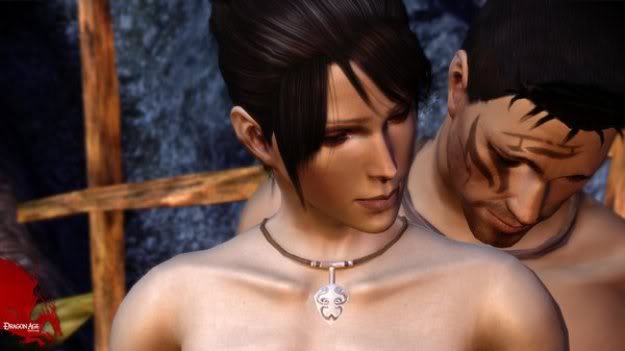
Basically, by just treating my companions with respect and not acting like a dick to the world at large, I’ve somehow managed to get a few of them to fall in love with me (Lelianna and Zevran in my first playthrough and those two plus Alistair in my second, which I guess makes this one a love square?)
One of the big problems for me is that I haven’t pursued any of these relationships; I’ve done no flirting; I’ve made no come-ons. Repeatedly sending signals that just about any adult would pick up on in real life (telling Leliana what a good friend she is; telling Alistair how much I appreciate our friendship) effectively just delays the inevitable; it nudges their approval meters up by a point or two, instead of the 10 or so if I’d said something flirty.
Over time, those points add up and none of the context or meaning of my dialogue with these characters makes a difference. They forget the things I’ve actually said and only remember the approval numbers derived from our conversations.
By just role playing my avatar as a decent human being, I now have to deal with a whole mess of drama that comes off as arbitrary and immature. Because of reductive math -- a number scale of how much someone likes me -- I’m involved in an annoying situation that brings the pacing of the story to a halt. Even though I’ve spent the entire game saying that Leliana’s religion is bullshit, she doesn’t seem to care, because the numbers still manage to add up in my favor.
I’m not convinced that stories about relationships work when left to player agency. And I don’t just mean romantic relationships; I mean relationships with other people, period. Typically, companion characters’ personal politics are black and white, their emotions are extreme, and their lives are completely dependent on the player. They're less like people and more like robots reacting to whatever stimuli the player creates through the choices he or she makes (actually, I guess that’s truly what they are in terms of the programming). They don't even have relationships with each other, much less with the world around them. They're just narrative devices -- foils to help expand the story of your hero.
Basically, this all comes down to a storytelling vs. agency issue and the conflict that can arise between the two. What makes for better storytelling might not be what the player wants. And that can be a problem.
A good relationship story, in my Dragon Age case, could have been the triangle of unrequited love I accidentally fostered. God knows, looking back at my earlier youth, I sympathize for every girl I knew who had to delicately balance my crush with our friendship. I didn’t make it easy for them. But, at the very least, those relationships had an arc to them, and we all got stories out of them (some better than others).
Unfortunately, the lack of a relationship between party members causes this potential story to break down. Their only interaction with each other is through me, referencing my other relationships. The story lacks conflict.
The story of a single, unrequited love could have been interesting. However, that particular story always conveniently ends when I say, “thanks, but not interested.” Allowing for player agency, the player can turn someone down and continue with the game, unburdened by the optional relationship side plot. In this case, the story lacks a proper end or even a middle. The end isn’t so much that my character rejects another character, but more so that I, as the player, say “stop” and the game itself obliges by flipping a switch. The relationship plot goes from on to off without any further exploration.
Then there’s the story of any one of these relationships. Unfortunately, they all have to allow for any number of variables based on my choices -- there’s that pesky math. My relationship with Leliana could have been a beautiful tragedy -- something with a lot of potential that falls apart because I can’t accept her religion, of all things. POW! Now that hits on all cylinders; scorned lovers and religion … I dare you to invent juicier conflict.
But of course, the story never plays out that way. Our disagreements gain some negative points but our positive points outweigh those, so … it must be true love, right? After a lengthy talk about “us” and how great “we” are, the virtual avatars get down to the physical act of love, as awkwardly and unsatisfyingly as only masses of pixels can. And afterwards … well, that’s it. That’s the end of the story; the ultimate reward for the relationship side quest: sex. Because, as we all know, a relationship just stays frozen in time once sex gets involved (please note my sarcasm). That’s a lot of ceremony for such a weak payoff.
But what if the game didn’t have to account for as much player agency? What if there weren’t several options for relationships, but only one or two? And what if the player’s agency, like so much of the genuine role playing that’s so successful in recent BioWare releases, simply boiled down to conversation?
The relationship happens, as a core element of the plot, and your agency is in how you handle it: what you say, how you treat the other person, the effects of your other relationships, the effects of the other character's other relationships, the kind of person you choose to be, and how it affects both you and the other character. What if all the time, energy, and resources that go in to fleshing out a lot of optional side plots went into writing this one story and its very limited number of branches?
Again, these ideas don’t just apply to romantic relationships.
I think the most I've gotten out of Dragon Age 2 so far has been my (well, Hawke’s) relationship with my brother, Carver. We’re family and we’re rivals. He looks up to me at the same time he grows jealous of me. He’ll defend both my life and my character to the bitter end but never without a constant voice of doubt in the back of his head. We fight like dogs and stick together like a pack. We both, at least partially, blame each other for our sister’s death. Our strained relationship is a constant source of stress for our beleaguered mother; in fact, most of our fights revolve around her. That’s downright Oedipal.
My relationship with Carver is also much more restricted than my relationship with other characters. I'm reacting to him just as much as he's reacting to me, and that's what makes it so convincing. I can't just say something nice and completely turn him around; his attitude is always an issue. My role playing manifests in how I handle our relationship.
Ultimately -- and I know this isn’t a popular opinion among the “hardcore” crowd these days -- I think story-based games, particularly RPGs, are going to need to become more linear if they want to tell an emotionally satisfying story. That’s not to say completely linear, like a first-person shooter, but player agency, or actual role playing, is going to need to come down to smaller, but more personal choices. These choices will affect character development and provide the player with an opportunity to more thoroughly explore a game’s themes, rather than just give high-concept plot points that add nerd-coveted “replayability.”
To get off the RPG track (and, let’s face it, give poor BioWare a break), I think that Heavy Rain is an example of a video game with an open-ended narrative driven by the player’s choices where the optional romance -- and all of the relationships -- work.
The relationship that develops between Shelby and Lauren always ends tragically, regardless of how the player chooses to handle the moments that lead to that tragic conclusion. Nevertheless, the impact of the relationship has greater meaning for me precisely because of how I handled those moments. And it would work just as well for anyone else who might pursue it differently. The majority of the plot is linear and scripted, but the meaning it has on the player is informed by the player’s small, but emotionally relevant choices.
Similarly, even though Madison feels completely superfluous to the overall plot of the game (and even though, in my playthrough, I didn’t have Ethan pursue a relationship with her), I can see how that potential sub-plot could be incredibly satisfying.
Madison isn’t simply reacting to the things Ethan says, or vice-versa; instead, their individual paths cross, they spend time together, and possibly come together (please don’t take that out of context). The relationship feels like it’s actually built on a foundation that continues to develop over the events of the game’s plot, as opposed to flipping a switch because some background math finally tipped the scale to one side. It’s spontaneous but not random -- exactly the way a relationship is.
Originally posted at digitalhippos.com
Madison isn’t simply reacting to the things Ethan says, or vice-versa; instead, their individual paths cross, they spend time together and, eventually, possibly come together (please don’t take that out of context). The relationship feels like it’s actually built on a foundation that continues to develop over the events of the game’s plot, as opposed to flipping a switch because some background math finally tipped the scale to one side. It’s spontaneous but not random, exactly the way love is.I almost never pursue romance options in RPGs. At their worst, game romances are sensationalistic, meant to appeal to the 14-year old boys in the audience. At their best, they’re cliched, ceremonial, dry, and potentially disturbing. In either case, they say nothing about the human condition, the sole reason why we connect with stories about relationships at all.
I recently replayed Dragon Age: Origins and I ran into an identical problem in this, my second play through, that I ran into in my first: an unwanted love triangle.
Basically, by just treating my companions with respect and not acting like a dick to the world at large, I’ve somehow managed to get a few of them to fall in love with me (Lelianna and Zevran in my first play through, plus Alistair in my second, which I guess makes this one a love square?).
One of the big problems for me is that I haven’t pursued any of these relationships; I’ve done no flirting; I’ve made no come-ons. Repeatedly sending signals that just about any adult would pick up on in real life (telling Lelianna what a good friend she is; telling Alistair how much I appreciate our friendship) effectively just delays the inevitable; it nudges their approval meters up by a point or two, instead of the 10 or so if I’d said something flirty.
Over time, those points add up and none of the context or meaning of my dialogue with these characters makes a difference. They forget the things I’ve actually said and only remember the approval numbers derived from our conversations.
By just role-playing my avatar as a decent human being, I now have to deal with a whole mess of drama that comes off as arbitrary and immature. Because of reductive math -- a number scale of how much someone likes me -- I’m involved in an annoying situation that drags the game down and brings the pacing to a halt. Even though I’ve spent the entire game saying that Lelianna’s religion is bullshit, she doesn’t seem to care, because the numbers still manage to add up in my favor.
I’m not convinced that stories about relationships work when left to player agency. And I don’t just mean romantic relationships; I mean relationships with other people, period. Typically, companion characters’ personal politics are black and white, their emotions are extreme and their lives are completely dependent on the player. They're less like people and more like robots reacting to whatever stimuli the player creates through the choices he/she makes (actually, I guess that’s literally what they are in terms of the programming). They don't even have relationships with each other, much less with the world around them. They're just narrative devices; foils to help expand the story of your hero.
Basically, this all comes down to a storytelling vs. agency issue, and the conflict that can arise between the two. What makes for better storytelling might not be what the player wants. And that can be a problem.
A good relationship story, in my Dragon Age case, could have been the triangle of unrequited love I accidentally fostered. God knows, looking back at my earlier youth, I sympathize for every girl I knew who had to delicately balance my crush with our friendship. I didn’t make it easy for them. But, at the very least, those relationships had an arc to them, and we all got stories out of them (some better than others).
Unfortunately, the lack of a relationship between party members causes this potential story to break down. Their only interaction with each other is through me, referencing my other relationships. The story lacks conflict.
The story of a single, unrequited love could have been interesting. However, that particular story always conveniently ends when I say, “thanks, but not interested.” Allowing for player agency, the player can turn someone down and continue with the game, unburdened by the optional relationship side plot. In this case, the story lacks a proper end or even a middle. The end isn’t so much that my character rejects another character, but moreso that I, as the player, say “stop” and the game itself obliges by flipping a switch. The relationship plot goes from on to off without any further exploration.
Then there’s the story of any one of these relationships. Unfortunately, all have to allow for any number of variables based on my choices. And, of course, there’s that pesky math. My relationship with Lelianna could have been a beautiful tragedy; something with a lot of potential that falls apart because I can’t accept her religion, of all things. POW! Now that hits on all cylinders; scorned lovers and religion … I dare you to invent juicier conflict.
But of course, the story never plays out that way. Our disagreements gain some negative points but our positive points outweigh those, so … it must be true love, right? After a lengthy talk about “us” and how great “we” are, the virtual avatars get down to the physical act of love, as awkwardly and unsatisfyingly as only masses of pixels can. And afterwards … well, that’s it. That’s the end of the story; the ultimate reward for the relationship side quest: sex. Because, as we all know, a relationship just stays frozen in time once sex gets involved (please note my sarcasm). That’s a lot of ceremony for such a weak payoff.
But what if the game didn’t have to account for as much player agency? What if there weren’t several options for relationships, but only one or two? And what if the player’s agency, like so much of the genuine roleplaying that’s so successful in recent BioWare releases, simply boiled down to conversation?
The relationship happens, as a core element of the plot, and your agency is in how you handle it: what you say; how you treat the other person; the effects of your other relationships; the effects of the romantic interest’s other relationships; the kind of person you choose to be and how it affects both you and your significant other? What if all the time, energy and resources that go in to fleshing out a lot of optional side plots went into writing this one story and its very limited number of branches?
And again, these ideas don’t just apply to romantic relationships.
I think the most I've gotten out of Dragon Age 2 so far has been my (well, Hawke’s) relationship with my brother, Carver. We’re family and we’re rivals. He looks up to me at the same time he grows jealous of me. He’ll defend both my life and my character to the bitter end, but never without a constant voice of doubt in the back of his head. We fight like dogs and stick together like a pack. We both, at least partially, blame each other for our sister’s death. Our strained relationship is a constant source of stress for our beleaguered mother; in fact, most of our fights revolve around her. That’s downright Oedipal.
Ultimately -- and I know this isn’t a popular opinion among the “hardcore” crowd these days -- I think story-based games, particularly RPGs, are going to need to become more linear if they want to tell an emotionally satisfying story. That’s not to say completely linear, like a first-person shooter, but player agency, or actual roleplaying, is going to need to come down to smaller, but more personal choices; choices that affect character development and provide the player with an opportunity to more thoroughly explore a game’s themes, rather than high-concept plot points that add nerd-coveted “replayability.”
To get off the RPG track (and, let’s face it, give poor BioWare a break), I think Heavy Rain is an example of a video game with an open-ended narrative driven by the player’s choices where the optional romance -- and all of the relationships -- work.
The relationship that develops between Shelby and Lauren always ends tragically, regardless of how the player chooses to handle the moments that lead to that tragic conclusion. Nevertheless, the impact of the relationship has greater meaning for me precisely because of how I handled those moments. And it would work just as well for anyone else who might pursue it differently. The majority of the plot is linear and scripted, but the meaning it has on the player is informed by the player’s small, but emotionally relevant choices.
Similarly, even though Madison feels completely superfluous to the overall plot of the game, and even though, in my play through of the game, I didn’t have Ethan pursue a relationship with her, I can see how that potential relationship sub-plot could be incredibly satisfying.
Madison isn’t simply reacting to the things Ethan says, or vice-versa; instead, their individual paths cross, they spend time together and, eventually, possibly come together (please don’t take that out of context). The relationship feels like it’s actually built on a foundation that continues to develop over the events of the game’s plot, as opposed to flipping a switch because some background math finally tipped the scale to one side. It’s spontaneous but not random, exactly the way love is.I almost never pursue romance options in RPGs. At their worst, game romances are sensationalistic, meant to appeal to the 14-year old boys in the audience. At their best, they’re cliched, ceremonial, dry, and potentially disturbing. In either case, they say nothing about the human condition, the sole reason why we connect with stories about relationships at all.
I recently replayed Dragon Age: Origins and I ran into an identical problem in this, my second play through, that I ran into in my first: an unwanted love triangle.
Basically, by just treating my companions with respect and not acting like a dick to the world at large, I’ve somehow managed to get a few of them to fall in love with me (Lelianna and Zevran in my first play through, plus Alistair in my second, which I guess makes this one a love square?).
One of the big problems for me is that I haven’t pursued any of these relationships; I’ve done no flirting; I’ve made no come-ons. Repeatedly sending signals that just about any adult would pick up on in real life (telling Lelianna what a good friend she is; telling Alistair how much I appreciate our friendship) effectively just delays the inevitable; it nudges their approval meters up by a point or two, instead of the 10 or so if I’d said something flirty.
Over time, those points add up and none of the context or meaning of my dialogue with these characters makes a difference. They forget the things I’ve actually said and only remember the approval numbers derived from our conversations.
By just role-playing my avatar as a decent human being, I now have to deal with a whole mess of drama that comes off as arbitrary and immature. Because of reductive math -- a number scale of how much someone likes me -- I’m involved in an annoying situation that drags the game down and brings the pacing to a halt. Even though I’ve spent the entire game saying that Lelianna’s religion is bullshit, she doesn’t seem to care, because the numbers still manage to add up in my favor.
I’m not convinced that stories about relationships work when left to player agency. And I don’t just mean romantic relationships; I mean relationships with other people, period. Typically, companion characters’ personal politics are black and white, their emotions are extreme and their lives are completely dependent on the player. They're less like people and more like robots reacting to whatever stimuli the player creates through the choices he/she makes (actually, I guess that’s literally what they are in terms of the programming). They don't even have relationships with each other, much less with the world around them. They're just narrative devices; foils to help expand the story of your hero.
Basically, this all comes down to a storytelling vs. agency issue, and the conflict that can arise between the two. What makes for better storytelling might not be what the player wants. And that can be a problem.
A good relationship story, in my Dragon Age case, could have been the triangle of unrequited love I accidentally fostered. God knows, looking back at my earlier youth, I sympathize for every girl I knew who had to delicately balance my crush with our friendship. I didn’t make it easy for them. But, at the very least, those relationships had an arc to them, and we all got stories out of them (some better than others).
Unfortunately, the lack of a relationship between party members causes this potential story to break down. Their only interaction with each other is through me, referencing my other relationships. The story lacks conflict.
The story of a single, unrequited love could have been interesting. However, that particular story always conveniently ends when I say, “thanks, but not interested.” Allowing for player agency, the player can turn someone down and continue with the game, unburdened by the optional relationship side plot. In this case, the story lacks a proper end or even a middle. The end isn’t so much that my character rejects another character, but moreso that I, as the player, say “stop” and the game itself obliges by flipping a switch. The relationship plot goes from on to off without any further exploration.
Then there’s the story of any one of these relationships. Unfortunately, all have to allow for any number of variables based on my choices. And, of course, there’s that pesky math. My relationship with Lelianna could have been a beautiful tragedy; something with a lot of potential that falls apart because I can’t accept her religion, of all things. POW! Now that hits on all cylinders; scorned lovers and religion … I dare you to invent juicier conflict.
But of course, the story never plays out that way. Our disagreements gain some negative points but our positive points outweigh those, so … it must be true love, right? After a lengthy talk about “us” and how great “we” are, the virtual avatars get down to the physical act of love, as awkwardly and unsatisfyingly as only masses of pixels can. And afterwards … well, that’s it. That’s the end of the story; the ultimate reward for the relationship side quest: sex. Because, as we all know, a relationship just stays frozen in time once sex gets involved (please note my sarcasm). That’s a lot of ceremony for such a weak payoff.
But what if the game didn’t have to account for as much player agency? What if there weren’t several options for relationships, but only one or two? And what if the player’s agency, like so much of the genuine roleplaying that’s so successful in recent BioWare releases, simply boiled down to conversation?
The relationship happens, as a core element of the plot, and your agency is in how you handle it: what you say; how you treat the other person; the effects of your other relationships; the effects of the romantic interest’s other relationships; the kind of person you choose to be and how it affects both you and your significant other? What if all the time, energy and resources that go in to fleshing out a lot of optional side plots went into writing this one story and its very limited number of branches?
And again, these ideas don’t just apply to romantic relationships.
I think the most I've gotten out of Dragon Age 2 so far has been my (well, Hawke’s) relationship with my brother, Carver. We’re family and we’re rivals. He looks up to me at the same time he grows jealous of me. He’ll defend both my life and my character to the bitter end, but never without a constant voice of doubt in the back of his head. We fight like dogs and stick together like a pack. We both, at least partially, blame each other for our sister’s death. Our strained relationship is a constant source of stress for our beleaguered mother; in fact, most of our fights revolve around her. That’s downright Oedipal.
Ultimately -- and I know this isn’t a popular opinion among the “hardcore” crowd these days -- I think story-based games, particularly RPGs, are going to need to become more linear if they want to tell an emotionally satisfying story. That’s not to say completely linear, like a first-person shooter, but player agency, or actual roleplaying, is going to need to come down to smaller, but more personal choices; choices that affect character development and provide the player with an opportunity to more thoroughly explore a game’s themes, rather than high-concept plot points that add nerd-coveted “replayability.”
To get off the RPG track (and, let’s face it, give poor BioWare a break), I think Heavy Rain is an example of a video game with an open-ended narrative driven by the player’s choices where the optional romance -- and all of the relationships -- work.
The relationship that develops between Shelby and Lauren always ends tragically, regardless of how the player chooses to handle the moments that lead to that tragic conclusion. Nevertheless, the impact of the relationship has greater meaning for me precisely because of how I handled those moments. And it would work just as well for anyone else who might pursue it differently. The majority of the plot is linear and scripted, but the meaning it has on the player is informed by the player’s small, but emotionally relevant choices.
Similarly, even though Madison feels completely superfluous to the overall plot of the game, and even though, in my play through of the game, I didn’t have Ethan pursue a relationship with her, I can see how that potential relationship sub-plot could be incredibly satisfying.
Madison isn’t simply reacting to the things Ethan says, or vice-versa; instead, their individual paths cross, they spend time together and, eventually, possibly come together (please don’t take that out of context). The relationship feels like it’s actually built on a foundation that continues to develop over the events of the game’s plot, as opposed to flipping a switch because some background math finally tipped the scale to one side. It’s spontaneous but not random, exactly the way love is.
14

Problem? Report this post