

Miasma: Citizens of Free Thought immediately invokes a feeling of grandeur not usually found in an Xbox Live indie game.
The delightful Piano music accompanying the title screen wouldn’t feel out of place on a Final Fantasy soundtrack, and the game doesn’t pull out the big guns in just the music department.
Graphically the game looks like a full-blown Xbox Live Arcade release, and more importantly for strategy role-playing game fans, the story is full of political intrigue and dynamic, well written characters.
The story, however, starts out with a cliché. Paul, one of two selectable heroes, has lost his memory. Our bald hero is the leader of a rebel group, and is fighting against Vilhelm Industries -- a corporation turned evil worldwide ruler of man after nations allowed the company to take over their infrastructure and public services.
Since then the corporation has retained a tight grip on almost each person’s life with the help of a mysterious element. I can’t go any further than that in fear of ruining anything. I can reveal that the story is solid and two revelations near the end of the game reveal why exactly Vilhelm has been able to stay in power so easily while also exposing a Knights of the Old Republic-esque revelation about amnesic Paul.
It’s cool to play in a futuristic setting not too far fetched with overpowered corporations and flu vaccines at the center of the mystery.
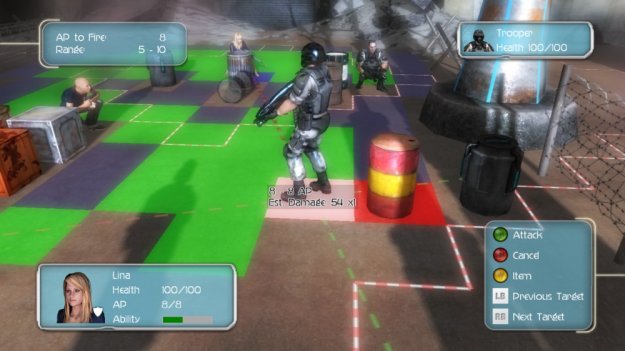
The battle system isn’t anything to out of the ordinary. Anyone who has played a turn-based strategy RPG will immediately be able to pick up the game.
Characters have a set amount of action points or AP to move, take cover, attack or use items and abilities each round.
It’s simple, but it works. Two things do set the game apart from other similar titles in the genre: characters can take cover for defensive bonuses, and actions such as attacking and moving can be performed more than once as long at the AP is available.
This makes for a slicker game. Players can pop out of cover for a quick shot or two at a powerful mech and then retreat back behind the safety of a barrel. It’s an absolute blast to not have to be restricted to only one action per round.
After each battle players are awarded with money and a pool of experience. Instead of characters separately leveling up, players will use the pooled experience to upgrade maximum AP, attack power, defense hit points, and how quickly their ability charges.
Miasma is a fun title to get immersed in, but it suffers from its share of issues.
The worst problem is more my error than anything.
Far too often I would move around my cursor after selecting a character and see where I could move them. If I accidentally hit A on a spot I didn’t want to select I was in trouble because Miasma doesn’t let you take back your movements or ask you to confirm them.
This adds to the much quicker and welcome pace of the game, but it also irked me to accidentally select a square deep in enemy territory to only await my impending doom the next round.
The presentation leaves much to be desired. All mid-mission chatting is done via text slapped next to the same 2D character portrait. This is similar to PlayStation 1 era strategy RPGs; however, Miasma takes it one step further with giving players the same gray skyscraper to look at. The camera will pan around this building and occasionally flying cars will pass by. That's it.
The drab scene works against the overall impact of the story and characters. Just once I would have liked to see Paul and crew inside their base chatting it up.
Another complaint stems more from the limitations of being an indie designer. For a strategy RPG, Miasma is really short and takes less than five hours to complete.
The game does add some replay value by letting you keep all your current items and upgrades in a new playthrough of the game. A survivor mode allows players to take their upgraded team head-on against waves of enemies -- a nice way to keep players in the dystopian world.
It’s also worth mentioning that it’s a slight disappointment to not be able to learn new abilities. Each character is stuck with one ability for the duration of the adventure.
ESP Games’ debut title is easy to get into and has a great story with a solid cast of characters. Those who love to pump in over 100 hours of gameplay into a strategy RPG will find the length less than stellar, and the lack of abilities and customization may prove to make the game a bit simple.
It’s not a perfect experience, but it’s a great one deserving of a play. If ESP can work in some improvements into the next few games of their planned trilogy, there’s no doubt they’ll strike indie game gold.
The good: Excellent story boosted by slick graphics and an epic musical score.
The bad: Short. Characters don't equip new items or learn new abilities. Presentation between missions is a little dull.
The wait: The rest of the story won't be finished until ESP completes the planned trilogy.