

Editor's note: Andrew's got beef with the constant abuse of the rock-paper-scissors analogy in game criticism. I have to agree -- what the hell does it even mean? -James

I don't know who messed it up. I don't know why journalists rely upon the comparison so much. But in my best Seinfeld voice, I have to ask: What is the deal with the rock-paper-scissors video game analogy?
I understand the appeal. Rock-paper-scissors is a game that everyone understands -- it is elegant in its design and simplicity.
The major trouble with the analogy is the multitude of ways people use it to prove whatever argument they are discussing. Observe these two comments about Halo 2's combat changes:
The elegance and skill of a good pistol battle were lost in the pray and spray rock/paper/scissors of dual wielding. -Former 1UP News Editor Luke SmithLike rock-paper-scissors, part of the fun was frantically deciding which method would work best. But in Halo 2, the designers decided to let players wield two guns, an option so overpowering that players rarely used any other form of attack. -Wired's Clive Thompson
Both reviewers indicate similarities to rock-paper-scissors but diverge with regard to the implications of the comparison.
Now, I could go through every example in the literature that uses the comparison and explain how it is inappropriate, but I won't. What I will do is list some of the criteria sufficient for a journalist to make the comparison:
- Tools of interaction (destruction) that are balanced in power specific to a situation
- Items that appear in threes
- Elegance in design
- Simple constructs that hide depth
- A cyclical, ordered nature of power and weaknesses of power by chained categories
Starcraft, which is perhaps the perennial rock-paper-scissors comparison, adheres to most of the criteria. Halo adheres to a couple and so does Pokemon.
Generally speaking, analogies are a great way to communicate an idea, but what gets to me are the misuses of the game's qualities. Even someone as literate and thoughtful as Shawn Elliott is powerless in the grips of the trifecta: He used it to describe Company of Heroes on a GFW Radio podcast (11/28/2007).
Let's step back a moment and reflect on this quote from a Gamasutra article, which is a fairly decent explanation:
The core idea behind the game is that no one strategy can win every time. Regardless of which 'attack' you pick, you can either win or lose (or tie in the case of both players picking the same attack). Many game designs follow this pattern. This keeps players from finding one specific strategy which will win every time. It encourages players to play dynamically
The above Gamasutra piece does a wonderful job of explaining both the initial concept of the children's game and the implementation of such a development strategy in a way that is appealing to the gaming audience.
Unlike Gamasutra, the larger media outlets rarely feature stories and articles about a game's conceptual phase. The final product is the point of the discussion -- but rock-paper-scissors is merely inspiration, not the explicit execution of the game.
Gamasutra outlines three necessities that arise from developing from a rock-paper-scissors concept:
- Each attack has a known and effective defense or counter attack.
- Each attack presents a signal that is detectable.
- Each attack occurs after the signal at a time interval which allows the defender to react.
Two of these items are irrelevant to the actual game of rock-paper-scissors.
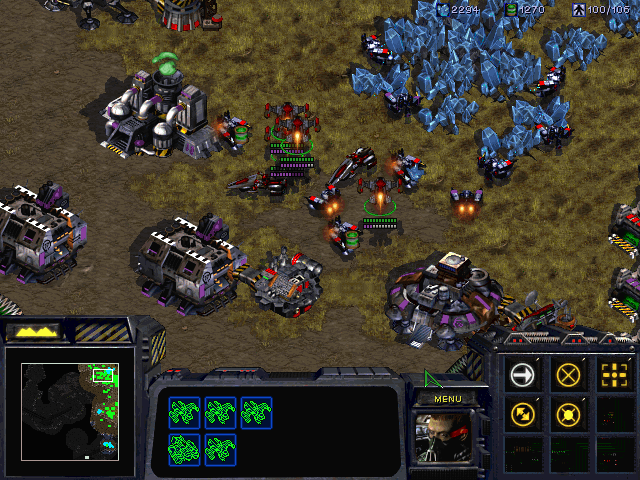
So let's work backwards. Am I to believe that Blizzard put hundreds hours of balance work in to Starcraft -- all the buildings, defenses, units, and interactions -- so they could develop a gigantic metagame of rock-paper-scissors? That doesn't capture any of the subtlety, excitement, or elegance of a thousand parts working cohesively to provide a fantastic experience.
Am I splitting hairs here? You could say that the analogy has entered the common vernacular and conveys its user's intended meaning -- much like the expression "feeling blue." But I don't use the term "feeling blue" when I want to play music with instruments relying heavily on mixolydian scales and seventh chords.
Perhaps it is a short hand; the problem with that is that you are packing a whole lot of meaning in to a very short string of words. If you use the above definition and replace "balanced gameplay mechanic" with "rock-paper-scissors," it's useless. You're only saving yourself a couple syllables and a handful of keystrokes to convene the same mildly inappropriate image.
Back to my original point, the use of the term in popular media is so far removed from the actual meaning. In turn, it is rendered meaningless. (Refer back to my comparison of Halo 2 transition descriptions.)
It's much the same to using the word "literally" to describe things which cannot not be literal. People do it all the time. In most instances of "rock-paper-scissors," the author is referring to a gameplay mechanic or design decision that is precisely not like real-life rock-paper-scissors.
It's a buzz word. It's secret code for "I understand the development process, and I understand the underlying mechanisms of strategy." Sadly, it is applied here, there, and everywhere. And in the end, the analogy has lost all meaning. Each misuse has driven it closer and closer to a synonym for "game." Or as I like to call it: "the competition-twixt-two-opposing-forces mechanic of social interaction."
Hey, that is kind of like a game of rock-paper-scissors.