Home
Home

Editor's note: Omar takes on some pretty weighty topics in this one. I think we can all agree that games could use more diversity and less stereotypes, although I'd say that the increasingly common create-a-character option is a big step in the right direction. - Demian
It doesn't require too much research to conclude that most video game characters are white men. Beyond that, they are usually white men between the ages of 18 and 40. While there are a few outliers to this rule, the mainstay of video game development has been to create a world and story which surrounds a white person, or is told through the eyes of a white person. I've been playing video games since I was a toddler, and yet, I've only had one or two opportunities to play as a character who exists in the same ethnic demographic as myself.
With a few exceptions such as Akuji the Heartless and Grand Theft Auto: San Andreas' Carl Johnson, all the black protagonists of video games are either real-life celebrities (Shaq Fu, Michael Jordan: Chaos in the Windy City, Moonwalker, Wu Tang: Shaolin Style) or otherwise pre-existing personalities (Blade and Spawn). The few non-White characters which do exist normally reinforce negative stereotypes (Shadow Warriors' Lo Wang) or aim for irony and fail (Daikatana's Superfly Johnson).
Either way, it's clear that very little creative effort has gone into fabricating interesting, amiable, or heroic non-White, non-male protagonists.
Sadly, Half-Life 2's Eli Vance is one of the few realistically
portrayed African-American characters in games.
The Industry and its Games
In 2004, the International Game Developers Association (IGDA) formally acknowledged the importance of encouraging diversity in the industry. Jason Della Rocca, then executive director of the IGDA, claimed "We're seeing, to a large extent, that games that are being designed often, unconsciously, include the biases, opinions and reflections of their creators."
Who are the creators though?
In a 2005 survey, it was found that only 2% of game developers across all disciplines were Black, 2.5% were Latino and 7.5% were Asian. However, Henry Giroux, an American university professor, warns that a more diverse development industry may not necessarily "translate into a more satisfactory representation of minorities in video games."
Speaking of which, how bad is the current representation of minorities? Pretty bad!
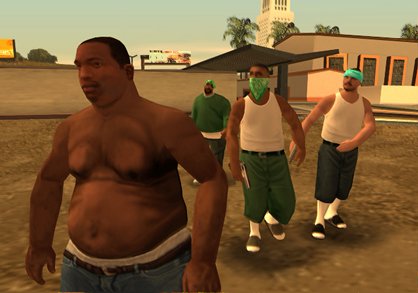
Carl Johnson does little to fight negative
stereotypes. If anything, he promotes them.
In recent years, there have been a number of studies which deal with ethnicity, race, and gender in video games. A study conducted by the Center of Media and Child Health concluded that racial representation was poor and stereotypes were reinforced in the 1,716 games which they surveyed. According to the study, a child has a 73% greater chance to play as an animal than as a woman.
The children's media advocacy group, Children Now, concluded in a study that 83% of African-American males in videogames appear in sport games, while almost 90% of African-American women were victims of violence (twice the percentage of white females).
In a comprehensive survey by David Leonard, entitled High-Tech Blackface, he makes claim that 80% of African-American videogame characters are physically and verbally aggressive, using taunts and trash-talking in the place of rational or level-headed discussion.
Developers have been taking dissapointing shortcuts. By creating characters like OG LOC in San Andreas, they appeal to an almost-racist template in the public consciousness. Instead of creating a more intriguing, deep character, Rockstar simply presents a shirtless, rapping, drug-addicted African-American who doesn't require much of an introduction -- the players already understand what type of character they're looking at.
I personally implore all developers to eschew lowest common denominator pandering, and instead, strive to create characters who have their own motivations and impulses. OG LOC seems to be a criminal because he's Black -- there should be further justification beyond that.
The romanticizing and enforcing of negative, "Ghetto-cool" stereotypes is normally met with success in the industry, with games like NFL Street, NBA Street and Street Hoops leading the way.
Even when removed from these wildly exaggerated settings, characters like Gears of War's Augustus Cole "Train" perpetuate outdated ideas of African-Americans.
Offensive to just about everyone who played it, the release of Shadow
Warriors was met with protest by Asian-American lobbying groups.
Is there any room for non-White characters outside of sports and crime games? It seems like True Crime and Jade Empire, both culturally obtuse games, are the only places where Asian characters can comfortably exist. The few genres (sports and fighting games) which depict diversity only do so to promote visual variety.
Rated AO! Adults Only
But sports games aren't the only culprits. In an MTV Multiplayer interview, Morgan Gray, Senior Producer at Crystal Dynamics, said, "San Andreas is the only Grand Theft Auto that I didn't beat, because if I had to hear one more N-word drop out of someone's mouth knowing it was penned by a bunch of white cats -- I'm done."
Despite Rockstar's adamant claims that their games are meant as satirical parodies of contemporary culture, it's difficult to deny the developer's guilt in the fetishization of Italian-Americans, Latin-Americans, and African-Americans.
While it may not be explicit, the choice of soundtrack, voice casting, and slang all converge to create an immediately displeasing and uneducated image of the relevant ethnic groups. It might not be racist, but it usually is enough to encourage minority lobby groups and parents to protest.
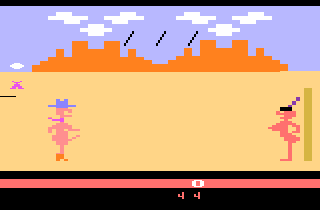
Does this count as NSFW?
Controversial and insensitive games have often sold relatively well, regardless of the game's actual quality. Felice Standifer, Producer at Sony Computer Entertainment of America, remarks that when a controversial game sells well it "gives the people making the game a feeling that it's OK because people are buying this game."
Custer's Revenge, a game whose objective is to rape a Native American woman, sold over 80,000 copies! That's right. The game places you in the ascot, hat, and boots of Custer and orders you to rape a Native American woman up against...what looks to be a wooden pole.
Being Culturally Obtuse = Uncool
...Oh, I come from a land
From a faraway place
Where the caravan camels roam,
Where they cut off your ear
If they don't like your face.
It's barbaric, but hey, it's home...
Believe it or not, but before an Arab lobby group protested to have it changed, that was the opening theme song to Disney's Aladdin movie. What started off as subtle racism has turned into an intense bifurcation between "Western" and "Eastern" cultures.
According to a study conducted by Prague University professor, Vít Šisler, 70% of Arab-centric games begin with the kidnapping of a princess/maiden/daughter and end with the regicide of a vizier/caliph/ayatollah.
Games like Prince of Persia: Harem Adventure, Disney's Aladdin and Beyond Oasis, only serve to promote negative stereotypes of arbitrary cruelty conducted by Arabs.

Not so innocent after all!
Japanese games have the dubious honour of possessing some of the most distasteful race-related imagery in the industry. Most Black characters possess stereotypical facial or personality features. Large lips, low brows, and loud mouths seem to be the foundation of Black ethnic depiction.
However, many Japanese games are influenced by anime, and inevitably caricature all characters -- regardless of their background. It becomes difficult to determine where the anime-style ends and cultural misinformation begins.
It's not uncommon for Japanese games with clownishly illustrated Blacks and Latinos to reach Europe and North America. And yet, no developer would dream of shipping a game to Japan which included slant-eyed, buck-toothed Asians. [Editor's note: Actually, I can think of one: Kung Fu Chaos was released in Japan as Kung Fu Panic. -Demian]
Uh huh....
Conclusion
So where do we find ourselves? These strange, outlandish representations may only exist in games, but there are broader social considerations present. As consumers and producers in an emerging industry, we have pressing questions to ask ourselves.
Would the experience which Half-Life provides change if Gordon Freeman was Puerto Rican?
Would players have been as comfortable if Mario was from Vietnam?
The issue here isn't one of simply "displaying" the presence of social and ethnic minorities. The industry has to effectively acknowledge their presence, including them and reaching out to them. In a commercial industry such as this, it seems counterintuitive to alienate potential consumers by perpetuating off-putting stereotypes. By including individuals from all walks of life, developers lose nothing -- instead they gain new, loyal customers and fans.
After asking members of the Geekbox forums, it seems that few people have issue playing as Black or Asian characters. Why don't developers respond to this? Developers should be fighting against out-dated perceptions, instead of giving life to them.
Why wasn't Cole as cool, and level-headed as Dom (A Latino)? It seems
Epic couldn't help creating at least ONE culturally insensitive character.
Whereas the film and music industries were steeped in creative miscegenation for decades, the videogame industry has the opportunity to celebrate the differences and similarities we all share. Video game developers have a responsibility to the consumers to promote equitable and fair portrayals of every race.
There will always be bad guys, and they will always need to be bested, but let them be "bad" because of their absent scruples, moral perspective, or ethical deductions...not simply because they are Black, Latino, Asian or White!
In the words of Gamasutra's Ernest Adams, "It's time the game industry gave minorities their due as full-fledged members of the cast."
Bibliography
Nakamura, Lisa. Cybertypes: Race, Ethnicity and Identity on the Internet. (New York: Routledge, 2002).
Kolko, Beth. "Erasing @race: Going White in the (Inter)Face." Beth Kolko et al., eds. Race in Cyberspace (New York: Routledge, 2000) 21-3-232.
Hayot, Eric and Edward Wesp. ""Style: Strategy and Mimesis in Ergodic Literature."" (2004) 41:3 Comparative Literature Studies. 02/07/05
Meades, Alan. "Observing Player Behaviour in Virtual Worlds: Evidence of Ethnographically Motivated Player Difference." (Middlesex University, 2005). 03/07/05
Gonzalez, Jennifer. "The Appended Subject: Race and Identity as Digital Assemblage." Beth Kolko et al., eds. Race in Cyberspace (New York: Routledge, 2000) 27-50.
Kilman, Carrie. Video Games - Playing Against Racism. Tolerance.org, June 8, 2005,
http://www.tolerance.org/news/article_print.jsp?id=1228
Leonard, David: 'Live in your world, play in ours' - Race, video games, and consuming the other. Studies in Media & Information Literacy Education, 3(4), November, 2003,
http://www.utpjournals.com/jour.ihtmllp=simile/issue12/leonardfulltext.html