


Editor's note: James wants to explore the world of indie gaming with you, just like Greg Ford does in Indie Scene: A-Z. But if you've read James' intro to his new column, you'd know he's a lot more fiery about it -- maybe even a little angry. He's a bit calmer here, however. Perhaps Auditorium's gentle tunes has soothed his soul....
Save the "That Damned Little Indie Game" tag to keep up-to-date on future articles in this series from James. -Shoe
So, first up on the plate is Auditorium. (You can play the five-level demo right here.) I chose this because I'm especially biased. Developer Cipher Prime is from Philadlephia and so am I.
But not really.
It's more because I occasionally come across game that defies description.
Auditorium is just such a game.
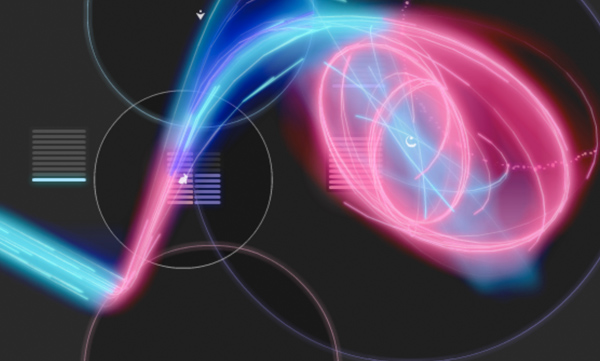
It is a game which can be most closely described as an aural and visual experience fused with a few simple puzzle mechanics. It's segregated into different, almost symphonic pieces that represent a normal gamer's concept of levels. Much like a piece of classical music, each Act is divided into levels or movements. The songs, or Acts as they are called, each incorporate a new puzzle mechanic.
The concept is simple: A thin stream of color silently runs across an all-black screen. At different points on the screen are equalizer markers which represent the volume levels of various instruments throughout the mix of the movement. If the flow crosses over one of these equalizers, it will fill up, and its associated instrument will begin to play. The problem is that the flow is linear. It enters the screen at a specific point and goes straight in one specific direction -- a direction which does not cross over any of these markers.
In each movement, you are given one to three tools you use to warp the flow. The earliest tools are circles that let you place a gentle bend into the flow, redirecting it around the curve of the circle.
It's easiest to think of the flow as a taught string being pulled in one direction. Then imagine pushing a pinion into the string, thus bending its linear course. While its hard to describe in writing, its implementation is exceptionally (doubly exceptionally) elegant.
Auditorium, does have a few "game-y" aces up its sleeve -- it's not as abstract as a game like Flow. The bending mechanics can get tricky. Not only can you change the position of the bend tools (there are actually four, each of which has an associated cardinal direction), but, later in the game, more advanced mechanics come into play, such as the vortex icon or color-coded filters, which the flow must cross first before hitting the newly associated color-coded equalizer icon. The flow can even be divided into two by small breakers.
Even more mechanics show up later, but the important thing is that all of this leads to a rewarding puzzle game -- one that favors careful logic over rambunctious trial and error. In addition, the open-ended gameplay means that there are many, many ways to solve each puzzle. Many. Um....like, really many.
As you figure each movement out, you'll probably hit each equalizer icon by itself, enticing you further by giving you a hint of the wonderful song part which will be unleashed once you complete the puzzle. Upon completion of an entire Act, the player is treated to an unlimited time moment. Here, all of the previously played movements coalesce into one final, functioning symphonic song. Or as gamers think, Act.
As you've only heard snippets of the music leading up to this point, this is really one of the finest examples of organic play reward I can think of to date.
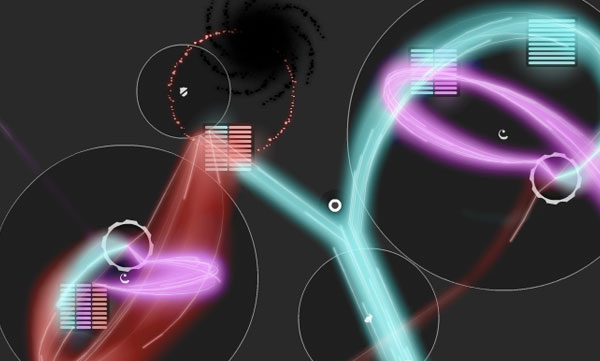
To state it simply, Auditorium is inspired in its concept and is precise in its execution, yielding a package with the construction of a finely tuned Rube Goldberg contraption and the constitution of a game like Braid.
It's unfortunate to say, but even though I'm writing this, I don't think anyone will spend the $10.99 for the full game. And that's a shame.
Auditorium is an experience; describing it on paper is like describing the winds before a rainstorm, sledding down a snow-covered hill at an uncontrolled speed, or kissing someone you really like for the first time. Its quality is somewhat ineffable. You've just got to play it -- in a dark room, with no other sounds, full-screen mode turned on.
Â
~James D., The Sophist