Home
Home


Alright, Rogerian self-analysis time: do you like yourself? Are you content with your place and your abilities? Are you engaged in meaningful responsibilities in your everyday life? Do you feel like you have a sense of purpose and reason? If you've answered yes to each one of these questions, congratulations: you're OK.
What about me? Ah...let's just assume I'm OK too. For now.
Okay, so you're OK, I'm OK. Then what's the problem?
Bulletstorm.

What's wrong with Bulletstorm? Well, first we've got to establish what Bulletstorm is. Bulletstorm is a game that involves shooting, kicking, leashing, and scoring. You mix and match these various elements while reducing digitized men into digitized men-bits. The more "skilled" you are doing so, the more score you are awarded.
The game tells you that score is an indication of your skill. The more skilled you are, the more points you score.

Now, back on that counseling couch. Carl asks you again, "do you like yourself?"
"No. No I don't."
“Why don't you like yourself?”
“Because I don't like bulletstorm. Because I should like Bulletstorm. Bulletstorm is everything I've always said I liked, but I don't like it. I don't understand. I should like it, but I don't. I don't like Bulletstorm and now I don't know what I like anymore because Bulletstorm is what I've always believed I wanted.”
Bulletstorm is about skill. Score determines your skill, since skill is measured via score. But there's a twist: score is used to purchase weapons and ammunition, which are tiered in such a way that more expensive weapons and ammunition have greater score potentials associated with them. So your score is in fact determined by...your score.

"it sounds like you don't like yourself."
"Well, I...I feel like I've been duped."
And you have: after all, a game that claimed to be so contingent upon skill is now shown to be a game that is contingent upon one’s skill at manipulating the scoring system so as to attain greater score in an attempt to prove greater skill. It’s so obvious and offensive that the realization of this fact actually causes you to be sick to your stomach. You have been lied to. You have been lied to so baldly and without any seeming cause. And you have been lied to by a fresh-faced naïve infant of a game that just wanted so badly to do something fun.

And yet, something else begins to reveal itself too. Something else begins to gnaw away at your conscience, as though a common thread has surreptitiously woven its way into all of your gaming experiences, one which you are now becoming slowly, inevitably, and dreadfully aware of. Every game has lied to you. Every game is about score. Every game is keeping score and the only means of beating that score is to find the switch that manipulates that score so as to maximize it, to conquer it, to solve the undeniable rule of the game. It’s always been there. Bulletstorm has simply lifted the veil.
This is the problem with Bulletstorm.

Bulletstorm is a finely tuned laser beam of incalculably large radius composed of all the purified elements of modern first person shooters. Thus, the act of playing bulletstorm is an exercise in the delicate guidance of said laser beam upon various metaphysical objects of one's perception. When aimed externally, it is a parody: it tears apart the serious, stern-faced gazes of our military sims to reveal their undeniable, crude, and ultimately ridiculous game mechanics beneath. It reveals to us the reality of he medium and proclaims an inescapable inevitability for any and all games that have proclaimed or may yet proclaim any kind of closeness to reality. It makes us feel good. It makes us feel enlightened. It makes us feel vindicated. It also makes us realize how empty games are.
This is problem with Bulletstorm.

Aimed inwards, and it does the same exact thing. Bulletstorm is a commentary on the gamification of games. But it is not only a commentary on what gamification has done to our games, its a commentary on what gamification has, does, and will do to games, and what gaming will look like if nothing changes. And it is a commentary laid so bare that when looked upon, it is either dismissed as irrelevant, or missed altogether. But so accurate is its message that a single playthrough injects this idea so deeply that it eventually colors the way one looks at everything.
This is the problem with Bulletstorm.
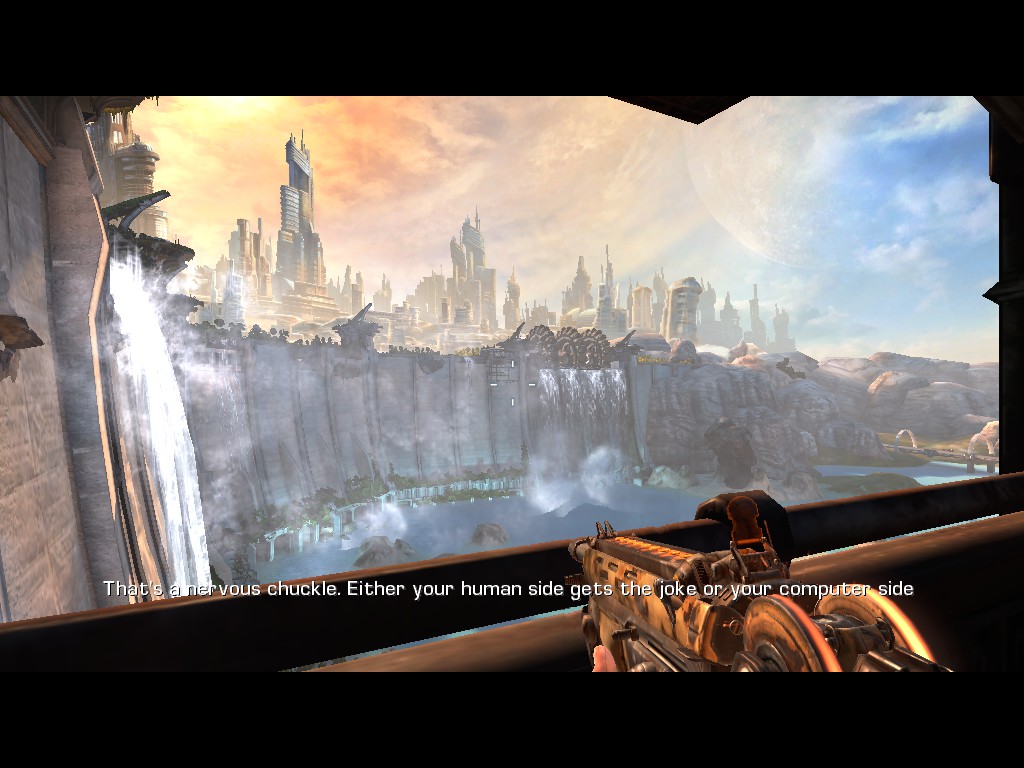
Bulletstorm is so well-executed at times that it’s impossible to fault it: it plays as what it is meant to be played as. And yet its insistence on quality, consistency, and dedication to the game world it creates is exactly what makes it such a powerful example of what games are today and what they will continue to be if something, if someone, doesn’t do something about it.
The problem with Bulletstorm is you and me. The problem with Bulletstorm is you and me.

The Problem with Bulletstorm is that it reveals to us the monster that our loving habit has become. The Problem with Bulletstorm is that it shows us what we're really thinking, and what it really means. The Problem with Bulletstorm is that it's too honest, too real, and too good of a game to be forgotten once played. The Problem with Bulletstorm is that it makes you hate the gamer that you know you were all along. The Problem with Bulletstorm is well, being Bulletstorm.
Why didn't it do better? Why couldn't it get any of those astronomical First-Person-Shooter sales that seem to be so easily garnered nowadays? I honestly can't say. But my best guess is simply because no one really wants to see how ridiculous and ugly they are, how vapid and meaningless their emotion-driven habits can be, and how inevitably satisfying gaming is supposed to be once you stop taking it seriously. No one really wants to look into that mirror.
And Bulletstorm didn't sell well because it's the clearest mirror yet.