
What the Mac App Store means for Mac gaming

Assassin_shot_edited_small_cropped
Tuesday, January 11, 2011
EDITOR'S NOTEfrom Brett Bates

I'm not sure whether the new Mac App Store will transform Mac gaming, but I do think it's a step in the right direction -- especially if developers bundle in iOS versions or offer them together at a lower price. Richard gives a great rundown of the store's possibilities.
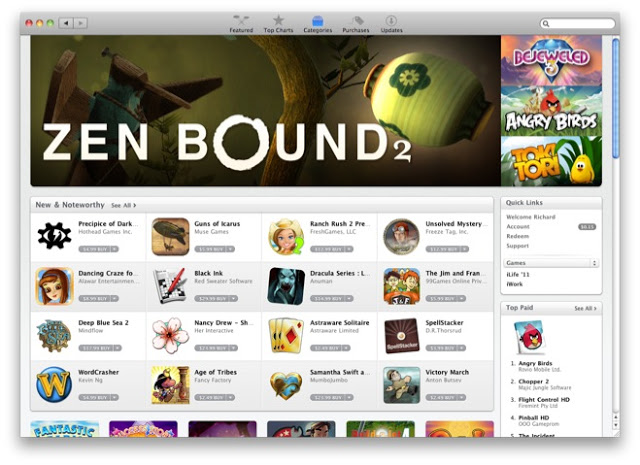
Mac App Store Games

The past 12 months in the world of Mac gaming have been interesting, to say the least, with the arrival of Steam for Mac accompanied by several high-profile releases and greatly increased coverage from the press (somewhat over-enthusiastic, in some cases). All this attention has left some pinning their hopes to the new Mac App Store as the final piece in the puzzle of Mac gaming’s rise to popularity.

Are they justified in their celebration of what is really just another distribution platform? Can the fact that Apple is involved and that -- more importantly -- it is built into the Mac operating system be decisive in proving the Mac once and for all as a viable gaming platform? What does the Mac App Store actually mean for Mac gaming? Let’s take a look.


Out of the roughly 1,000 apps (TUAW puts the number at 959) available at launch, around 200 are games. That’s an impressive showing, and the number will surely increase dramatically in the coming weeks. But unless you are only interested in casual games, the catalog is sorely lacking in depth.

Still, a game’s a game -- right? If sales take off the way they did with some early iOS games, the bigger and more ambitious developers will jump in with more traditionally hardcore titles, hoping to snag some of the lucrative casual audience for the extra sales they need. The potential for earning money for games on the Mac is huge, now that hundreds of games are available at the click of the button in one of the most visible OS X apps (the Mac App Store appears in the Dock alongside the Finder icon, and in the Apple Menu Bar as the third option).

Expect more iOS ports -- lots of ‘em

The day-one showing makes one thing painfully obvious: There will be a lot of games ported from the iPhone, iPod Touch, and iPad. Some will be good, such as Angry Birds, The Incident, and Flight Control HD; others not so much. Sadly, the Mac App Store shares the iOS App Store’s weaknesses in categorization and searching. Genre distinctions are arbitrary and often misleading, while games that appeal to very different audiences are liable to be listed alongside each other -- as though they were similar.

Call me crazy, but I doubt the target audience for Majesty 2
has much overlap with that of Making Mr. Right.

Nevertheless, reports indicate that it is relatively simple to develop for both Apple’s iDevices and the Mac. That means that a lot of developers will release their games on both platforms in order to maximize sales. We’ll have to wait and see how many people will be willing to buy the same game twice -- once for the iPhone or iPad, once for the Mac. But this could turn into a lucrative business practice.

More exposure for PC and console ports

Virtual Programming, Aspyr, and Feral Interactive have done much to prop up the Mac gaming scene for the past decade, ensuring that a steady trickle of the best PC and console games make their way to the Mac. TransGaming have joined those three companies since the shift to Intel processors. Now all four are looking to field a strong lineup on the Mac App Store. Virtual Programming’s Majesty 2, a real-time-strategy game, and three TransGaming-published games -- Garage Inc., The Path, and Puzzle Quest -- are already on the store, while Feral’s Lego Harry Potter: Years 1-4 didn’t quite make it for a day-one release.

Aspyr didn’t manage to get anything ready in time for launch but promises that they have games on the way. Similarly, Feral and Virtual Programming seem enthusiastic about getting more of their respective catalogs -- which include BioShock, Borderlands, and Supreme Commander 2 -- available on the Mac App Store.

PC and console hit Borderlands -- soon to be on the Mac App Store.

This could be a huge boon for Mac gaming, as many, even among the hardcore, are oblivious to the existence of such ports. While Steam threatens to extinguish the porting houses with features such as SteamPlay, the Mac App Store promises to give them much needed exposure. Sales will rise, giving them the resources to port more games faster, and perceptions will change -- the Mac does have games, and good ones at that.

New life for old games?

As a lifelong Mac user, one thing instantly jumped out at me while looking through the games listings: The Mac App Store is the perfect place for older Mac games -- from a time before Mac gaming got any real attention from the press. Pangea Software have their lineup available already, despite the fact they left the Mac scene in 2009 for the more lucrative iOS devices -- after two decades of loyal service. If their games find second wind on the Mac App Store, they might just return to their roots and develop new IP for the Mac.

And others may follow their lead. Ambrosia Software’s legendary presence on the shareware scene has faded a little in recent years, but success on the Mac App Store might return the company to the limelight. Formerly independent Freeverse (now owned by ngmoco) could look to the Mac App Store as a metric for whether they should throw a bone to their Mac fans.

I’d pay good money for a new or updated Escape Velocity -- Ambrosia’s flagship title.

New business

The Mac is no stranger to online stores -- besides Steam, there are Mac Game Store, GamersGate, Aspyr Game Agent, Direct2Drive, GameTree Online, and Deliver2Mac (among many others). If people don’t find what they’re looking for on the Mac App Store, they may be encouraged to try one of these other stores -- leading to a yet more vibrant market.

Moreover, if the Mac App Store continues to offer insufficient granularity in its categorization of games, an increasing number of people are likely to look around for more information -- something to help them wade through the crap to get to the gems. That will lead to a greater number of well-informed Mac gamers, which will help ensure good games do not get overlooked -- wherever they may be sold.

Early days, but already a win

Of course, it is much too early to say just how significant the Mac App Store will be for the future of Mac gaming. What is clear is that the store will increase sales and exposure for developers of all flavors. It might transform the landscape, or it might not (my money’s on the former, as it has been for some time).

But we must be careful not to get too far ahead of ourselves. Apple’s 30-percent cut on sales may be too much to swallow for some developers. And this is the company, remember, that has shunned games and game developers throughout its history and only backed iOS games after they became widely popular.

 
Problem? Report this post
RICHARD MOSS' SPONSOR
Comments (7)
Me04
January 07, 2011

The Mac App Store has unfortunately adopted the "race to the bottom" mentality that's dominated the iOS App Store to date. And for most programs, stripping bloatware of most of its functions and streamlining apps to one or two functions so that users can construct their toolset in a modular fashion is nothing short of amazing. I wholeheartedly encourage it, in fact.

However, this kind of model applied to games leads to poor quality when we're not even seeing a limitation in budgets as Indie developers "enjoy", but a downright decimation of them. How Angry Birds is so popular never ceases to amaze me. Five years ago it would've been a free web based flash game!

I think Jon Blyth summed up my thoughts perfectly with this tweet:
Another way to play Angry Birds! If only there were as many ways to eat dogshit

https://twitter.com/#!/disappointment/status/23060055783907328

I think the Mac App Store won't be very good for gaming on the platform. If top developers so much as dare try and sell their high budget games, the community will moan when they're lined up against cheap tat like Angry Birds. The only thing I can think of that would change it is if Apple created a different category for big budget games which ostensibly come from big name publishers. The problem with that is that it goes against everything the App Store currently is: everyone's on equal peggings.

Assassin_shot_edited_small_cropped
January 07, 2011

When I first looked at the Mac App Store, I had a similar reaction to you, Chris. But if you look a little closer at the numbers, you'll see that it has actually resisted the "race to the bottom." (I pray that things stay that way.) TUAW did a great [url=http://www.tuaw.com/2011/01/06/mac-app-store-by-the-numbers-almost-1-000-apps-on-day-one/]break-down of the distribution of pricing.[/url]

As I mentioned in the article, many of the games (and other apps, too) currently on the App Store are ports from iOS. There are lots of commercial titles on their way that just weren't quite ready in time. This skews the data set in a way that I don't think will be (or at least hope won't be) accurate going forward.

I share your concern about the lack of distinction between high-budget and low-budget games, but don't take such a fatalistic view. Take Steam as an example: there are hundreds of games spread across an extrememly broad price spectrum, with many a cheap indie game getting just as much attention and exposure as a $60 title that gets a retail release. Yet Steam is doing fine, and so are the people selling games on Steam.

If the Mac App Store is to have a big impact on Mac gaming, it probably will need a change in tack. The top 10 sales charts and poor filtering do encourage a race to the bottom with pricing, but I'm not sure that will happen. Instead, it risks becoming too bloated with crapware for people to find the good stuff -- which will be priced competitively, since the Mac App Store is not a walled garden like the iOS App Store.

The mere fact that ever Mac user will have access to this store, and, with that, hundreds of games at the click of a button, is one that cannot be underestimated in terms of significance. If people are buying and playing games for the Mac, that will help the platform -- no matter what else happens.

Me04
January 07, 2011

Whilst I agree that opening games up to more Mac users is a good thing, I'd prefer it if they didn't get a skewed presentation of what games are. Apple don't even hold games in the same regard as films or books, judging by the way they impose far stricter censorship on them. For those of us who want to see our medium grow and mature, Apple's nannying approach, which will no doubt extend to the App Store, reduces games to a mere infantile distraction.

And another thing, Steam and App Store is like apples and oranges. For starters, Valve control pricing and releases. If they feel your game isn't up to snuff or they're swamped, it won't make it to the store. The difference between App Store and Steam is that developers on Steam are more like partners; Valve have created an eco system whereby only their approved partners get games up, and it's quite an exclusive club. Yes, this has its drawbacks, but at least they keep the garbage out. On the flip side, App Store developers are just as much customers to Apple as the people buying the games are. Their treatment of developers really isn't much different to that of those vanity "print on demand" services offered to unpublished novelists.

I'm not going to write the App Store off entirely, but I think the kinds of prices people are expecting to pay for games on this are completely at odds with the price bigger publishers are prepared to charge. When you have an open market like the App Store, where developers have 100% control over the price of their apps, what will eventually happen is a price war. It's what customers expect, even if it's bad for the health of the industry.

Why do you think platform holders such as Steam, Sony, Microsoft and Nintendo have an agreed (though not strictly enforced with the exception of Steam) price on full budget games? It's to stop developers undercutting each other, which would eventually lead to a diminished quality, which is unhealthy for the their long term interests, even if it leads to short term profits on one game.

The App Store offers developers no such protection against their rivals undercutting them, and that's why I fear a race to the bottom. It only takes one developer to oblige, and everyone else drags their prices to rock bottom and you end up with garbage like Angry Birds becoming a hit.

Stopping the debate for a moment, I'd just like to add that this is a good story, Richard. I'm a big Mac fan and I'd love for the day that I could ditch Windows for good, but as a gamer I don't feel that time is here yet. To me, the App Store does little to make me want to jump ship.

Assassin_shot_edited_small_cropped
January 07, 2011

I thought you might say that. :)

The one thing that you're ignoring is that the Mac App Store is really just another place to buy Mac software, whereas the iOS App Store is the [i]only[/i] place to buy iOS software (unless you jailbreak, of course). I think that will help to keep things in check, as people aren't going to totally abandon the other stores and look exclusively at the App Store for software or games.

I agree with pretty much everything you've said; I just make a different, more optimistic, conclusion. I have faith in the open market balancing everything out and keeping some attention on the non-conformists (there have been plenty of successful iOS apps that refused to engage in price-wars, too, such as Real Racing and everything by The Omni Group (non-games) -- so there is some precedent even in the "walled garden"). Is my faith misguided? We'll find out in due course.

Edit to respond to your edits: I [i]hate[/i] the way Apple treats games and game developers. They have always held a poor view of this medium -- although it should be said that there are plenty of individual supporters within the company.

Dscn0568_-_copy
January 07, 2011

I've never understood the Mac Vs. PC debate, though admittedly I mostly use my PC for the web and MS Word. When I took graphic design courses the computer lab was all Macs and they all had game design programs installed in them, so hearing about Apple's frosty relationship with games seems counterintuitive on its part.

Photo_159
January 11, 2011


Richard, I am really surprised you didn’t bring up accessibility and exposure for up and coming developers. That is really what makes iOS so valuable - and what will help the Mac App Store become more than a digital wagon full of buffalo chips. The bar of entry is slightly lower - and now all those would be iphone developers are also Mac developers. A strong community is there and growing producing tons and tons of content. Sure a majority of it is down right lousy but not every garage band can be as big as Led Zeplin - and not every developer/garage band wants to be. However, a larger developing community eventually yields more unique and quality content. I use the music industry here very specifically.

Then there are those big mainstream publishers and developers who refuse to stop pushing out misplaced ports and shovel ware. Sure, Apple should make a better way to find good content but the truth is people trust brands they have already invested money in and will buy apps even if they are crap just because they say: EA, Call of Duty, Activision, Ubisoft, Lucas Arts, etc. All of these big hitters have done virtually nothing in terms of creating incredible even decent content for iOS. Technically, they should be leading the way.

On the upside think about one of the biggest limits old guard game developers have been facing with iOS. Figuring out how to create “complex” gameplay with a touch screen and an accelerometer. Some might even argue this is why there is so much shovel ware on the iOS mobile devices. Simply put The Mac App Store now gives developers more familiar ground to build on.

We are going to see some incredible things from that space and I think it would be unwise to turn a blind eye to the mac app store based on the content of the app store with mobile devices. Although the code for the software is similar the hardware is much different.

Chris mentioned pricing and I just wanted to say that places like steam and the app store are the quickest way to make publishers realize they are charging too much for digital content. Or at the very least the sales model isn’t really cutting it anymore. Distribution is expensive but we all know it is significantly less to distribute digitally. Developers and publishers aren’t as worried about undercutting each other as they are about undercutting brick and mortar stores who have until recently been the “dominant” way to get your product to the masses.

As for the larger concern Chris brought up.

I think the thing to remember is that change takes time. Apples relationship with gaming is changing. The more people invested in the Mac App store(and iOS gaming in general), the more people there will be to raise concerns about the way developers are treated.

Assassin_shot_edited_small_cropped
January 11, 2011

Good points, Evan. I did allude to the point that the Mac App Store grants great exposure for new developers, but perhaps should have spent some time talking explicitly about it.

The situation with the Mac App Store is different for the big publishers, since they aren't (yet) putting out terrible games on the Mac that are loosely associated with their hit releases. Rather, they are -- albeit slowly -- releasing Mac ports of their PC and console hits. Hopefully they will keep the shovelware away as the Mac App Store grows in popularity, and maybe even set an example with highly-polished original content *possible pipe dream*.

I read somewhere that the Mac App Store will redefine the way publishers and developers think about pricing, particularly with games. Apparently $5 is the "right" price for games, and that is why Steam sales are so successful. I don't know that I would set a default price that low for really good content, but it certainly seems that games are too expensive.

Interesting side-point about the issue of potentially undercutting brick-and-mortar stores: In Australia, new games typically retail for $100-120. Many publishers artificially inflate their prices on Steam to figures way above those in the US store so that the high street retailers don't get run out of business.

You must log in to post a comment. Please register if you do not have an account yet.