How smart people can make dumb games

Default_picture
Monday, May 14, 2012
EDITOR'S NOTEfrom Sam Barsanti

Whether or not you agree with the assertion that most video games are dumb, Steven's piece is a good reminder of the fact that this medium has a completely different set of strengths than books or movies, and that it's important for developers to take advantage of them if they want to create something really unique and powerful.

BioShock

As Taylor Clarke points out in this now-infamous Kotaku piece, you aren’t treated to a whole lot of depth in your average video game. You’re probably just running around shooting lasers at aliens, or navigating an environment while you punch people until they die. This is the story and nothing else matters.

Character motivation, narrative arcs, and philosophical dialogue all become a muffled whisper to the player's psyche against the deafening roar of what you're actually doing onscreen.

Ken Levine claims that Bioshock is about "human nature," but the only message echoing in your brain is "Shoot, shoot, and burn the psychos, shoot, shoot, electrocute the monsters."

I have no doubt Levine is one of the brightest and most intelligent storytellers in any medium, but adding something “smart” to a video game is like putting Yo-Yo Ma on stage with Rammstein and wondering why the metal-heads crowd the mosh pit and the cello enthusiasts leave in disgust.


I am inclined to agree with Matthew Burns in that adding a "better story" to a game about shooting aliens is as dissonant as overlaying Mozart to a Jackass movie. Like watching Steve-O snort wasabi set to a stirring violin, "it is extremely difficult -- maybe impossible -- to come up with a story and characters that, when placed within the context of most current video games, don't feel inherently silly."

I read the previews for Spec Ops: The Line, an ambitious new title that aims to be one of the "smart" games that Clarke yearns for, and was intrigued. Creative lead Cory Davis sums up the vision as "hyper-realistic, but emotionally authentic." The IGN preview explains how Davis is striving for that: Every enemy speaks and yells like a real soldier, military experts mo-capped the correct usage of a shotgun, and there will even be a moving story. Actual writers are painting a narrative of horrific torture situations, heroic rescues, and the human soldiers who live through them. There is no reason to think these professionals and visionaries are not capable of creating an interactive Heart of Darkness. The equation is in place for the "smart game" we’re looking for.

Except that Spec Ops: The Line is still another big, loud, and especially dumb game...but it may not be anyone's fault except the medium of video games itself.

During the recently released demo, I earnestly tried to keep the story and the vision alive. I was tuned into the whispering good intentions of so many smart people, but then the violins began to drown underneath the "bang, bang, kill the bad men, bang, bang, reload."
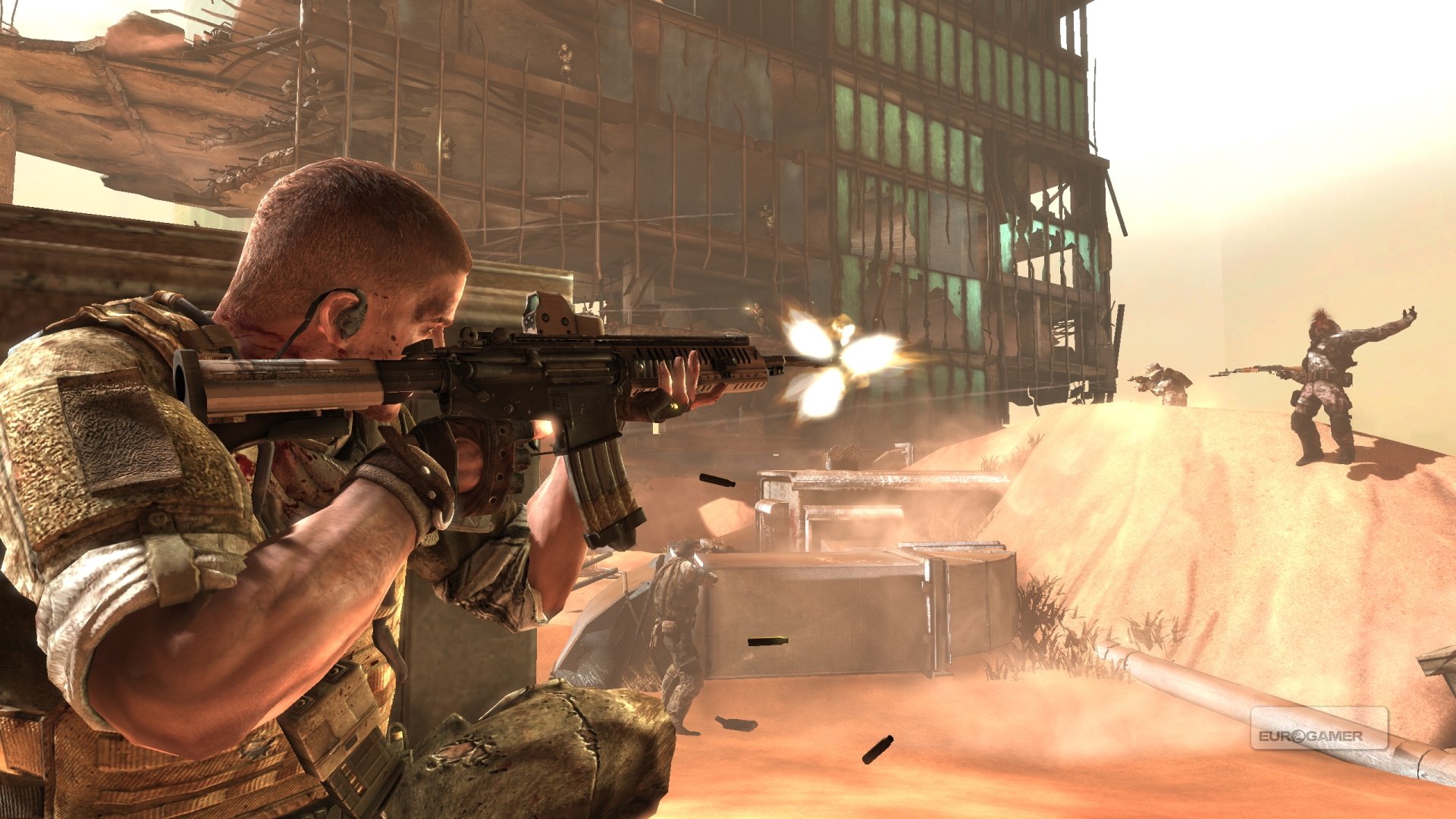
Spec Ops: The Line

I had come for Yo-Yo Ma, but all I could hear was "Du Hast" screaming over my speakers.

Davis acknowledges his medium is different, but he doesn't understand why: "I think we have a really huge opportunity to use interactivity to spark certain emotions and thoughts in the player that other mediums don't necessarily have and can't explore in the way we can...."

He has incorrectly attributed the wrong strengths and weaknesses to video games. He is assuming that interactivity creates stronger emotions, but he then talks about pushing the narrative. This is the biggest sin of smart people: They create dumb games because they don't understand their medium.

Journey's creator Jenova Chen is a rarity among developers. He chooses to push and revolutionize gameplay -- rather than narrative -- to introduce emotions and thoughts in the player that other mediums would not be able to. Chen is a smart person creating smart games, and Simon Parkin's interview explains why: Journey's emotional impact was the result of not a narrative decision, but a gameplay decision. When he removed collision-detection between players, people begin to look for other ways to give feedback to each other. Namely, they began to help one another.

That's how video games are unique to film or television, and that's what Davis, Levine, and other well-meaning people fail to understand. Until they do, expect to see more dumb games from smart people.

 
Problem? Report this post
BITMOB'S SPONSOR
Adsense-placeholder
Comments (8)
Default_picture
May 14, 2012

I really wish I could feel smart while I'm playing BioShock. I just think that the format of the FPS genre doesn't lend itself to much intellectual pondering. I guess that's why the game stopped appealing to me after I finished it.

Fez and Journey, on the other hand, are rare anomalies in today's world. I really appreciate how the indie scene is shaping modern-day games into something more unusual. In today's world of action-heavy titles, these low-budget productions provide many of the beautiful innovations and emotions that were lost in the transition to blockbuster shooters.

Default_picture
May 15, 2012

Yeah, I mean it's hard thinking deeply just watching an action movie, how much harder is it to actually be the guy doing the shooting and thinking deeply about his or her motivations and the implications of one's actions? It's like trying to read The Heart of Darkness while someone shoots a rocket launcher at you. It just doesn't have the same effect.

Default_picture
May 15, 2012

Good points, Steven. The one thing I loved about Journey is the way that it elicits real, authentic emotions through gameplay -- I was geuninely afraid, sad, and elated at various points throughout the game. Few other games have been able to achieve that organically: most either pander to the audience or try (and fail) to "force" those kinds of emotions through narrative tricks and cliches (Gears of War 2 comes to mind).

It definitely is an interesting problem to tackle, however -- trying to balance "smart" games with the demands of the market, as well as with rising costs of development. I think of Bioshock as a compromise (kind of like a Trojan horse for smarter game design) of these two facets, a sort of incremental evolution with an intelligent narrative, but wrapped in a nice looking FPS package to make sure it'd still find a wide audience. Unfortunately, it does appear that most developers are still stuck in this mindset of balancing familar mechanics with little innovation -- over five years after Bioshock's debut, no less. But hopefully, they'll figure it out soon enough. 

Default_picture
May 15, 2012

I like that analogy, it was kind of trojan horse, bringing in some more thoughtful content but still wrapped up in the FPS. And that's the other thing, can "smart" games grab that large audience and still make a profit? Or are they stuck to being indie titles? But maybe there's nothing wrong with that?

Lolface
May 15, 2012

Steven, I have to disagree. I do agree that most action games are big, dumb events that just send wave after wave of idiotic AI your way to be shot down until the game tells you that it's over. However, the operative word here is, "most".  The implication of this article seems to be that action games (more specifically, the camera-in-the-chest shooter (FPS)) can never aspire to be about anything other than the action that is happening on screen. I disagree.

Bioshock was about more than just shooting everything that moved. Yes, you did a lot of that, but there was more going on. With the whole "Would you kindly" aspect, Bioshock questioned player agency within the confines of a designed structure by asking if the player was in control of the game they were playing, or if the developer was actually in control, reducing the player to a mindless monkey that only does what they're told.

The game also asked if you were willing to murder a little girl for more power. I've played a lot of games (mostly RPGs) as both good guys and bad guys. My Shephard is a renegade. However, in Bioshock (and its sequel) I am physically incapable of fully draining the Little Sisters. I know its a game, this decision has little to no effect on the actual narrative, but that doesn't matter. I can't kill a child.

Is that a comment on human nature as Ken Levine suggests? I don't know, but it is more than just shooting everything that moves until the credits come on.

Also, I don't agree with the notion that a good story can't elevate a "dum action game" to be something more than just dumb. I'm not particularly fond of Metal Gear Solid 2, but as Bitmob editor Rob Savillo pointed out, it is probably the first post-modern game. In a game where you mostly snuck around, shot a lot of people (sometimes from the first-person perspective), and did naked cartwheels, its narrative plays a large role in the reason why it's considered to be post-modern. 

Default_picture
May 15, 2012

Yeah, I was very impressed with the "would you kindly" twist at the end. Definitely an interesting comment on videogames themselves. But unfortunately, while pointing out the limitation of the genre, Bioshock doesn't actually move beyond it, Levine just seems to point it out. And here's the kicker, immediately following this meta revelation, you're stuck in a generic, cliched boss battle! ugh.

And when you say you can't kill a child, I think that's Bioshock's biggest failing. I would way prefer a more nuanced decision, one with no right or wrong answer. Or maybe, if you saved the children, you couldn't use plasmids. That would be a REAL choice.

With your MGS 2 example, I would say the gameplay actually shapes the narrative quite a bit. The story is off-the-walls bonkers. I cannot stress how ridiculous the narrative is. But all I remember about the story is being confused. What really stuck with me is doing naked cartwheels, playing as a character I DID NOT WANT TO PLAY AS, and fighting Dr. Octopus on the roof of the capital building. Kojima wanted to tell a story that made you question reality, a post-modern story. But he also made you question reality through the gameplay as well.

You need both story and gameplay to make a smart game, but I would suggest gameplay is by far more important. The focus should be 90% on gameplay and 10% on narrative. It's too bad many developers seem to try telling stories with their priorities the other way around.

Robsavillo
May 15, 2012

This is really smartly written. I definitely want to see more games embrace the narrative possibilities of gameplay. It's one reason I talk about Demon's Souls so damn much, heh.

You're right about shooters. That genre's primary language (the primary way through which players interact with the world) is shooting stuff, as you point out so elegantly.

I just finished reading No Country for Old Men (been on a Cormac McCarthy kick lately), and even with all the shooting and violence in that novel, it comes nowhere close to the amount of shooting in a typical FPS. I'm trying to imagine how McCarthy could weave such a brilliant story if he had to write about shooting guns and killing people every other sentence. It just wouldn't work.

Regarding BioShock, have you read Clint Hocking's piece on ludonarrative dissonance?

Default_picture
May 15, 2012

Thanks for the kind words Rob, and I haven't played Demon Souls but from what I've seen it makes a lot of interesting design choices, and I bet that's what makes it such a refreshing experience.

And that's a perfect metaphor, if every sentence had to mention someone shooting guns or someone dying, it would definitely devolve into crass and muddled story.

Thanks for the link, I think I've read articles about that article, but I'm glad to read the original. Hocking really sums it up nicely about Bioshock, "we are mocked after a 20 hour commitment for having sympathy for the limitations of a medium. The ‘twist’ in the plot is a dues ex machina built upon the very weaknesses of game stories that we – as players – agree to accept in order to have some sort of narrative framework to flavor our fiddling about with mechanics. To mock us for accepting the weaknesses of the medium not only insults the player, but it’s really kind of ‘out of bounds’

You must log in to post a comment. Please register if you do not have an account yet.