How Spec Ops: The Line risks pushing video game narratives too far

Default_picture
Friday, December 07, 2012
EDITOR'S NOTEfrom Sam Barsanti

I still haven't checked out Spec Ops: The Line, but articles like this show exactly why I want to. It seems like the sort of title that everyone should experience, whether they end up enjoying it or not.
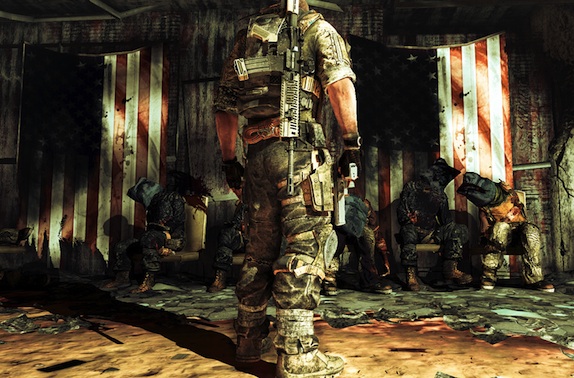
This article contains minor spoilers for Spec Ops: The Line.


Recently, a video game made me want to put down the controller and walk away. It wasn’t due to frustration or boredom either, but because I couldn’t handle its intensity.

Actually, this happened several times. I could only take about an hour or two of it in one sitting. The game was Spec Ops: The Line, and It wasn't because of the particular decisions that it forced upon me, but the overall weight of the narrative. Each battle wore me down, and eventually I would have to quit and go do something relaxing.

I enjoyed Spec Ops: The Line. The story was great and it is a refreshing title in an industry filled with cookie cutter military shooters, but the experience got me thinking about something: Is making the player walk away from the game a good thing?


The word "game" suggests that players should be having fun and enjoying their time with the product. While Spec Ops was an overall enjoyable experience, it almost crossed a line a few times. It’s a lot like a horror movie, in that you want the film to be scary enough to entertain a crowd but not so scary that it truly terrifies the viewers. I have played numerous Call of Duty campaigns in one sitting with no problem, and there is just as much slaughter in the those games as there is in Spec Ops. That means the issue is with the narrative. Spec Ops is an intense and personal story that aims to make the players question the glories of war, but it went a little too far sometimes.
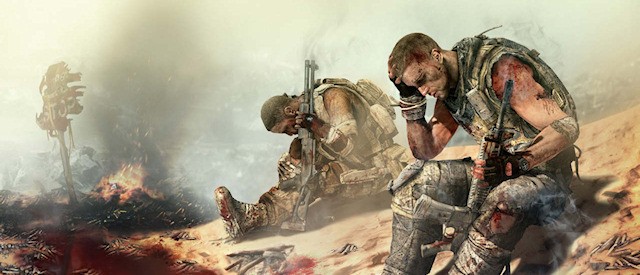
Seeing rows of U.S. soldiers lined up next to a wall filled with bullet holes, or innocent civilians who were accidentally burned to ashes by your own hands, are both pretty shocking. Each gunfight leads to another scene of desperation and violence. While some people may get "combat fatigue" from shooters, Spec Ops can supply plenty of fatigue just from its immersion alone. The situations presented in the game are more than enough to make the player feel exhausted.

With budgets for triple-A titles growing more and more every year, I believe we will see more games likes Spec Ops. Titles that are extremely immersive and force players to question their actions based on actual ethics and not just arbitrary rules will become more common. 

One example of how not to do this is Fable 2. There are certain actions in that game where if you choose the "good deed" you get experience points taken away from you, while if you choose the "evil deed" you keep your XP. This is an example of a decision based on a game's rules, while in Spec Ops you make decisions based on ethics. Who do you kill? The solider following orders or the criminal who is trying to feed his family? When you give game-based rewards, the decisions themselves lose their power, but if you make the player question the reality within the choices, you can reach them on a whole new level. 

Spec Ops has started something amazing. Hopefully other developers will follow suit, but they need to be careful. That cannot forget that video games need to be inherently fun, and they must not cross the line into an experience that is no longer entertaining. 

 
Problem? Report this post
BITMOB'S SPONSOR
Adsense-placeholder
Comments (6)
Default_picture
December 03, 2012

It is absolutely the future of ethical choices in video games.  I don't want a binary good/evil choice that just gives me different rewards; I want a choice that affects things more subtly and instead makes me feel like a terrible person if I choose "wrong."  It isn't the first game to do it, but hopefully it will inspire more games to put some thought into those choices.

I didn't experience this fatigue when playing Spec Ops: The Line.  The only fatigue I felt was from the bland gameplay.  Maybe that's why I never got to the point where I was being hit with too much depression to push onwards?  I can see how the game might have that effect on people, but it never happened for me.

Default_picture
December 04, 2012

What I thought was great about Spec Ops is that even if you make the "right" decision, you still feel like a bad person. The entrie game is just one big grey area, no black and white. 

Default_picture
December 04, 2012

I love Spec Ops because the game makes it abundantly clear just how much it hates you. You are a horrible person and none of the choices you make matter because you—not necessarily Walker—are just some nutjob murderer playing hero in a virtual fantasy.  It’s a game that managed to make me feel guilty for years of virtual bloodshed. By the end of the game, I was exhausted; it really puts you through the emotional wringer.

Mark, if you like Spec Ops, there’s a critical reading out called Killing is Harmless by Brendan Keogh  that’s superb.

Default_picture
December 07, 2012


While I disagree with Justin and Mark in there being right or wrong choices within the game, I think they are all merely ‘choices’, I find their unilateral admiration heartening. The game throws a mirror in front of the player throughout, and at one point directly, in an attempt to question the very nature of video war game enjoyment. As Keogh correctly points out, the game and its developers do not offer an answer to the problems associated with the current trend in jingoistic modern shooters, they merely question the person enjoying them.
The Line is slowly becoming the touchstone of post modernity in video games. It clearly exhibits a will to draw accountability from the player and make them responsible for their actions. It is certainly a brave step in the progression of video games, regardless of its mechanics or narrative missteps.

Default_picture
December 07, 2012

I don't think you necessarily have to have 'fun'. I can't say Spec Ops: The Line or Name of the Rose or Moon were 'fun' (I could give several more lines of examples), but they all kept me riveted and engaged. Amnesia was not pleasant at all, but it was like being a deer in headlights and the adrenaline hit was awesome. 'Interesting,' not 'fun.'  The times I was least interested in The Line was when it was trying its hardest to be a Call of Duty.

Which is a good comparison - I just played Modern Warfare 2 (yeah, way behind, but not paying full price for this crap any more) and though it should have been the epitome of adolescent male power fantasy fun, it was just boring and pathetic. I'll take The Line any day.

I guess you can ding The Line for trying a little too hard, but I think that's mostly a reaction to the sea of horribly written hoorah FPSes it's swimming in. Put another way, once the default narrative isn't horrible you can stop pushing it so obviously.

Default_picture
December 08, 2012

The idea that videogames have to be "fun" because there's "game" in the name of the medium is a fallacy, and one I hope more developers get rid of. Games need to be engaging, just like movies need to be engaging, but don't have to be fun.

When I played Spec Ops: The Line, I made an immediate connection that I've seen other people make as well. War movies for a long time were gung-ho, Americans are awesome, kill the Nazis it's fun, for a very long time. Then Hollywood grew up a little and started questioning the necessity of war, and we got movies like Apocalypse Now. Spec Ops is the videogame Apocalypse Now. I just wish it had sold better so other developers could see that "fun" wasn't necessary to make a good game.

The one thing videogame makers have to be aware of is that a game is a lot longer than a movie, so the emotionally taxing nature of it has to take that into account and give the player breaks to recouperate. That being said, there are plenty of emotionally taxing novels that people can only handle a few chapters at a time, so it's perfectly doable to make art that forces the consumer to walk away and come back again.

(How many US soldiers have you killed today?)

You must log in to post a comment. Please register if you do not have an account yet.