Déjà doo-doo: Charting the chronic familiarity of video game landscapes

Default_picture
Wednesday, November 07, 2012
EDITOR'S NOTEfrom Rob Savillo

Have video games felt a little too "on rails" lately? Brian argues so, with great insight, and segues into a thoughful discussion of the drab, colorless worlds that we're no longer given the freedom to explore.

Deja Doo Doo Cover

Had I been born in another age, chances are that I would have been an explorer. Once upon a time, our world was wrapped in magic and wonder. Nowadays, an airplane ticket and a few hours time can span oceans. And, if you’re really ambitious, you might venture a mouse click and a keystroke or two to reveal the particulars of your destination on the flight over.

Perhaps, then, it stands to reason that the biggest draw of video games has been very much the urge and challenge to unravel the mystery of what waits behind the next door, inside of locked chests, or beyond distant mountaintops -- a sort of surrogate thrill in a world divested of secrets.

This seduction of exploration -- if only virtual -- caused me to slip out of bed at 4 a.m. on school days to sneak in a few extra hours of the original Zelda while my need to chart the unknown came up during parent-teacher conferences in the form of maps I had sketched of Metroid’s long shafts in the margins of my math homework. I doubt I’m alone here.

Clearly, games scratch a deep itch for adventure and discovery in an world now containing little opportunity for either. But what happens when the vistas and environments of video games become more familiar than the scenery outside our front door?


One might expect the opposite to have happened. Considering the technical limitations and relative poverty of viable platforms of the mid-to-late '80s -- coupled with the publishing strictures put forth by the market-share leader of this period, Nintendo -- the Nintendo Entertainment Systen library fares comparatively well against modern releases. Best sellers like Metroid, Mega Man, Ninja Gaiden, Dragon Quest, and Kid Icarus (to name but a few) offer an impressive breadth of surroundings each distinct from the other.

Even between releases of first-party mainstays, such as the Super Mario and Zelda series, each sequel has a look and and feel all its own. There’s no mistaking the dreamy otherworldliness of Super Mario Bros. 2 from the imaginative and unpredictable domains of an updated Mushroom Kingdom while traversing the third iteration. 

Likewise, at the risk of alienating fans of the first Legend of Zelda, developers threw Link into a reconfigured Hyrule in which players spent most of their adventure scrolling sideways through a world altered so vastly as to seem a new franchise entirely.
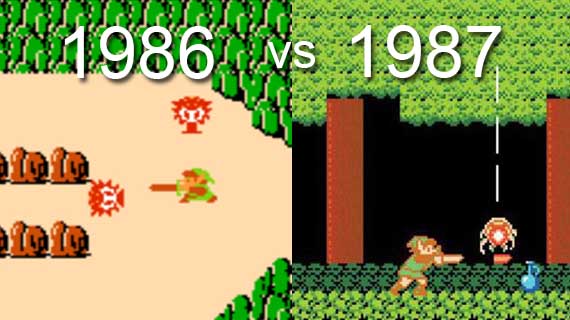
zelda1_2comp
How many modern sequels would risk such a shift?
 

By contrast, today’s software sales leader, the Xbox 360, has hosted little more than a series of brown-and-gray routes through near-identical landscapes lacking both personality and the ability to surprise. More often than not, what exploration does exist begins and ends looking down the ever-present barrel of an assault rifle -- a perspective that presents little nuance or range in its method of interaction.

To the uninitiated, or even many longtime fans, there is very little to distinguish one Call of Duty or Halo from the next. You’re either on a battlefield from World War II; in a steroid-amped modern time; or within some remote yet usually hackneyed, off-world future, depending on the trend du jour. 

Further, most of these games do little in the way of encouraging exploration, instead leaning heavily on their multiplayer modes at the expense of underdeveloped single-player missions. And as enjoyable as those online modes can be, they are no substitute for the gratification of an engrossing journey through truly original, wide-open lands and a field of interactions just as vast.

Of course, gamers seeking more variety may seek the slightly greener (or, at least, less brown and gray) pastures of the PlayStation 3. In fact, it’s my system of choice due in large part to a more diverse first-party library partly fostered by Sony Computer Entertainment Japan Studio as well as the ingenious work of Thatgamecompany, Q-Games, and others.

As we turn our attention to the best sellers on Sony’s console, however, we’re presented with an almost mirror image of their competitor's calling cards. Three COD’s make the top five, while the likes of Resistance and its sequel, Metal Gear Solid 4, and Killzone 2 -- none of which stray much from the same dull, rubble-strewn terrains -- round out the top 20.

Whatever happened to the impetus to build worlds using a full box of crayons and prodding the player to step beyond the lines? Is it that open, colorful environments have become less compelling today than they were 30 years ago? Or have habit and a sad lack of alternatives simply forced us to line up for the same old roller coaster no matter how diminished its thrills or memorized its twists and turns?

 
1 2 3 4 Nextarrow
Problem? Report this post
BITMOB'S SPONSOR
Adsense-placeholder
Comments (7)
Bmob
November 05, 2012

"Did they think we would be so hypnotized by the clichéd narratives, so distracted by our itchy trigger fingers, as to quell that urge to burst through the repetitive artifice?"

Yes, because we are. Well, I'm not, but the sales tell the story.

The slightly funny and incredibly annoying thing is that the much-maligned JRPG genre--forever lambasted as stale-- has many, many examples that buck this trend. Star Ocean: The Last Hope has colour seeping from every pore. Verdant forests in abundance, an ocean horizon that genuinely left me awe-struck for the first time in years... admittedly a lot of inside areas are generic sci-fi grey, but there's enough of a punching of colour to buck the Western trend somewhat. Final Fantasy XIII and XIII-2, even. They weren't half as successful as I'd have liked, but the variety of colourful landscapes would have Mario blushing.

Infinite Undiscovery had a smattering of beautiful dungeons. Lost Odyssey, too (http://lostodyssey.wikia.com/wiki/Side_Quest:_Crystals_From_the_Crimson_Forest). Even Magna Carta 2--which has a decidedly dreary landscape--makes some distinction with fantastically exaggerated characters and the full spectrum of yesteryear's special effects.

And then there's Blue Dragon, Tales of Vesperia, and Eternal Sonata. Three stunning, crafted games. There are a dozen unique and vibrant areas in each, epitomised by an art style that isn't afraid to take risks.

If you want more good looking games, buy them. They're there, but they're dying because the masses flock to Call of Duty every year.

Default_picture
November 05, 2012

"They're there, but they're dying because the masses flock to Call of Duty every year." 

Very true. In fact, I intend on touching upon the Japan issue in part two. Whether or not you agree with those who are ready to sign Japanese developers' death certificate (I'm not just yet), it's hard to deny that the influence of Japan on our industry as a whole is no where near what is was just 5-10 years ago. I'd argue that the dearth of this creative presence in our current visual vocabulary is a hefty share of the problem.

And, as you mentioned, we're fortunate enough to still see a number of colorful JRPGs every year, thanks to the efforts of Atlus, Xseed, and a few other niche publishers. Too bad companies like Square-Enix and Nintendo (who have the budgetary and marketing muscle to help these type of games find a wider audience) more and more often either stick to uninteresting retreads or fail to localize their more innovative titles.

As I said, I'll dig a little deeper in part 2. Thanks for you thoughts.

Default_picture
November 07, 2012

I'm glad you mentioned Nintendo because they finally published and released one of their more interesting looking games in Xenoblade Chronicles. You'll be amazed at how much freedom there actually is in that game.

Default_picture
November 09, 2012

I'm glad that finally happened. Though, one troubling aspect is that it took the petitioning of the Operation Rainfall taskforce to twist Nintendo's arm into doing so. That says that Nintendo didn't believe the market for such a game was significant enough to invest in it's localization.

Fortunately, NA sales doubled Japan's, which hopefully means it won't take such a groundswell effort next time Nintendo's faced with such a decision.

Too bad the community wasn't able to prevail upon the big N to bring over Mother 3, eh?

Default_picture
November 08, 2012

It's not even just relegated to gaming. To me eyes, at least, there have been a growing number of movies and TV shows (especially in the action and horror genres) that have hit the screen with hyper-sharp focus, desaturated colors, and (in many cases) blown out whites.

It seems to be an overall trend in all manner of visual media, and it's gone from an avant garde style decision to being the norm. Not a huge fan.

Default_picture
November 09, 2012

Agreed. Though I tried to limit my focus to games, Hollywood has become plagued with many of the same problems as video games, and often, I think, for similar reasons.

Is it just a conicidence that the genres you mentioned -- action and horror -- are ones more likely to employ computer graphics? If part of the problem is the need to conceal the artificiality of computer generated imagery, then we should see these limited hues replaced with wider palettes once sufficient advances in horsepower arrive. 

Then again, if these monochromatic visuals become part and parcel of the above genres, then it may mean their cementing for some time. Not only that, but as I alluded to in the article, if it means more money and a longer production schedule, then, from the perspective of a media company, why not go the cheaper route, since it's established as not only acceptable, but bankable?

Default_picture
November 09, 2012

I hadn't really put together the high percentage of CGI in the movies and shows with the washed out pallette. Hmmm… That seems to make sense, given the theory behind why it occurs in games.

And I do agree with the feeling it's not going anywhere any time soon, for pretty much the same reasons you put forth here.

By the way, I must admit, it's one of those things I've noticed, and been cognizant of, but hadn't put the brain cells together to articulate. Thanks for the great article.

You must log in to post a comment. Please register if you do not have an account yet.