Home
Home

Editor's note: Andrew delves much deeper into the topic of why people play video games than your typical article tackling the subject. Take the time to read the entire thing and you'll have some good ammo the next time your mom/dad/husband/wife/girlfriend/boyfriend gives you grief for playing video games. - Aaron
When Robert Ashley put together Episode 3 of A Life Well Wasted and asked the question, "Why game?" I was left disappointed. Not with the question, but with his informants' answers, which were mere Christmas decorations on a window to a true answer.
With my particular background and interests (an Archaeology Major converted from a Psychology B.Sc four courses short of my degree), I hold the belief that there is always some deeper reason to our behavior. To game is not a personal decision. Well, it is on a micro level. But the sum total of "to game" decisions represents something larger, something more universal, that leads people to play video games.
While this article is merely a thought experiment and series of hypothesis, I do hope it will spur discussion and thought on what video game playing actually represents in our society.
As an anthropologist, I hold the firm belief that humans are essentially the same as when we started, some 200,000 years ago in eastern Africa. There are certainly some differences. I will point to the physically (and not psychological) differentiations of race and the transition to full modern behavior (art, language, etc) in the Upper Paleolithic (some 50k years ago). Humans are evolutionarily designed for a specific niche: social omnivores living in grasslands with the capacity to adapt to difficulties with the use of culture. While this may seem a rather narrow niche, the key word is: "Culture." It is culture that has allowed the human species to colonize every corner of the Earth prior to any sort of modern technology (with a little bit of physical differentiation to help us along: color of skin, general physique, etc).
 The word "culture" is also a mouthful. It is not a simple concept. The ability to adopt, manipulate, and evolve culture has allowed us to go from nomadic hunter-gatherer groups to what the sum total of human activity is today. But there are rules to how we use culture which date back to the dawn of humanity, albeit in much simpler forms: social hierarchy, problem solving, task differentiation, organization, intragroup dynamics, and intergroup dynamics. Again, each of these concept is no simple matter, and each has small parts that can take an entire faculty lifetimes to research the intricacies. But the general concepts are easy enough to understand.
There were simple governing concepts in early human groups: you usually had one guy, gal, or small group that had a different rank than the rest and that was it. Everyone did a bit of everything, but always did a little more of one particular thing (hunting, gathering, caring for young, tool manufacture) to fill a need. You worked with the people in your group for the benefit of your kin, and you didn't give a lick about anyone else, insofar that you had no use for them (resource trade, intergroup mating, etc).
Fast forward to today. It's no surprise that culture and society have become much more complicated as the population has increased.We live in an infinitely complex society, but we still use these rules of culture to get through the day -- they just manifest themselves in ways that our ancestors could barely conceive.
So what happens when we have this incredibly complex society with a people who are physically designed for what early humans actually were?
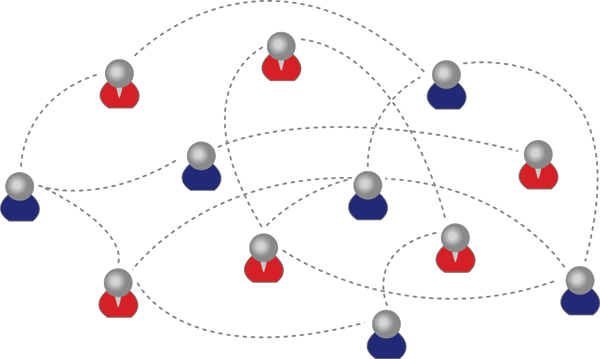 Use yourself as an example. You can refer to your Facebook account, your address book, or your mental roll call of who you know. How many people, at this very moment, are in your circle of friends? How many of your family members are truly close? I'm going to guess that it is no more than 20-30. But how many people do you know and can have a casual conversation with? Between 200 -500 people? Maybe as high as 1,000? These numbers are reminiscent of early humans: small nomadic groups within a larger group of culturally similar and geographically close people. I propose that this is the sweet spot for human social psychology. Whether you are a 14-year-old surviving high school, or the president of the United States, you won't get much difference in these numbers.
The problem is that, as I've stated, society has a staggering complexity. We have evolutionary defined social circles existing in a society that may not allow for the full expression of cultural needs to be expressed within the "close" group and the "regional" group. There is poor organization, no set hierarchy, and no loosely defined roles. Sure, these are taken care of in society at large, but not in the people we can call part of our sphere. This has set up a sociological conundrum in which modern man find themself.
Comparing the social circles of today and the social circles of early man, we can find a variety of differences:
- There is a lack of shared group problem solving that leads to solutions to direct and clearly defined problems.
- There are no clearly defined roles within a set hierarchy.
- Any member can adopt any role they wish, without clear benefit to the group at large.
- Boundaries of intergroup activity are not clearly defined
We can see these points articulated in modern video games: the rise of social (either online or communal) gaming; the development of role-based games (World of Warcraft, Battlefield, and MAG all come to mind); specific scoring systems associated with roles within a video game; and video game fans' self-identifiers (hardcore vs. casual, Sony vs. Microsoft).
While this supports the presence of video games, anyone can see there are a million of other pieces of culture that can fill these roles: gang warfare, knitting clubs, and organized sports, to name a few. Why video games in particula fill these roles, requires a closer look at what Western society has adopted as its character, and what video games actually are.
No one is a unique snowflake. Unfortunately, we are all replaceable, anonymous, and more or less inconsequential to the world at large. Going back to my look at early humans, it wasn't always this way. Human beings are designed to feel like important, empowered, and active contributors. And many of us aren't. If we are, it is hard to actually realize. A gas station cashier is an important part of the world's largest industry, but (and I speak from experience), it's hard to feel like that on $6.50 an hour while counting packs of cigarettes to prove that you didn't steal any.
While humans are designed to be one thing, modern society has developed in such a way that it is hard to achieve what was so natural thousands of years ago. The average member of Western (or modern) society has little to no control over their own comings and goings; they do not solve problems or at least problems that are immediately rewarding; they are confronted with a world that makes little sense.
It's obvious to some how video games can address these human needs, but lets take a look at them anyway.
 Control is the defining feature of a video game. There is something on the screen that you control. In the most basic example, you control The Paddle in Pong. There is a defined set of rules through which this control is governed. Modern video game trends are not only putting more control in our hands, but different kinds of control: control over persistent worlds and characters in MMO's, and online play and ethical control in RPG's are two examples.
Another defining feature of video games is problem solving. You are presented with a rule set, a series of obstacles, and a goal. Again, I will point out where modern video games have taken this simple concept. MMO's and co-op modes let you solve issues with groups; downloadable games have goals that can only be achieved with an entire audience (Noby Noby Boy and Battlefield 1943 are two examples); and Folding@Home (while not a video game per se, it is in gamers' hands) allows PS3 owners to contribute to medical research.
Video games also provide a clear and distinct world in which to be immersed. Narrative, art direction, and game mechanics combine to form a wholly contained world (until the next sequel), that can be understood. While something like Super Mario Bros. on the NES hints at a bizarre and strange world that makes sense unto itself, modern games have their own histories, technologies, and populations. Unlike the real world, these facts are readily available for discovery, use, and manipulation. While one can point to World of Warcraft as the obvious example, Halo, Mass Effect, and well... any game allows for a world that creates its own internal logic with which any player can truly understand with a little effort.
This last point hints that there is more to playing video games than a search for meaning in Western (or Westernized) society. Take knitting for example. You have control over your socks, you have to figure out how to close the end, and all you need is your grandmother's knitting circle to understand the depth and breadth of the knitting world. However, video games close the deal with a set of aspects that tune into exactly who we are as humans.
 Human psychology, while infinitely complex, is easy to understand on a superficial level. We like pretty things, we like stories, we like music, we like violence, we like sex, and we like well-placed checkpoints and forgiving save systems. Okay, not so much the last point... we like positive reinforcement and we hate negative reinforcement. I will briefly take on each of these in turn.
Beauty is in the eye of the beholder. That's why I can get away with calling Gears of War pretty. I guess the term I should use is "aesthetically pleasing." Whatever the criteria you set down (good graphics, stylized cel-shading, Itagakiesque boobs, bloom lighting), video games look good. And I think it is as simple as that. Humans like to look at things. Of course, fashions evolve and beauty is a very "in-the-now" thing. That's why Super Mario 64 once looked great and now looks jank as fuck.
Stories are also an elementary aspect to human psychology. Stories go back as far as language. They're an easy way to relate messages, world knowledge, and culture; essential to communication. That's why humans tune into stories, regardless of quality. Going back to Super Mario Bros. for the NES, it was about as simple a story as you can get: lady trapped by monster, hero does the saving. Now, you have critics claiming that you are a "peasant" if you don't appreciate Metal Gear Solid 4. Shane Bettenhausen aside, stories are good, and another draw for people to the medium.
Music in video games follows a similar implementation used by movies. Instead of the audience stepping back and saying "I understand the shooting, yes, but where the hell is the music coming from?" we take scores and soundtracks for granted. Music has always been a part of our culture. However, something interesting can be seen in constant discussions of old video game music. It was simple and melodic; perhaps more than complex "real" music in games today, and it hits that ancient nerve.
Violence is also, seemingly, an essential piece of video games. People smarter than I (although I can't for the life of me remember where) have said that the easiest way to interact with something is through violence, and that's why it is in video games. Of course, this is more than a technological constraint. It is easier to hit someone than to love them, and violence, for better or worse, is also a trait of humans that goes back beyond reckoning. It is the easiest way to interact with other groups, and if it knocks out genes that aren't yours while securing territory, all the better!
Sex is manifest in video games in perhaps more subtle ways. While overt sexual expression and issues dealing with sexual identity are somewhat new to video games, a little sexiness has always gone a long way. Who are you always trying to save? A person of the opposite sex (virtually in all cases a male protagonist saving the female). In fact, I would like to see an investigation into this to find out if this is why males are the primary consumer of video games (or maybe it's violence with a little bit of gender socialization thrown in). These days, scantily clad women with independent physics for specific body parts are a dime a dozen.
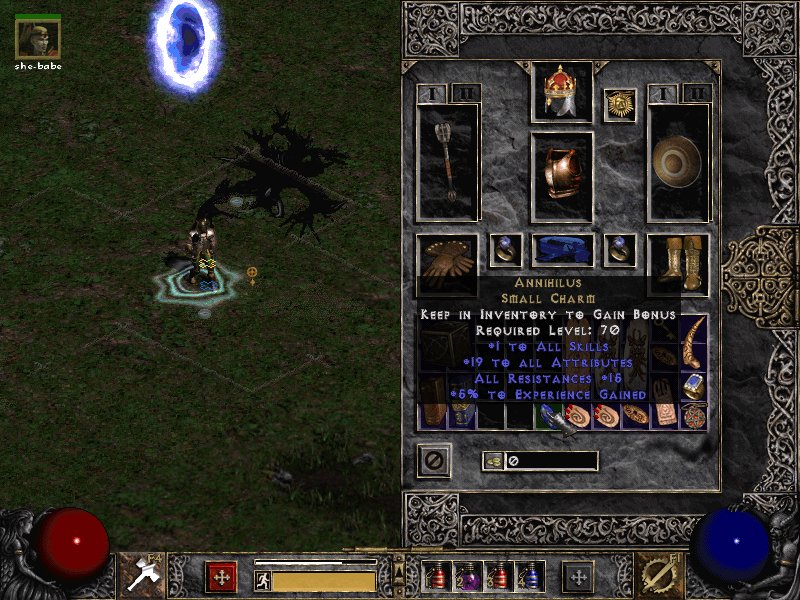 Finally, and perhaps the most important, is the positive reinforcement of video games. Immediate reward for good behavior is a standard. This is also expressed in the "carrot before the horse" analogy, where reward is just over the next horizon, spurring continued play. And we are also seeing trends that limit negative reinforcements. Plenty of checkpoints and toned down difficulty are in, constrictive save points and harsh death punishments are out.
Video games are a perfect storm for this day and age. We are a people that are designed in very specific ways that don't always mesh perfectly with the world we have created around us. Video games seal the deal by tuning into basic psychological needs that have an evolutionary basis, insofar that humans need culture to exist.
So why do I play video games?
I'm only human.