Home
Home

Get ready for the Halloween season with these five recommendations. Do you have any favorite horror games missing from this list?
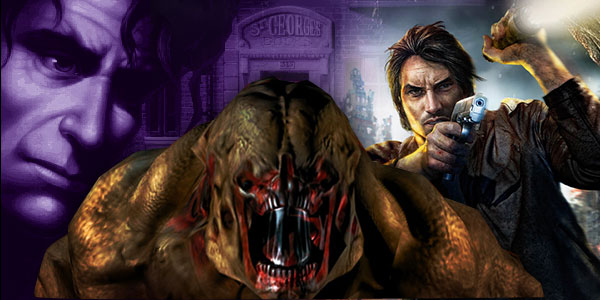
So we now have about a week and a half to go until Halloween, and if you’re a fan of horror games, chances are that you will be spending a lot of your time on the couch or at the computer, with the lights off and volume cranked up, playing some of your favorites.
Gamers have to be thankful for the fair amount of contributions to the horror genre available to them, but of course, like everything else, a few of those titles always manage to stand out from the rest due to their originality and innovation. Even those that are years -- even decades -- old still manage to just plain scare the living Hell out of us.
So, if you’re one of those longtime horror fans or if you’re looking to try your hand at the genre for the fist time, here’s a short list of 5 games that are most commonly considered among the best and why you should play them.
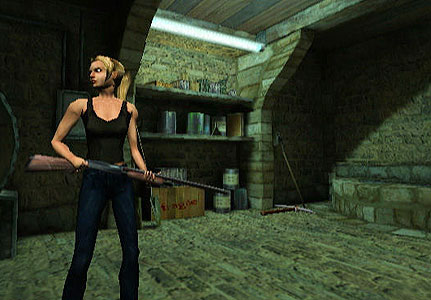
5. Eternal Darkness: Sanity’s Requiem
Released in 2002 for the Nintendo GameCube, Eternal Darkness puts the player in the role of Alexandra, who is investigating her grandfather’s murder in his Rhode Island mansion. Thanks to the mysterious “Tome of Eternal Darkness,” Alex and the player relive the horrifying experiences of different people from the past and discover a connection between them all.
The gameplay featured puzzles, an extensive magic system, and -- it’s most memorable feature -- the Sanity Effects. The Sanity Effect took the form of a meter that depleted when the player was put into scary and intense situations. If allowed to empty far enough, the player would begin to experience some disturbing phenomena, reflecting the character’s loosening grip on reality.
The way that the game antagonized players is perhaps the one thing that has stuck with us after all this time. Eternal Darkness breaks the fourth wall and does something truly terrifying ... it fakes errors. Yes, the game will go out of its way to tell you that your memory card is corrupt, among other things.
Dear developers, take away all our health items, all of our ammo, and pit us against undefeatable enemies, but never, ever tell us that our memory card is corrupt! As gamers, this was one truly horrifying force to be reckoned with.
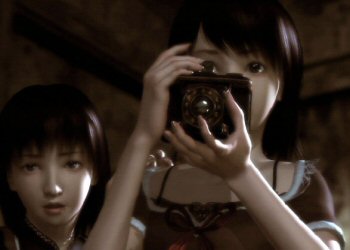
4. Fatal Frame 2: The Crimson Butterfly
Released in 2003 for the PlayStation 2, in 2004 for the Xbox, and again in June 2012 for the Wii, Fatal Frame 2 put the player in the role of Mio, accompanied by her physically disabled sister Mayu, who navigates a fog-enshrouded town that is abandoned and haunted by the ghosts of its former residents. While searching for an escape, the sisters begin to discover the town’s disturbing past.
The only weapon made available in this game is the “Camera Obscura,” an antique camera that can exorcise ghosts, which means that players had to take pictures of the ghosts in order to defeat them. Like many other video game weapons, players were able to customize the camera with different types of film (functioning as ammo) and modifications, giving the camera various effects and advantages in the game. Besides using the camera for combat, players looking for that perfect score could also take pictures of numerous non-hostile ghosts throughout their journeys for extra points.
One thing that added to the horror factor was the “Ghost Filament,” which appeared onscreen when looking through the camera lens. The Ghost Filament would change color depending on how close a hostile ghost was to the player, adding that extra layer of suspense.
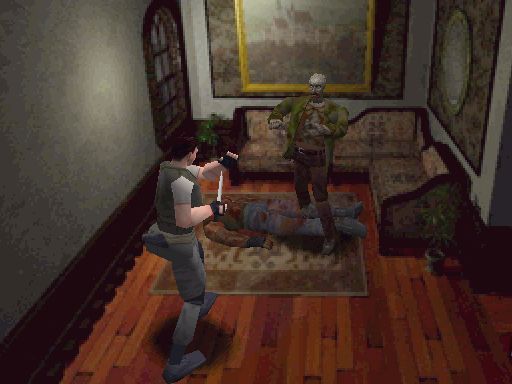
3. Resident Evil
Known as Biohazard in Japan, the original Resident Evil was released in 1996 for the PlayStation, Sega Saturn, and PC as well as on the PlayStation Network in 2009.
Resident Evil puts players in the role of either Chris Redfield or Jill Valentine, members of a search and rescue team investigating a mansion outside of Raccoon City. The team soon discovers that all is not well as they encounter various infected creatures and uncover a biological-weapon conspiracy.
Unique at the time of its release, Resident Evil placed its characters over prerendered backgrounds and used various fixed-camera angles, which added to the suspense. Also, giving the player a choice of characters gave the story multiple vantage points and outcomes, greatly increasing the game’s replay value.
Ammo and health items are purposley made scarce throughout the entire game, constantly leaving the player in fear for his character’s life. To make matters worse, players could only carry a limited amount of items.
Save points, taking the form of typewriters, required ink ribbons to use, which had to be acquired by the player. These ink ribbons were also limited in the amount that the player could carry. All of these things put together left us on the edge of our seats, anxious about what might be around the next corner.
One cannot forget that one moment early on in the story: walking down a long hall, not quite knowing what to expect yet, then wetting ourselves as a zombiefied dog burst through the window ... good times.
Often credited as the originator of the survival-horror genre, the original Resident Evil still stands as a classic 16 years later, not only in the genre but for video games in general.